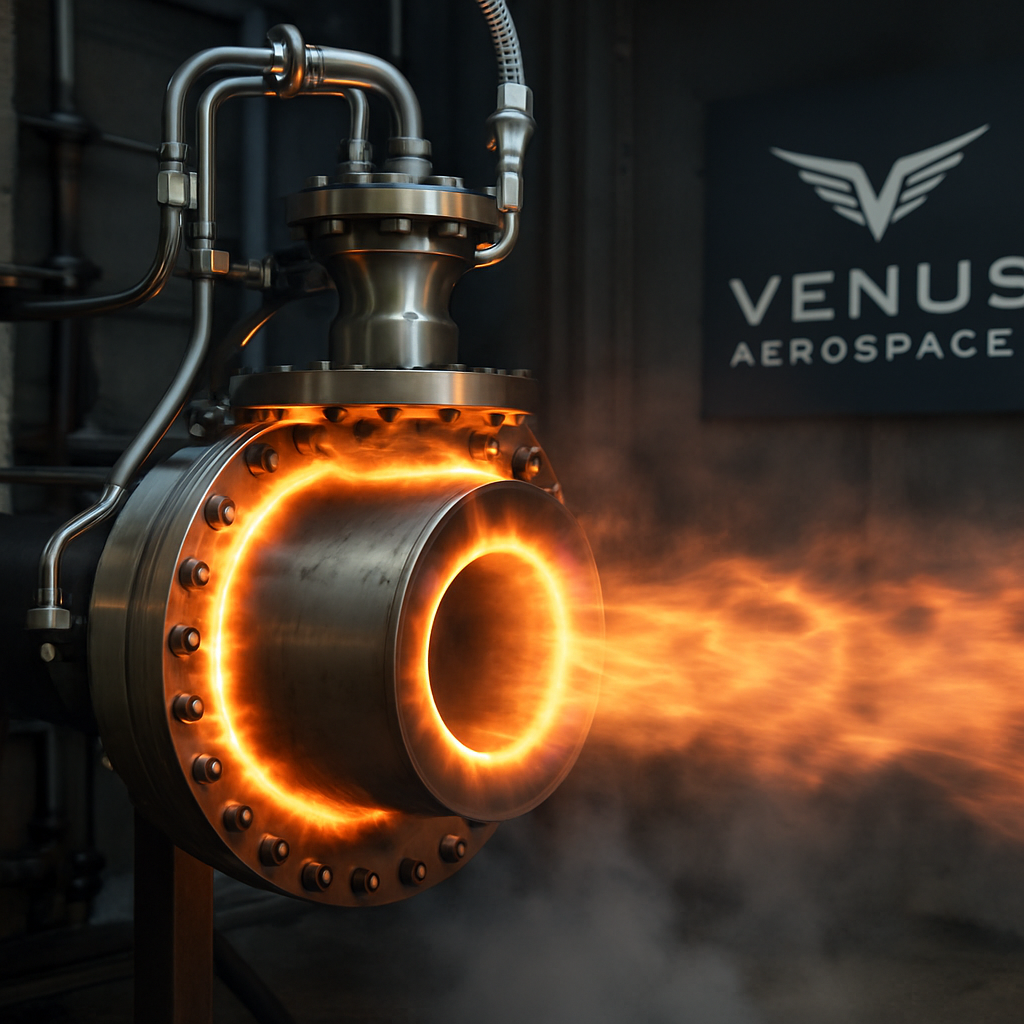
Venus Aerospace, a Houston-based startup, has successfully closed a $90 million Series B funding round to further develop its Rotating Detonation Rocket Engine (RDRE). This innovative propulsion system offers a more efficient method for launching payloads into space.
Established in 2020 by CEO Sassie Duggleby and CTO Andrew Duggleby, Venus Aerospace initially aimed to create environmentally friendly hypersonic passenger jets. However, following a successful demonstration of their RDRE in May 2025, the company shifted its focus toward defense applications. The demonstration attracted significant interest from potential customers seeking to integrate the RDRE into hypersonic weapons and high-speed space vehicles.
The RDRE operates by generating a continuous supersonic combustion wave that circulates within a circular channel, enhancing fuel efficiency compared to traditional rocket engines. While the concept dates back to the mid-20th century, recent advancements in 3D printing and simulation technologies have enabled practical implementation. Notably, Venus Aerospace’s 2025 test marked the first flight of an RDRE-powered rocket.
Addressing the technical challenge of preventing the engine from overheating has been a primary focus for the company. Through extensive research and over 600 tests, Venus Aerospace has developed solutions to manage the engine’s thermal dynamics effectively.
The recent funding round was led by Mercury Fund, with participation from Lockheed Martin Ventures, MESH, PEAK6, Draper Associates, Starboard Star Venture Capital, and Green Sands Equity. The capital will support further testing and development, including the construction of a larger test stand funded by a grant from the Texas Space Commission. This infrastructure is essential for extending engine burn durations to meet customer requirements.
Venus Aerospace’s progress signifies a significant advancement in propulsion technology, with potential applications in both defense and space exploration. The successful development and scaling of the RDRE could lead to more efficient and versatile propulsion systems, influencing future aerospace designs and missions.