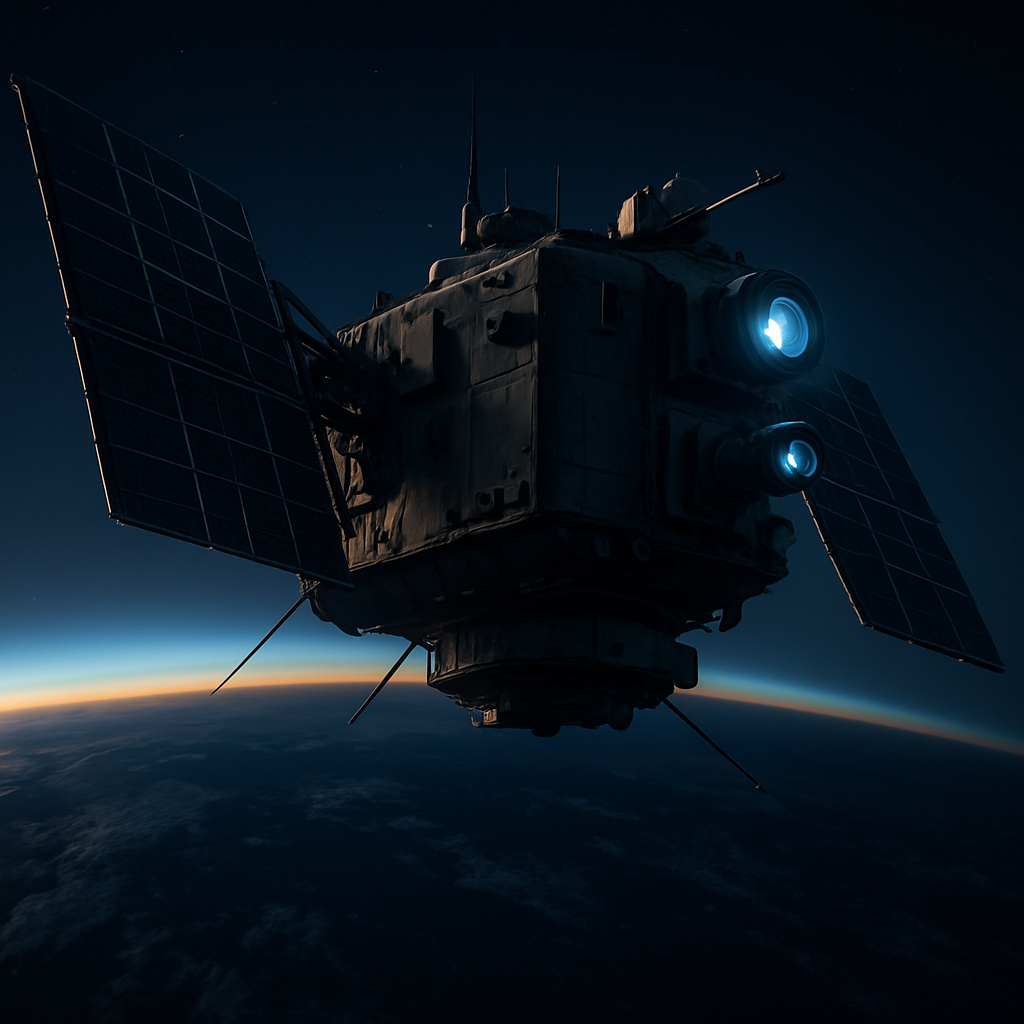
The United States has publicly confirmed for the first time that it has placed weapons in orbit around Earth. Air Force Secretary Troy Meink announced this development on September 14 at the Air, Space & Cyber Conference in National Harbor, Maryland, declaring that the Space Force now operates “on-orbit space control weapons capable of defending the Joint Force against hostile adversary action.”
What is Known—and What Is Not
Despite the landmark revelation, few details about these orbital weapons were disclosed. Secretary Meink did not specify what kind of weapons are involved—whether kinetic (physical destruction) or non-kinetic (such as jamming or electronic interference)—nor did he reveal when they were launched, how many exist, or exactly what they do. He described the phrase “space control weapons” as intentional and “very well thought out,” signaling that the terminology was chosen with great care. Meink said revealing further specifications could undermine deterrence efforts.
The announcement represents the most direct acknowledgment by a U.S. official to date that offensive military systems are already operating in space, overturning long-standing policy that avoided confirming such capabilities. It marks a significant shift in how the U.S. is signaling its readiness to address evolving threats in outer space.
Adversaries, Treaties, and the Geopolitical Context
Meink’s disclosure comes amid mounting concerns over China and Russia developing counter-space capabilities. China has reportedly deployed satellites capable of interference with other nations’ space assets, while U.S. analysts suggest Russia may be working on a satellite designed to carry a nuclear device. Also under scrutiny are China’s ground-based laser weapons that can disrupt satellite sensors. These developments contribute to rising international tensions around the militarization of space.
Under the Outer Space Treaty of 1967, placing nuclear weapons or other weapons of mass destruction in orbit is explicitly banned. However, the term “space control weapons”—which may include electronic jammers, directed energy systems, or signal disruptors—does not necessarily breach the treaty if those systems are non-nuclear. The lack of clarity around their nature and function leaves open many possibilities.
Strategically, Meink framed the announcement as a step toward deterrence. By confirming these capabilities now, the U.S. is aiming to signal to Russia, China, and other potential adversaries that it possesses tools for defense—both to protect its own satellites and to respond to attacks from space. Experts caution that such disclosures could escalate a space arms race if not accompanied by diplomacy or norms.
While no new treaties or changes to existing policy were announced alongside Meink’s remarks, the confirmation may prompt debates about international rules, transparency, and the risks posed by space debris and escalation. Allies and adversaries alike will be watching closely for how these weapons are deployed and whether they alter the strategic balance in orbit.
In short: the U.S. has weapons in orbit—verified, operational, yet undefined. As China and Russia continue advancing their own space weapon systems, this revelation underscores a turning point in space warfare doctrine, where ambiguity may serve both as shield and provocation. What comes next could determine the rules of engagement for outer space itself.
Why This Matters
Outer space has become a contested domain where satellites power global communications, navigational systems, military intelligence, and climate monitoring. For decades, U.S. policy emphasized denial of satellite attacks, jammers, and non-destructive interference—but always while maintaining plausible deniability of offensive weapons in orbit. This confirmation drops the mask. It makes what was previously speculation now official policy.
Future watchpoints include whether these space control weapons are weapons under international law (i.e., nuclear vs. non-nuclear), how the U.S. plans to manage escalation risks, and whether more nations follow suit. For allies and industry partners, transparency—or lack thereof—will become central to trust in space cooperation. For adversaries, this may harden their resolve to develop comparable systems.