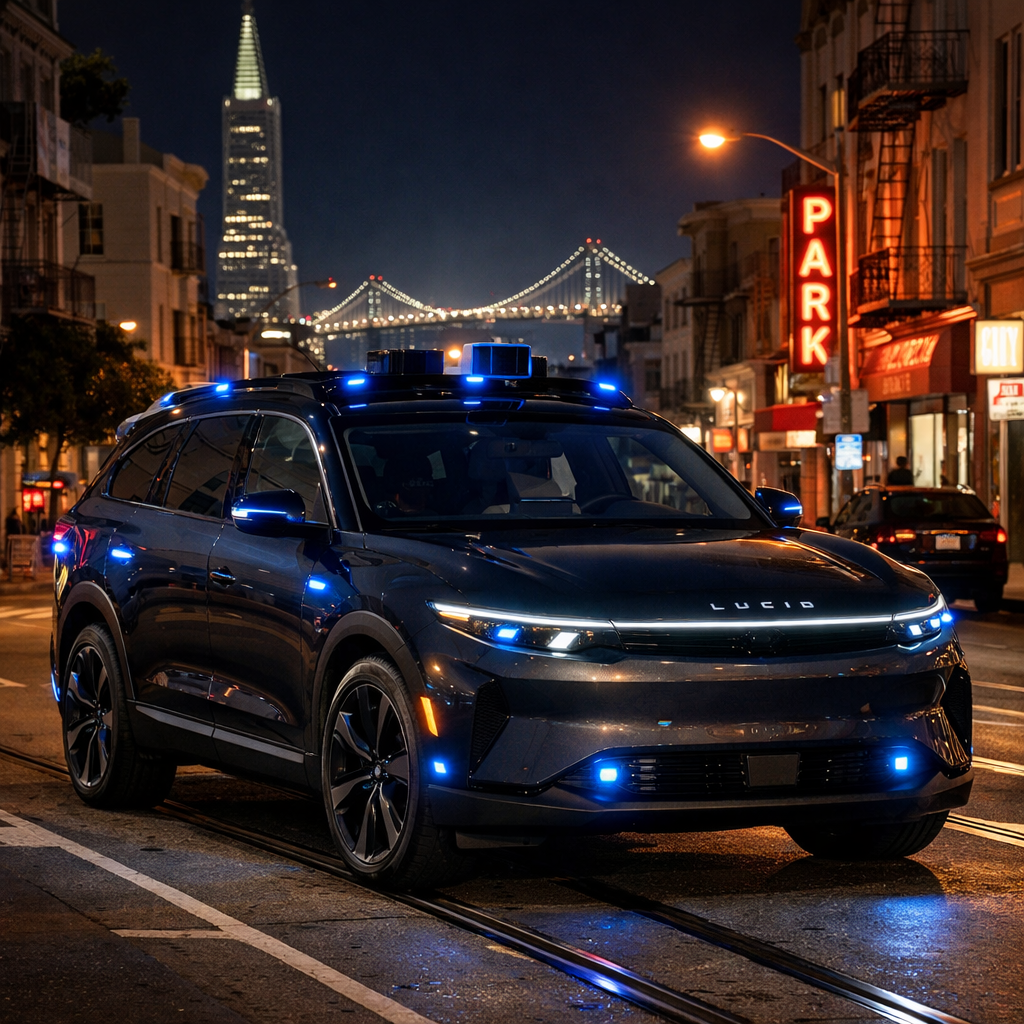
Uber and Nuro have started operating driverless Lucid Gravity SUVs on public roads in the San Francisco Bay Area, marking the latest step toward their robotaxi launch set for the first quarter of 2027. These trials follow state approval in California that permits the removal of human safety drivers from the driver’s seat. In the coming months, employees will be able to ride autonomously, ahead of the commercial rollout in 2027.
Details of the Vehicle & the Partnership
The Lucid Gravity, revealed in January 2026, is an electric SUV equipped with high-resolution cameras, solid-state lidar, and radar sensors for environmental perception. Uber will own the fleet, while Nuro contributes its autonomous driving tech. Uber’s focus lies on crafting the rider experience inside the cabin. The partnership returned to public view after Uber first announced plans for a premium robotaxi service using Lucid EVs with Nuro tech around 16 months ago.
As part of their agreement, Uber made a major investment — initially $300 million, later rising to $500 million — in Lucid. The deal also includes a commitment from Uber to purchase at least 20,000 Gravity SUVs over six years. Nuro has similarly received nearly $500 million from Uber, helping it shift away from delivery-focused robots to licensing its self-driving systems instead.
Testing Phases & Regulatory Milestones
Work leading up to full deployment has included months of public road testing in the Bay Area, initially with human safety operators in the driver’s seat. In May 2026, the California DMV granted Nuro a permit to operate truly driverless autonomous vehicles in the region. Parallel efforts are underway in Houston, where Uber and Nuro continue human-supervised testing. Alongside these real-world tests, Nuro is running closed-course tests and simulations to validate system safety.
The scale of testing is increasing as Lucid ramps up production of its first robotaxi versions at its factory in Arizona. Earlier this year, the engineering fleet numbered about 100 AVs; that fleet is growing as deployment plans tighten toward next year’s commercial phase.
With these advances, Uber and Nuro are edging closer to launching the first premium robotaxi service based on the Lucid Gravity. State permits now allow true driverless operation, and testing is shifting from supervised to unsupervised validation. Hyundai and Cruise are among competitors aiming for similar goals, but Uber’s timeline puts it among the front runners in advancing mass deployment.
What this means: autonomous vehicles are moving very rapidly from concept to consumer-ready service. If Uber and Nuro succeed, the robotaxi fleet could reshape urban mobility, reduce dependence on human drivers, and lead to new regulations, safety benchmarks, and transportation norms. Key watchpoints: where launch takes place, real-world safety record, and how the in-cabin experience aligns with rider expectations.