A sophisticated spear-phishing campaign dubbed UAT-11985 is targeting Taiwan-affiliated research professionals using fake event invitations to steal Google credentials and MFA codes. The campaign, uncovered by Cisco Talos, is believed to rely heavily on AI-assisted generation of content to rapidly produce tailored email lures. It first emerged in mid-2026.
How the Attack Works
The attackers send emails that mimic legitimate academic or policy event invitations, claiming to be from reputable institutions in Taiwan such as the Taiwan European Union Centre, NCCU Institute of International Relations, and Taiwan Research Institute. These messages begin with a polished geopolitical or policy context, include flattering language targeted at the recipient, and conclude with event logistics and registration instructions. Despite covering varied topics, the structure and rhetorical style remain nearly identical campaign-wide, suggesting mass generation via a reusable prompt template rather than bespoke writing.
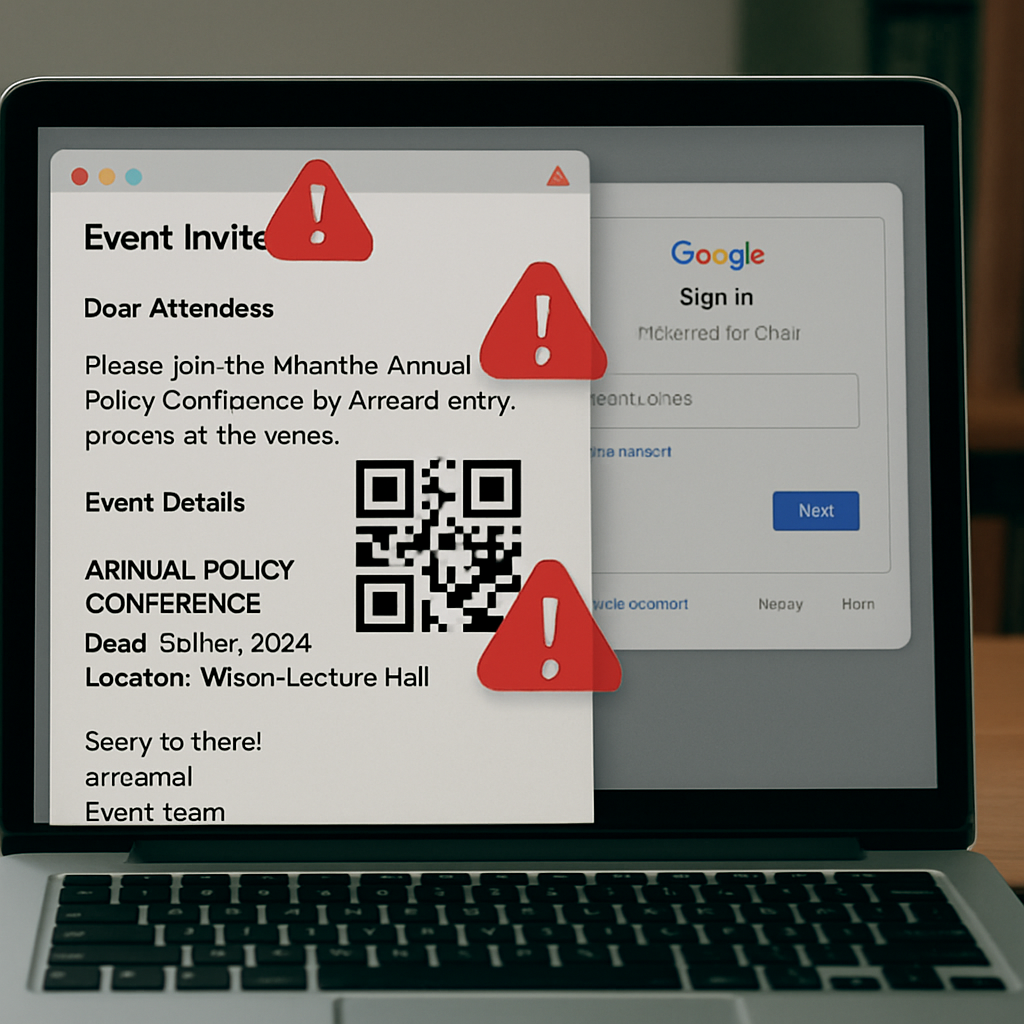
Victims are invited to register via links that appear as authentic Google Forms. Hovering over the link may show a Google Forms URL, but it actually points to attacker-controlled infrastructure. In some cases, legitimate posters from real events are used, but their QR codes are swapped with malicious ones. Scanning such a QR code or clicking the link leads to a fake registration page designed to harvest credentials.
Adversary-in-the-Middle and Real-Time Credential Theft
The phishing site is designed as an adversary-in-the‐middle (AitM) proxy: the fake Google Form prompts victims to sign in, then redirects them to a spoofed Google login panel. Behind the scenes, obfuscated JavaScript captures device and browser details—including locale, user agent, screen dimensions, and whether the device is mobile—and sends these to the attacker’s command-and-control (C2) server via a “google_login_start” request.
When the victim enters their password and MFA code, the phishing page relays this to Google’s real authentication servers while simultaneously sending the data to the attacker. The infrastructure splits actions: credential and account identifier uploads via POST requests, and state updates via WebSockets. The spoofed login supports only Simplified Chinese, Traditional Chinese, and English, and leverages browser locale settings to determine what to present—further indicating the focus on Chinese-language users.
Why UAT-11985 Is Especially Dangerous
By reusing narrative structure, impersonating institutions, flattering recipients, and using deceptive registration workflows, the campaign sets itself apart from run-of-the-mill phishing. Traditional email filters may struggle, especially as invitations appear legitimate and include cosmetic ties to real organizations. The inclusion of QR-based phishing (quishing) expands risk beyond inboxes to printed materials that people may share or see in public.
Additionally, the use of AitM proxy techniques that mirror Google’s live authentication flows in real time makes this attack harder to detect. Victims may input credentials thinking they are logging in, while attackers simultaneously validate and exploit those credentials. The tactic of adapting text for Chinese-speaking users by locale adds another layer of specificity.
Researchers recommend vigilance over unsolicited event invites, careful inspection of QR codes, and verifying registration links directly via known institution channels rather than via email. Institutions should consider awareness training on quishing, and implement additional protections, such as security keys or phishing-resistant MFA, especially for individuals in research and policy circles.
This campaign underlines how persuasive phishing has become when backed by AI and targeting infrastructures like those tied to academia and policy. Attackers are lowering the barrier for high-impact intrusion—using AI to scale custom lures and employing real-time credential proxies. For defenders, the stakes are growing: each compromised research affiliate could give rise to broader institutional exposure, sensitive policy data leaks, or geopolitical risk. What institutions do next—whether tightening MFA, securing identities, or rethinking how event invites are issued—will shape how effectively this threat is countered in months to come.