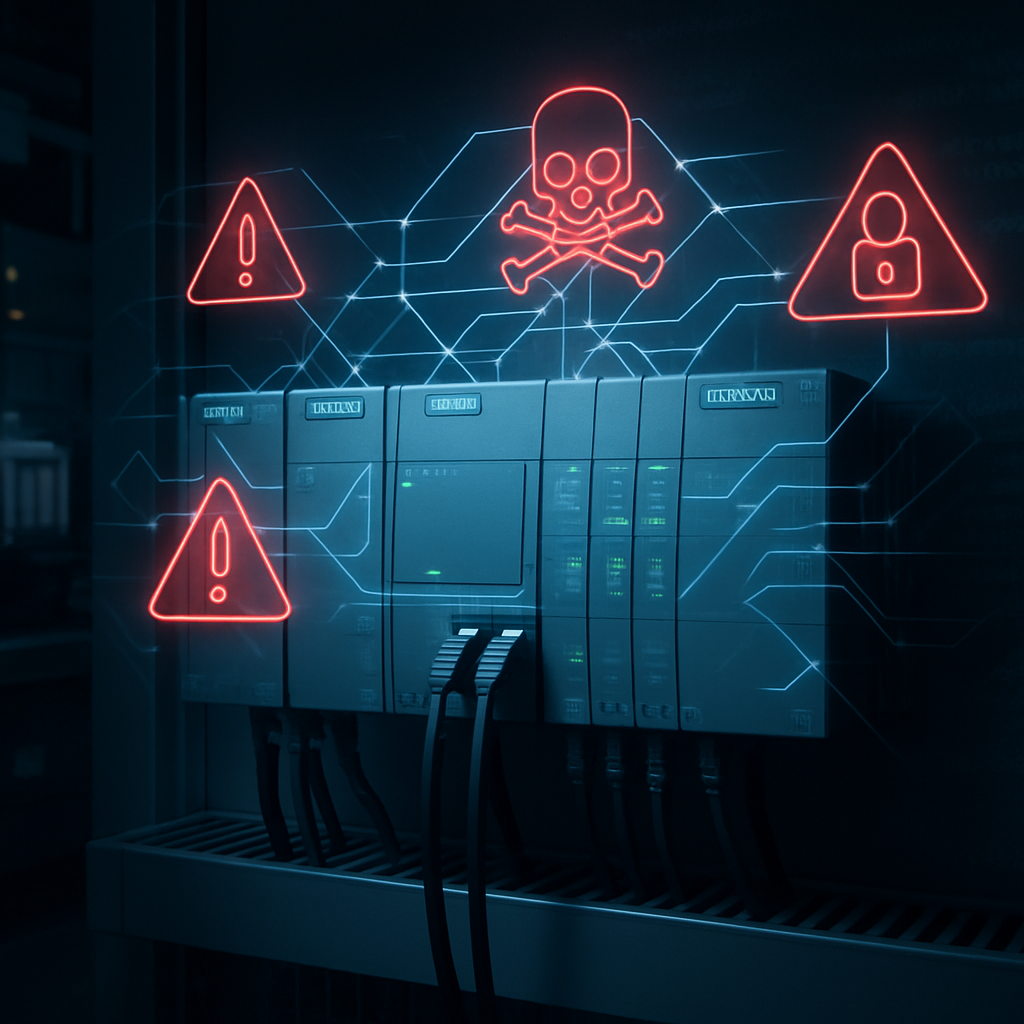
Federal cybersecurity agencies have issued a sweeping alert: attackers are actively targeting Siemens S7 programmable logic controllers (PLCs) across critical U.S. infrastructure. The Department of Energy, Environmental Protection Agency, FBI, CISA, and NSA released a joint advisory August 19 confirming the threat is live—not hypothetical—with adversaries leveraging AI-generated tools masked as routine monitoring systems to infiltrate and interfere with operational tech environments. ([cybersecuritynews.com](https://cybersecuritynews.com/hackers-attacking-siemens-s7-plcs/))
Who’s Being Hit and How
Threat actors are focusing on Siemens S7 PLCs—including S7-200, S7-300, S7-400, S7-1200, S7-1500 series, and F-series safety controllers—with targets spanning energy, water and wastewater, chemical processing, critical manufacturing, food and agriculture, commercial facilities, and the defense industrial base. ([cybersecuritynews.com](https://cybersecuritynews.com/hackers-attacking-siemens-s7-plcs/)) Attackers are using internet scanning platforms (e.g. Censys, ZoomEye) to find PLCs exposed directly to public networks or only weakly segregated from corporate systems. ([cybersecuritynews.com](https://cybersecuritynews.com/hackers-attacking-siemens-s7-plcs/))
Once devices are found, the adversaries employ AI to generate and refine exploit scripts, drastically lowering the barrier to entry. These scripts use automation libraries, especially snap7.dll and python-snap7, to access Siemens PLCs via the S7comm protocol, giving attackers read/write access to configuration data, PLC memory, and ladder logic. All the while, they cloak their activity by posing as normal OT monitoring tools. ([cybersecuritynews.com](https://cybersecuritynews.com/hackers-attacking-siemens-s7-plcs/))
Potential Risks and What’s at Stake
The current pattern of attacks appears to be reconnaissance and capability building rather than direct attempts at sabotage—mapping vulnerable environments, probing for write-access opportunities, and preparing for a future escalation. ([cybersecuritynews.com](https://cybersecuritynews.com/hackers-attacking-siemens-s7-plcs/)) If left unchecked, risks include manipulation of emergency shutdowns, disrupted industrial processes, damaged equipment, prolonged downtime, or broader supply chain consequences. ([cybersecuritynews.com](https://cybersecuritynews.com/hackers-attacking-siemens-s7-plcs/))
Contributing factors include devices left with default credentials or minimal access controls, as well as exposure due to inadequate network segmentation. Systems sitting in a DMZ or open to the internet are especially vulnerable. ([cybersecuritynews.com](https://cybersecuritynews.com/hackers-attacking-siemens-s7-plcs/))
Recommended Defenses
Operators are urged to immediately inventory all Siemens S7 PLCs on their networks, apply current patches and firmware—especially on systems exposed to external networks. ([cybersecuritynews.com](https://cybersecuritynews.com/hackers-attacking-siemens-s7-plcs/)) Blocking TCP port 102 at network perimeters, eliminating direct Internet access to PLCs, and restricting engineering tools like TIA Portal and STEP 7 to trusted workstations are also key defensive steps. ([cybersecuritynews.com](https://cybersecuritynews.com/hackers-attacking-siemens-s7-plcs/))
Continuous monitoring should be implemented using ICS-aware intrusion detection systems, vigilant for anomalies in S7comm traffic, unauthorized write operations, odd Python processes (especially those importing snap7.dll), and connections outside normal business hours. ([cybersecuritynews.com](https://cybersecuritynews.com/hackers-attacking-siemens-s7-plcs/))
Organizations that use third-party integrators or managed services must ensure those partners are aware of this advisory, as remote access arrangements can introduce unseen vulnerabilities. ([cybersecuritynews.com](https://cybersecuritynews.com/hackers-attacking-siemens-s7-plcs/)) Any suspicious activity should be reported to CISA or the FBI, and DOE-regulated entities must follow statutory reporting paths. ([cybersecuritynews.com](https://cybersecuritynews.com/hackers-attacking-siemens-s7-plcs/))
Securing PLCs is not merely a technical concern—it’s essential for maintaining public safety, critical infrastructure integrity, and economic stability. As AI tools lower the barrier for compromise, the window for reaction is shrinking. Entities operating Siemens S7 systems must view this alert as urgent: patch, segment, monitor—and anticipate that attackers will escalate from reconnaissance to disruptive operations if weaknesses remain.