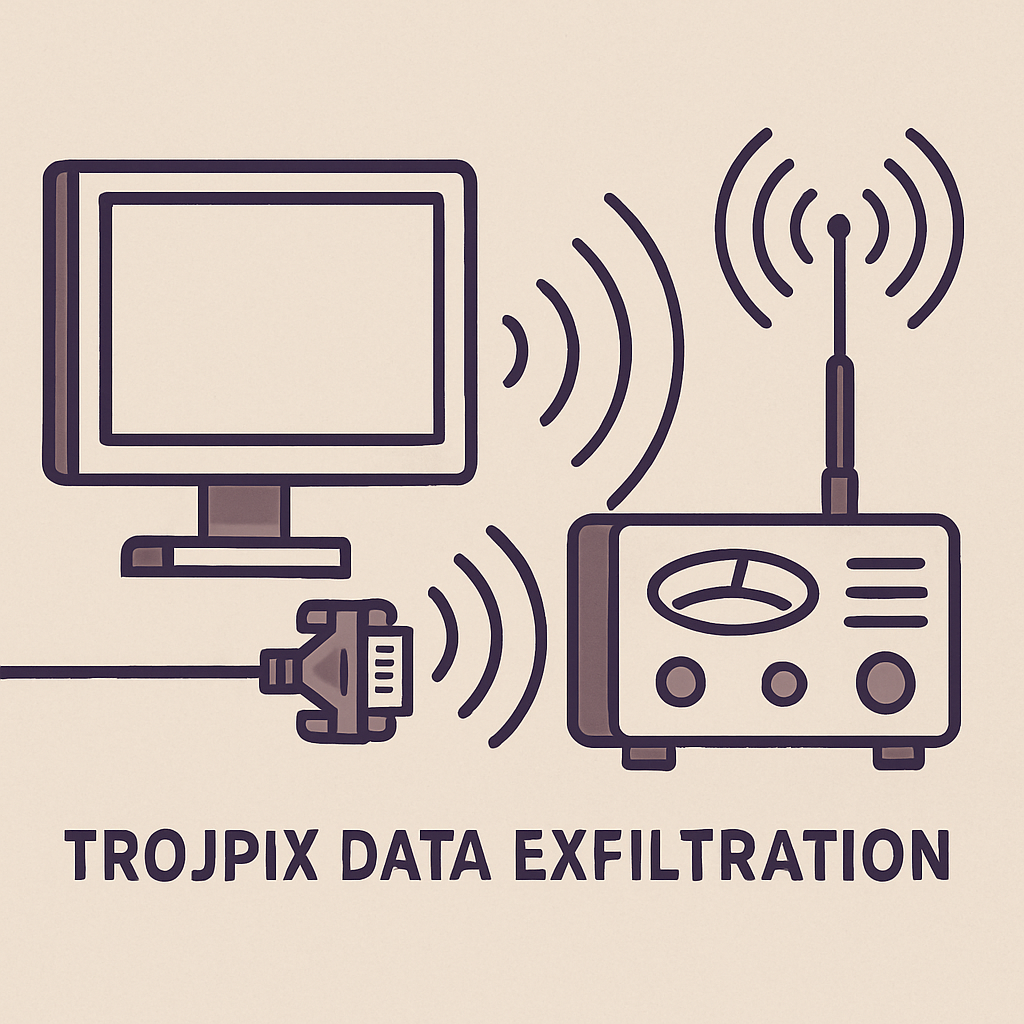
Researchers at Shandong University have unveiled a novel method, termed TrojPix, that facilitates rapid data exfiltration from air-gapped computers—systems intentionally isolated from external networks for security purposes. This technique manipulates on-screen pixels in a manner imperceptible to the human eye, causing video cables to emit faint radio signals that can be intercepted and decoded by nearby receivers.
It’s important to note that TrojPix requires the presence of pre-installed malware on the target machine, serving as a conduit for data extraction rather than an initial infection vector. In controlled experiments, TrojPix achieved data transfer rates up to 8.1 megabits per second and effective transmission distances up to 208 meters, though these metrics were measured independently.
Traditional covert channels in air-gapped environments typically operate at much lower speeds, often in the range of bits or kilobits per second. The significant throughput of TrojPix—approximately one megabyte per second—enables the transfer of substantial files, such as a 100 MB document, in under two minutes. This capability elevates the threat from merely leaking sensitive credentials to exfiltrating entire files, even when the monitor appears inactive.
However, real-world applicability may be constrained by environmental factors such as physical obstructions, electromagnetic interference, and signal attenuation. The researchers demonstrated that TrojPix operates across various monitor brands and video cable types, indicating its versatility and broad applicability.
The technique employs imperceptible pixel modulation, which does not require administrative privileges or hardware modifications. User-level malware capable of rendering graphics on the screen suffices to exploit this method. Two primary approaches were identified: one simulates a powered-off display by keeping the screen dark during data transmission, while the other embeds the signal within existing on-screen content, making the transmission virtually undetectable.
While the concept of using video cables as covert transmitters is not entirely new—stemming from longstanding studies on compromising emanations, known as TEMPEST—TrojPix represents a significant advancement in this domain. Previous methods, such as TEMPEST-LoRa, achieved data rates up to 21.6 kilobits per second over distances of 87.5 meters. In contrast, TrojPix’s peak throughput is substantially higher, though direct comparisons are challenging due to differing experimental conditions and receiver technologies.
It’s crucial to recognize that such emission-based channels remain largely theoretical and have not been observed in real-world cyberattacks. Historical incidents involving air-gapped systems, like Stuxnet and Agent.BTZ, primarily utilized physical media such as USB drives for malware propagation. Nonetheless, the development of techniques like TrojPix underscores the evolving landscape of potential threats and the need for proactive defense measures.
Mitigating the risks associated with TrojPix involves several strategies. Utilizing fiber-optic cables for video transmission can eliminate the electromagnetic emissions exploited by this method. Implementing physical shielding for cables and sensitive areas, as practiced in TEMPEST-rated facilities, can further reduce vulnerability. Most importantly, maintaining robust security protocols to prevent malware installation is essential, as the absence of malicious software nullifies the threat posed by TrojPix.
The emergence of TrojPix highlights the continuous innovation in cyber-espionage techniques targeting even the most secure systems. Organizations must remain vigilant, adopting comprehensive security measures that address both conventional and unconventional attack vectors to safeguard sensitive information effectively.