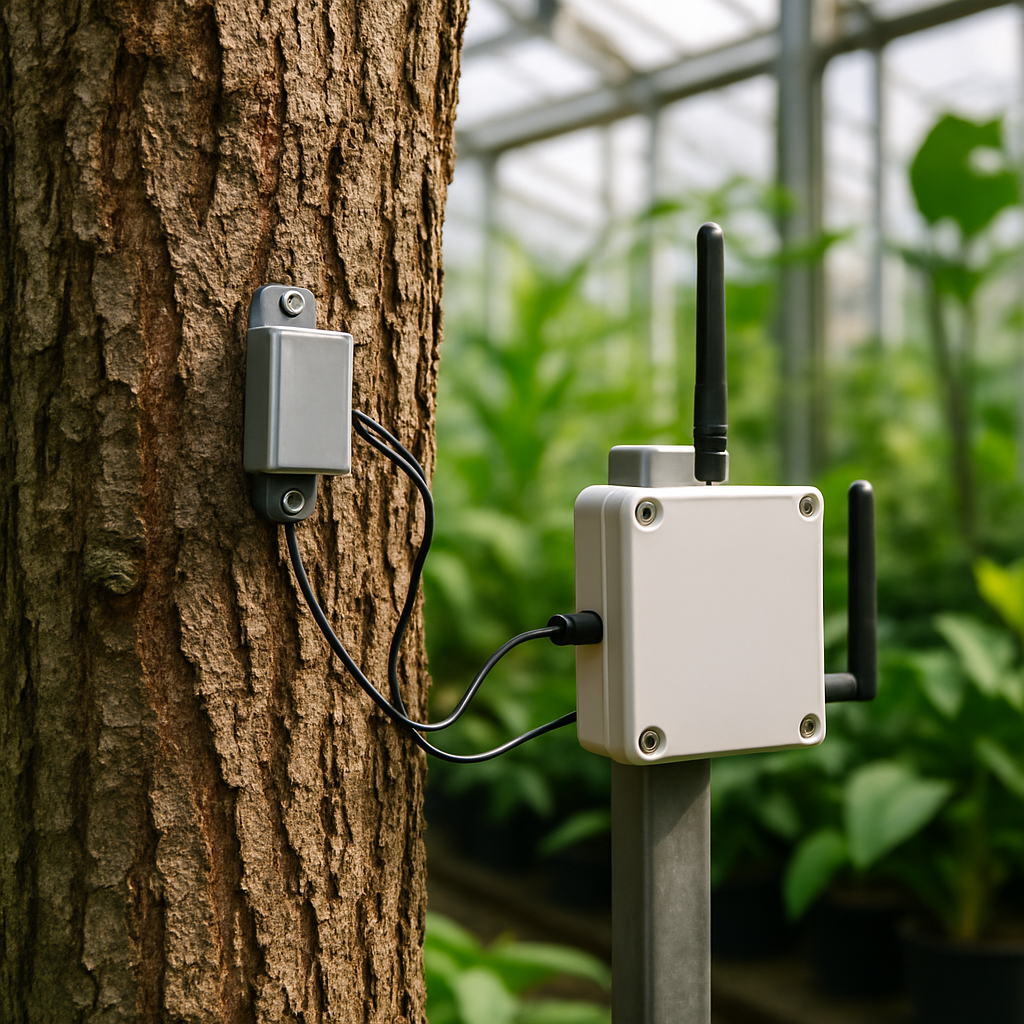
Plants don’t whisper, but they do send signals—tiny electrical changes coursing through their veins that hint at what they need. A new startup, Electric Plant, believes these signals are as telling as words. Founded by Justin Mast and neuroscientist Lee von Kraus, the company has built an AI model called Bombadil to decode subtle microvolt fluctuations in plants and translate them into actionable insights about their health and needs.
Why Plant Signals Matter
Traditionally, farmers and growers rely on indirect indicators—soil probes, handheld tools, satellites—to infer what plants may require in terms of light, water, or nutrients. These methods provide useful data, but often lag behind what the plant is experiencing in real time.
Electric Plant proposes a more direct approach: sensors screwed just past the bark into the cambium layer of a plant can detect electrical signals generated within the stem. These signals are then sent wirelessly to a cloud model. Bombadil, trained on data from over 125 plant species—including tomatoes, ferns, dahlias, and towering redwoods—interprets the data and delivers guidelines for care, such as watering or fertilization schedules.
How It Works and What Makes It Unique
The sensors themselves are simple but well calibrated—about the size of an iPhone when folded lengthwise and featuring stainless steel screws to reach living tissue. Each sensor handles microvolt-level changes and communicates via low-power wireless networks. For accuracy across an entire field, only a few sensors per acre are needed. The AI model processes the information in the cloud and presents actionable feedback. The result: potential yield boosts coupled with water use reductions of 20% or more.
With over a hundred species already modeled, Electric Plant claims Bombadil is the most varied biological-electrical signal model anyone’s built—surpassing existing tech in speed, cost, and breadth. The sensors cost tens of dollars, a contrast to traditional equipment that often carries price tags in the thousands.
Funding and Forward Momentum
Electric Plant recently closed an $11.2 million seed round. Investors include Onto Ventures, Climactic, Ponderosa, its partners, and several regional funds. This capital will support further product development, broader deployment of sensors, and expansion of Bombadil’s species coverage.
The initial customers aren’t disclosed yet, but the applications are evident: agriculture, forestry, greenhouse operations—anywhere plants grow and their hidden signals could reveal untapped potential.
This isn’t merely an academic exercise. Electric Plant believes that by listening to internal plant electrical signals, growers can greatly enhance precision agriculture—meaning better crop yields with fewer inputs. Bombadil’s diverse species base and affordable sensor hardware suggest a tool capable of scaling beyond high-end greenhouses into large farms.
Why It Matters: Understanding what a plant needs in real time has been a long-sought goal in agriculture and ecology. Most tools only allow indirect inference: soil moisture or leaf color, for example. Electric Plant’s approach treats plants like communicating systems, not just passive organisms—opening possibilities to reduce waste, increase resilience, and adapt environments more dynamically.
What to Watch: Will Electric Plant be able to scale production of sensors reliably? Can Bombadil adapt to diverse climates and stressors like pests or soil conditions? And how soon will growers trust AI models to make critical decisions? If this works, it could be a major stride toward bio-integrated agriculture.