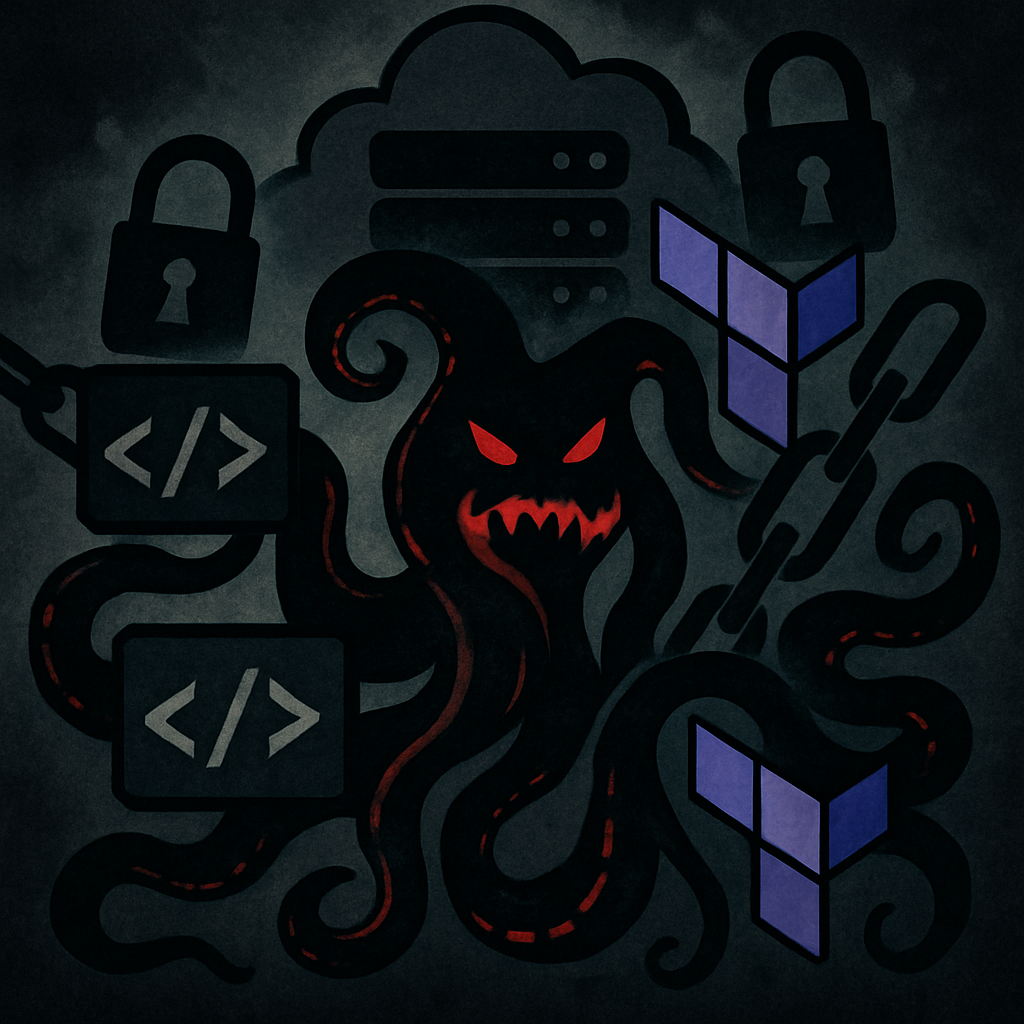
Developer tools once trusted for managing cloud infrastructure have become Trojan horses. A newly identified campaign linked to the group Graphalgo deployed malware within Terraform providers and Go modules, allowing routine infrastructure work to become dangerous attack vectors. Experts from cybersecurity firm Aikido were first to flag the threat and uncovered surprising sophistication in how the malware remained dormant until triggered by specific inputs.
Campaign Anatomy: Terraform & Go Infiltrations
In early September 2026, malicious actors uploaded two Terraform providers designed to closely resemble legitimate ones. One mimicked a well-known Docker provider with over 56 million downloads, relying on a single-letter variation to appear credible. Under normal conditions, these providers operated without raising suspicion; hidden code only activated when two input values produced a particular hash.
When that trigger condition was met, the malware decrypted a disguised archive from a remote origin, unpacked it, and executed Go code in a separate process. Though the providers were the primary bait, Go modules were also compromised: one provided readable malicious code, another embedded it in a false database file with forged commit history to appear credible.
Remote Control via Slack & Blockchain
Once initiated, the second-stage payload collected system information and communicated using Slack workspaces. It also generated ephemeral encryption keys and opened additional control channels. Notably, the attackers employed an Ethereum test network smart contract to issue commands—enabling execution of Go or JavaScript payloads or even self-deletion of the malware on infected machines.
Aikido found two fake Go package ecosystems—gocommunity[.]ioand gogets[.]dev—used to host the modules. Although activity on the control channels included over 1,200 encrypted messages via Slack and more than 1,400 smart-contract transactions, confirmed infections are fewer. Still, the discovery of the operation on Windows, Linux, and macOS systems shows reach across multiple platforms.
Indicators & Mitigation Steps
Aikido published a list of indicators of compromise: malicious Terraform providers with names like gocommunity-io/dockerdand kreuzwenker/docker, Go modules such as gocommunity.io/orderedbtreeand gogets.dev/btreex, disguised archive files like import-resource.sqlite3, and SHA-256 hashes tied to those files. An Ethereum smart contract used for command and control and certain Slack workspaces were also listed.
To mitigate, simply removing a malicious package won’t suffice—attackers may have deployed secondary payloads. Remediation recommendations include isolating compromised build hosts, rotating credentials, auditing code changes and Terraform activity, reviewing automated build systems, and reimaging hosts if needed. Systems that interact with blockchain services should watch for unexpected external calls. Experts emphasize preserving logs and snapshots to detect any lateral spread or credential misuse.
The core takeaway: Tools for provisioning infrastructure may themselves serve as gateways for sophisticated compromise. As attackers shift their strategy toward exploiting dev toolchains, it’s essential for security teams to scrutinize not just infrastructure code but all involved packages and dependencies. And as this campaign illustrates, vigilance around version history, module sources, and trigger conditions is more critical than ever.