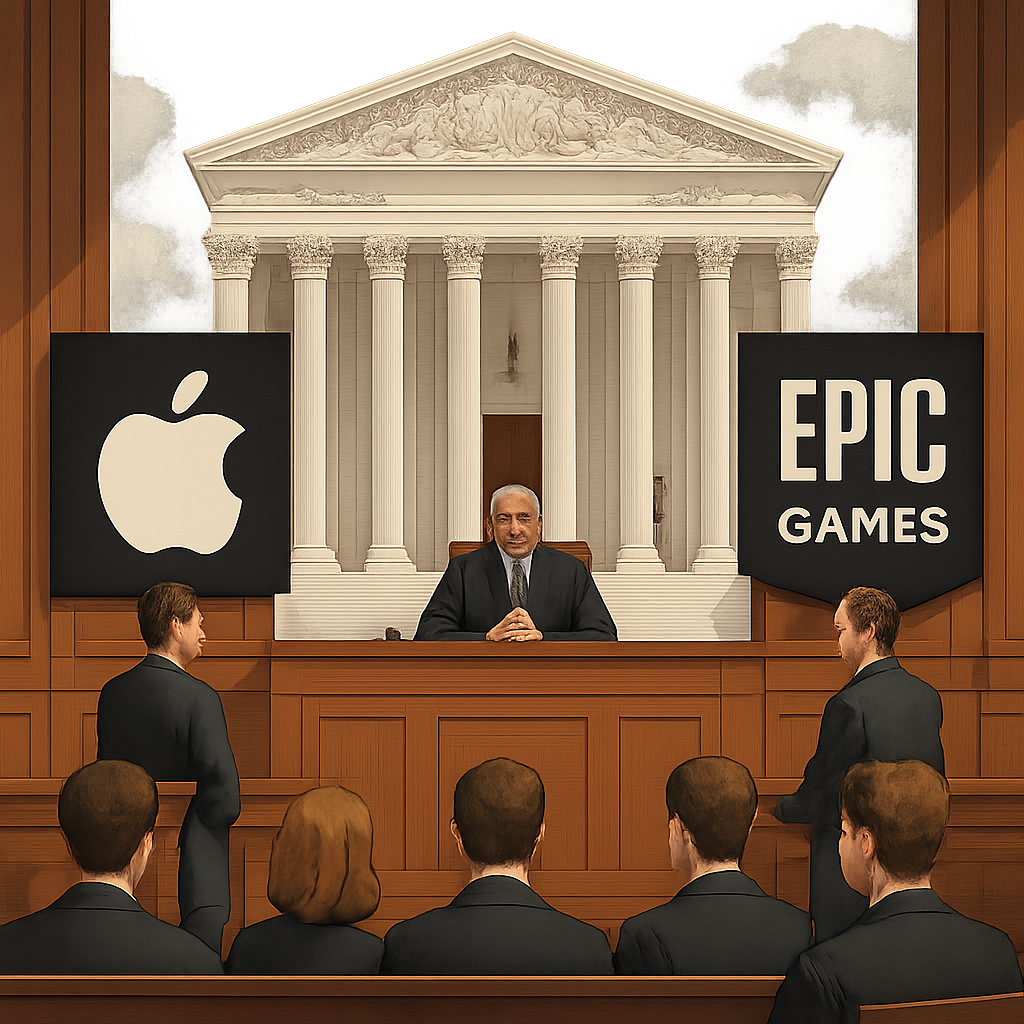
The U.S. Supreme Court has granted Apple a 24-hour stay in its ongoing legal battle with Epic Games, providing the company additional time to propose the fees it intends to charge developers for directing users to external purchase options.
Previously, the U.S. District Court for the Northern District of California had denied Apple’s request for a stay, mandating that Apple submit its fee proposal within 24 hours. In response, Apple filed an emergency appeal to the Supreme Court, arguing that fee calculations should be postponed until the justices review the case and render a decision on the contempt ruling. If the contempt ruling is overturned, the fee proceedings would become unnecessary.
The Supreme Court’s brief stay is designed to allow more time to consider Apple’s request. Without this pause, Apple would have been required to present its proposed fees by 5:00 p.m. Eastern Time on Wednesday. The company now has until 5:00 p.m. on Thursday, unless the Supreme Court grants a further extension. Notably, Justice Elena Kagan had previously denied a similar stay request from Apple earlier this year.
This fee dispute is part of a broader conflict with Epic Games that began in 2020. While Apple was not deemed a monopolist in the initial legal proceedings, the company was ordered to revise its anti-steering policies to permit developers to link to external purchase options. Apple complied but imposed fees nearly equivalent to its standard App Store commissions.
Epic Games contended that Apple violated the injunction, a position the court upheld. Consequently, Apple was found in contempt for willfully breaching the original ruling and was prohibited from collecting fees on external links within the U.S. App Store.
An appeals court affirmed the contempt decision but acknowledged that Apple is entitled to reasonable fees for its intellectual property. The case was remanded to the district court to determine an appropriate fee structure. Apple subsequently appealed to the Supreme Court, which agreed to hear the case.
Apple seeks to have the contempt ruling dismissed, which would nullify the order preventing it from collecting fees and the subsequent appeals court directive to establish reasonable fee calculations. The company has argued that regulators worldwide are observing this case to determine what a U.S. court considers a reasonable rate, implying that fee proceedings could set a precedent even if the contempt ruling is overturned.
Since April 2025, Apple has refrained from collecting fees from external links in the U.S. and prefers to continue this practice while exhausting all appeals, rather than having the court establish a rate.
This development underscores the ongoing tension between platform operators and developers over fee structures and the control of digital marketplaces. The Supreme Court’s forthcoming decisions could have significant implications for how platform fees are determined and regulated, potentially influencing global standards and practices.