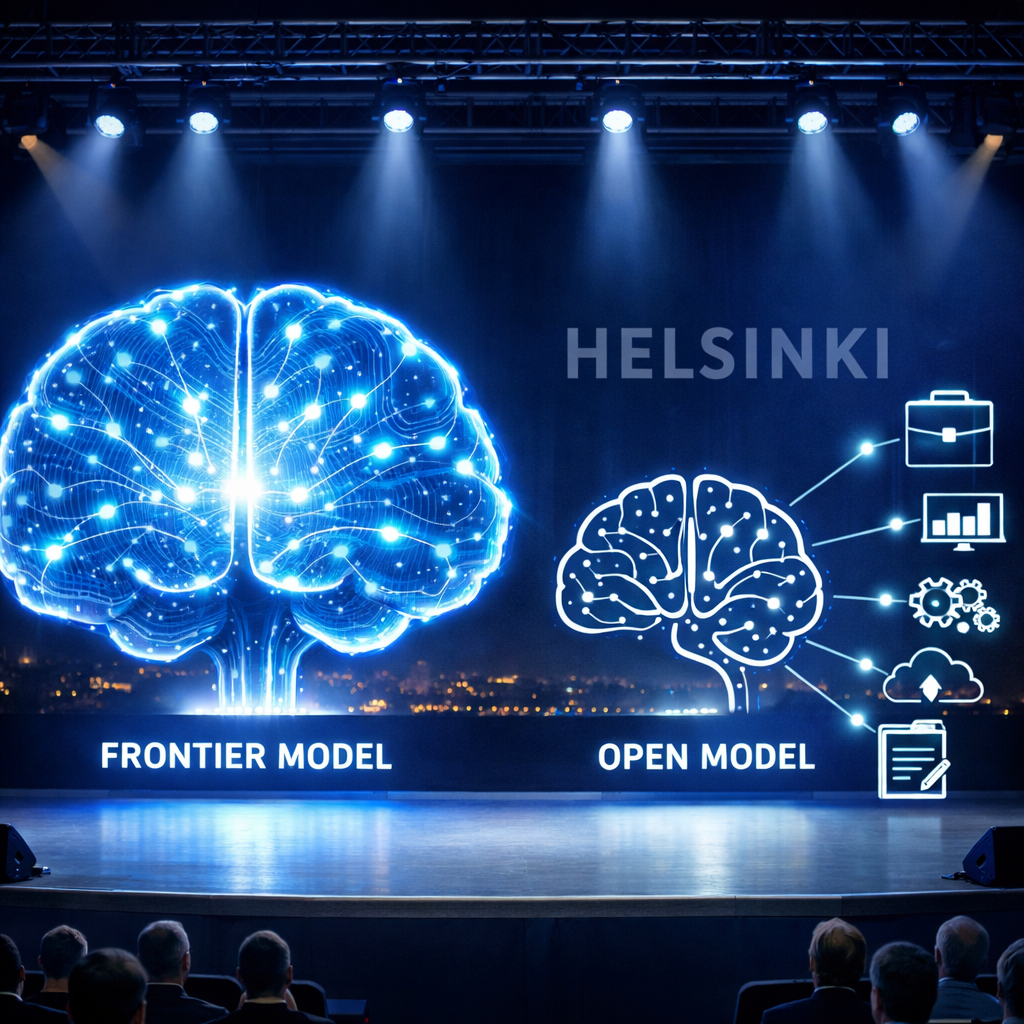
At the Slush conference in Helsinki, a rising startup called Fireworks AI made the case that most businesses don’t need the latest, most powerful AI models from labs like Anthropic or OpenAI. Fireworks builds on open-weight models—publicly accessible AI systems which enterprises can fine-tune on their own data—to create tools that are cheaper, faster, and more controllable than the so-called “frontier” models.
Frontier models are typically the big, cutting-edge AI systems built by major labs. They strive for generalized intelligence but come with high costs and significant resource demands. Fireworks cofounder Chenyu Zhao argues that, unless you require that level of generalization, lighter models often deliver sufficient performance. Zhao estimates that high-end open models are now only three to six months behind frontier ones in many respects.
Why the Shift Toward Open Models Is Gaining Steam
Rising costs are pushing companies to reexamine their AI strategy. When usage, token spending, or user base grows large, using expensive proprietary models becomes unsustainable. For those later-stage businesses, open models tuned to their data can significantly reduce both monetary expense and “intellectual property leakage,” a concern that’s shared by tech leaders across the industry.
Fireworks, which has worked with clients such as Uber, Shopify, and Notion, pitches its platform as one that allows enterprises to “own” their intelligence—letting them customize and control AI without being overly dependent on giant AI labs. The startup values specialization: instead of using a general AI model for every task, it routes simpler jobs to smaller, optimized models and reserves more powerful ones for high-level reasoning.
Security Issues and Rising Competition
The startup’s rapid rise hasn’t come without challenges. This fall, Fireworks disclosed two security incidents. In one, attackers accessed some customers’ API keys and tokens stored as secrets. Another breach involved intrusion into its cloud provider and development environment, exposing billing info and select datasets.
Reactions were swift. Notion, which said less than 1% of workspaces had exposed chat logs, severed its connection with Fireworks. Uber revealed roughly 150,000 drivers’ personal data—names, addresses, birth dates, and driver-license numbers—were accessed through a vendor later identified as Fireworks. The company has pledged to stick to zero retention of inference traffic and move more services out of batch-prediction systems, which involve storing data at rest.
Meanwhile, Fireworks has been assigned a valuation of US$17.5 billion by its investors, and is reportedly in the early stages of raising another funding round. Other startups in the space—such as Together AI and Baseten—are attracting large investments too. Major incumbents are also making moves: Palo Alto Networks is acquiring Applied Compute, a new AI model training and deployment startup, for US$4.5 billion in stock.
Anthropic itself went public the same day Fireworks was speaking about open-weight models. Zhao noted that while some firms will continue buying frontier models for tasks demanding the most advanced AI, many others will find open models not just adequate but preferable when cost, data control, and specialization factor in.
Matters of security, valuation, and model performance will influence whether open-weight platforms become the default choice or remain a niche preferred by cost-sensitive enterprises. As frontier models reach for ever-higher levels of generalization, open models are closing the gap—and that might shift the balance of power in AI.
Analytical angle
This shift toward open-weight models isn’t just a defensive response to frontier pricing—it’s a signal that AI infrastructure is maturing. We’re entering an era where businesses prioritize ownership, customization, and cost over raw power. The companies that best manage security, data privacy, and practical performance trade-offs will lead the next wave. Watch how the two-track world of frontier vs open models evolves—especially in areas like routing, cost-per-task metrics, and hybrid model deployments.