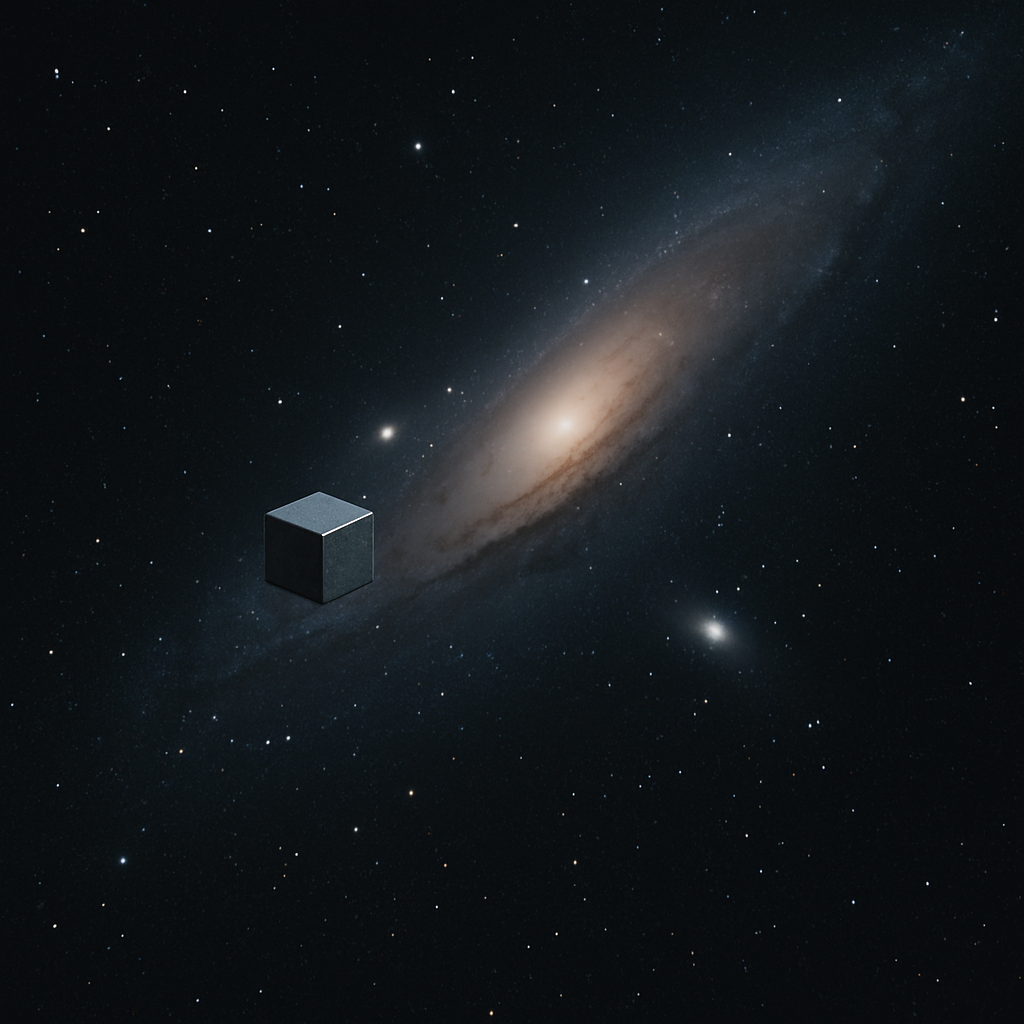
A new project named Fermi Explorer is aiming to send a miniature spacecraft toward Alpha Centauri by 2029, but the trip won’t be quick. Organized by the founders of Starcloud, this mission sets its sights on a journey lasting around 80,000 years. The payload will be diminutive: a 10-cm square housing just one kilogram of instruments, capable of operating actively for roughly 12 years before entering a long, drifting coast phase into interstellar space.
The team behind Fermi Explorer seeks both scientific and symbolic milestones. First, it intends to become the first human-built object specifically targeted at another star, and only the sixth ever to leave the solar system. Second, its launch is planned using existing technologies rather than speculative boosters. It will hitch a ride aboard a rocket, then rely on electric propulsion to gradually swing itself from Earth’s orbit outward until it breaks free and heads toward Alpha Centauri.
Financially, the mission is budgeted at roughly $15 million. The group is already reaching out for collaborators, sponsors, and payload contributions—sensor packages and even artistic components are on the table, with parallels drawn to NASA’s Voyager Golden Record. The project is officially public now, largely driven by John-, Philip Johnston, Adi Oltean, Ezra Feilden, and Garret Jameson.
Why 80,000 Years?
Previous high-profile efforts like Breakthrough Starshot aimed to cross the interstellar gulf in decades using high-risk, high-cost innovations like ground-based lasers. Fermi Explorer flips that approach: it accepts a vastly slower mission in order to eliminate technological risk. By stretching the timeline to tens of millennia, the founders avoid the need for unproven propulsion systems and allow the mission to move forward using reliable components.
Alpha Centauri lies about 41 trillion kilometers away. For context, Voyager 1, launched in 1977, is now just over 26 billion kilometers from Earth. Voyager may be slow by comparison, but it’s already exited the solar system. What Fermi Explorer trades in speed, it hopes to make up in endurance and legacy.
Legacy and Longevity
One challenge is ensuring the probe survives—both physically and in some trace of its mission—for tens of thousands of years. The project argues that if dinosaur bones endure for over 200 million years, a metal box with suitable shielding can persist under expected radiation and space conditions for at least 50,000 years. After the active 12-year period, there’s no expectation of power; instead, the hope is that a future civilization will find and study it.
This endeavor is still in the early phase: securing funding, designing the spacecraft, and selecting payloads are top of the agenda. The nonprofit is currently looking for vendors to build the physical probe and anyone who wants to contribute sensor, scientific, or artistic materials. Launch schedule is aiming for 2029.
The mission is named in reference to the Fermi paradox—the question of why, given the vastness of the universe and the odds, humanity hasn’t yet detected signs of intelligent aliens. By sending something outward, the founders intend both to test the boundaries of human exploration and to make an indelible mark, regardless of who—or what—might eventually intercept it.
Fermi Explorer is far from the first pen-and-paper interstellar idea, but it does stand out. With modest funding needs, existing tech, and a timescale that spans human history, it challenges how we think about space travel goals.
Analytically, this project matters because it reframes what ‘ambitious’ means in space exploration. Rather than insisting on speed or cutting-edge propulsion, Fermi Explorer bets on slow, steady, lasting endurance. If successful, it could redefine how we establish interstellar ventures—prioritizing feasibility and legacy over novelty. The real question now is whether the scientific, technical, and financial foundations will hold up long enough to make it through launch, much less 80,000 years of drift—and whether the mission will inspire others to dream with patience rather than haste.