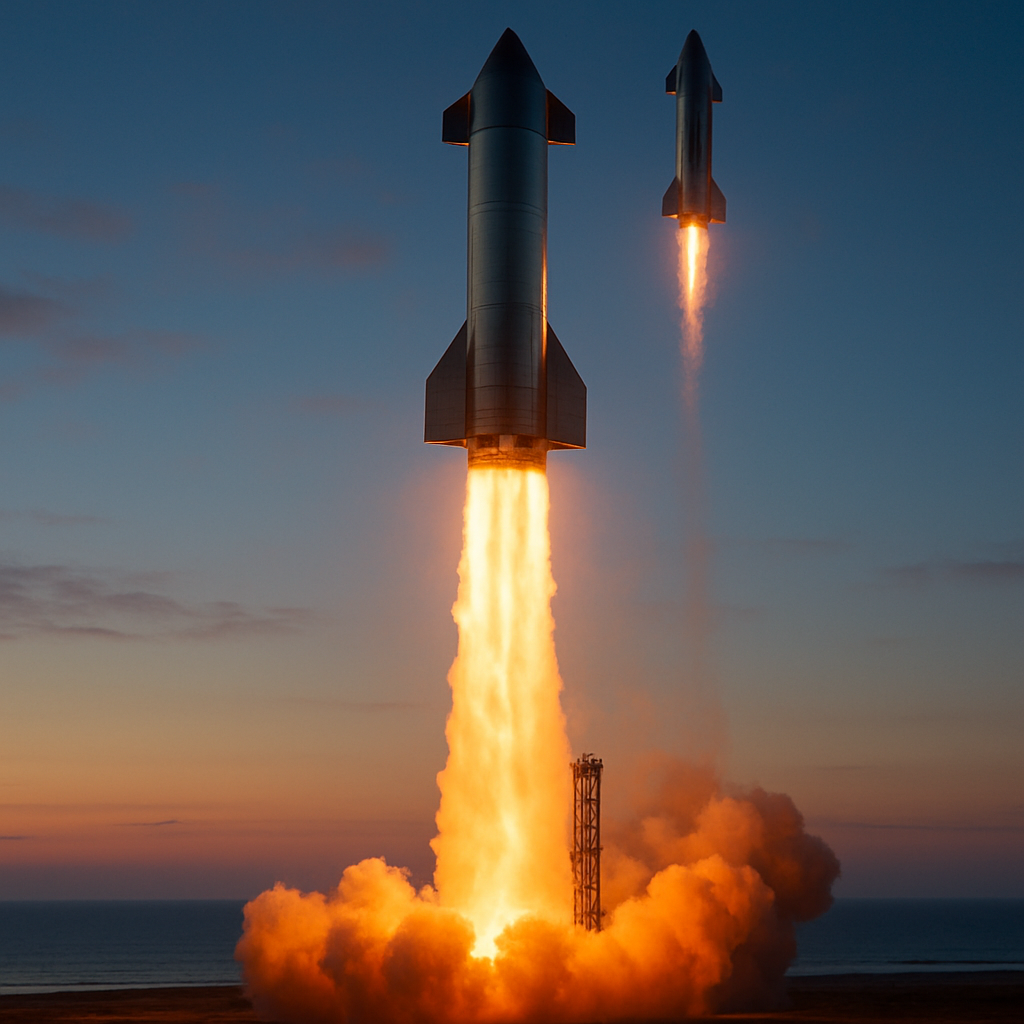
Early this morning, SpaceX’s Starship finally reached Earth orbit for the first time—a long-awaited milestone in its development. While the launch went largely as planned, things got tense when one of the six Raptor engines on the upper stage failed right after separation. Still, Starship soldiered on and achieved orbit despite the engine loss.
Originally, SpaceX considered aborting the mission once the engine issue arose. However, just minutes later, the company made the decision to continue. That proved crucial: mastering orbital insertion is pivotal for turning Starship into a reliable workhorse for commercial missions and fulfilling broader ambitions.
What Was Planned vs. What Unfolded
Before lift-off, SpaceX had laid out an ambitious agenda. The upper stage was set to circle Earth six times over nine hours, all while deploying 26 next-gen Starlink satellites. It remains unclear whether those goals were modified after the engine failure, or whether the full deployment proceeded as intended.
The launch took place from South Texas, where the Super Heavy booster, Starship’s first stage, almost immediately detached and then made its way back. Its return was a mock landing over the Gulf—no touchdown on land, but an important test nonetheless. With this flight, SpaceX logged its cleanest simulated landing yet for the V3-generation booster, which has been under flight testing since May.
Why This Orbit Matters
Reaching stable orbit transforms Starship from a prototype to a mission-capable system. For SpaceX CEO Elon Musk, this is core to his vision: a fully reusable mega-rocket capable of enabling moon missions for NASA and even orbital data-centers. Regular use of Starship could slash launch costs and open up entirely new space economy pathways.
Today’s mission didn’t just signify a one-off technical victory. It nudged SpaceX toward regular operations with Starship, potentially setting the stage for large-scale, frequent launches of everything from satellites to interplanetary hardware. Getting one critical element—engine failure—handled without mission abort shows the architecture is robust.
This achievement follows intense development efforts. Starship has been in testing for years, with multiple prototype flights aiming to validate its reusability, engine performance, and payload capacity. Each step has come with failures, but today’s success marks a shift: from experimenting with big ideas to executing them.
What to watch now: whether Starship can deliver the full Starlink payloads it was designed for; whether reusability in practice—especially landing and refurbishing the Super Heavy booster—keeps pace; and whether SpaceX can scale launch cadence without sacrificing reliability. Today’s launch didn’t just reach orbit—it opened a new chapter in space tech.
For the space industry, this is more than a victory for SpaceX. It recalibrates what’s possible. Lower costs, massive payloads, moon missions—it all hinges on Starship, but today’s flight proves it’s no longer just a concept. It’s now a functioning asset to build with.