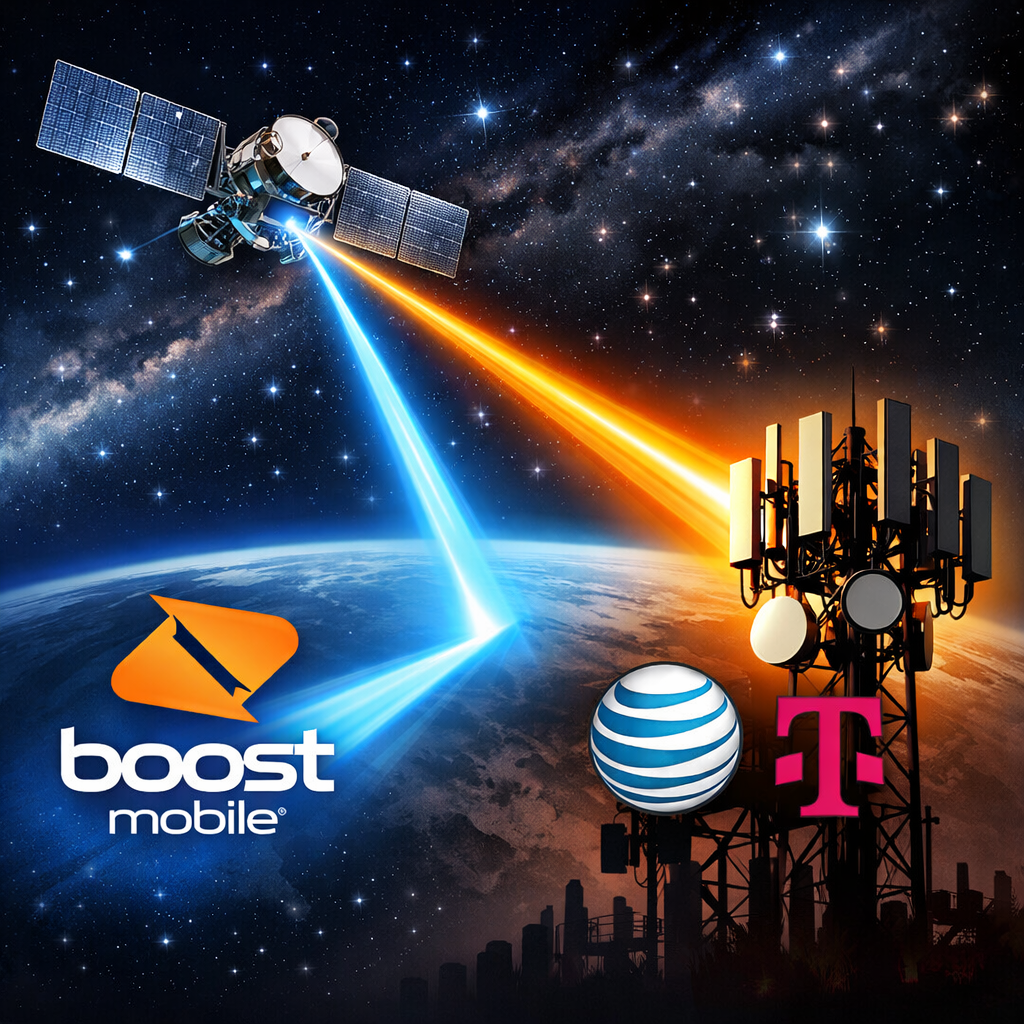
SpaceX is reportedly in active discussions to either buy Boost Mobile from EchoStar or gain access to its wireless network, a move aimed at allowing Starlink Mobile to go head-to-head with AT&T, Verizon and T-Mobile US. The deal would provide SpaceX a ready path into the U.S. wireless market — valued at an estimated $235 billion — at a time when its requests for roaming agreements with the major carriers have been rebuffed.
Boost Mobile, a discount provider owned by EchoStar, doesn’t own its own cell towers. Instead, it leases capacity from AT&T and T-Mobile. For SpaceX, acquiring Boost or striking a network-access deal could unlock the terrestrial infrastructure it needs to complement its satellite constellation. But those existing lease contracts likely can’t be transferred without carrier consent, introducing potential legal hurdles.
Why This Matters for SpaceX’s Wireless Push
SpaceX has been laying groundwork to become a full-service mobile carrier in the U.S. Its ambitions rest on hybrid architecture: combining satellites and ground-based infrastructure under the Starlink Mobile brand. As part of that strategy, the company recently purchased low-band spectrum from Grain Management for approximately $8 billion. It has secured Federal Communications Commission permission to launch up to 15,000 satellites capable of direct-to-device service, advancing its ability to deliver reliable nationwide mobile coverage.
During SpaceX’s latest earnings call, CFO Bret Johnsen stated that the company now sees itself moving toward becoming a “major mobile carrier” in the U.S. EchoStar shares jumped sharply following the news, while SpaceX positioning threatens to reshape the competitive landscape.
Obstacles Ahead
Despite the upside, several barriers remain. Lease agreements held by Boost with AT&T and T-Mobile may be non-transferrable without approval. The technical challenge remains stark: direct-to-satellite service struggles in dense urban and indoor environments, where terrestrial towers still dominate.
Moreover, the Big Three carriers have so far refused to provide SpaceX with the wholesale access it would need to build out its service via Mobile Virtual Network Operator (MVNO) arrangements. This has forced SpaceX to accumulate spectrum and explore terrestrial infrastructure partnerships to compensate.
Another legal and regulatory layer could complicate things. Whether through acquisition or network lease, any deal will likely come under scrutiny from both the FCC and carrier agreements themselves. The question of how spectrum rights, customer contracts, and lease terms would shift is still unresolved.
Still, for SpaceX, acquiring Boost Mobile or its network access would offer immediate scale. Boost’s customer base, EchoStar’s cloud-native 5G core, and existing retail presence would accelerate rollout compared to building from scratch. Combined with Starlink’s satellite assets and newly acquired spectrum, SpaceX could bridge its coverage gaps more rapidly.
SpaceX and EchoStar have not publicly confirmed the discussions. If the deal proceeds, it may represent one of the most significant shifts in U.S. telecom in years — a satellite-first company gaining control of terrestrial networks to rival the entrenched carriers.
What this means: SpaceX appears to be pursuing a strategy that combines its next-gen direct-to-device satellite infrastructure with a terrestrial backbone — one provided either by acquisition (Boost Mobile) or partnership. The deal, if successfully negotiated and approved, could force AT&T, Verizon and T-Mobile to rethink their dominance in wireless. Key details to watch: whether the MVNO leases held by Boost Mobile can be transferred, how fast Starlink Mobile’s satellites deliver usable performance in cities and indoors, and how regulators respond to what may amount to a new “hybrid-MNO” model in the U.S.