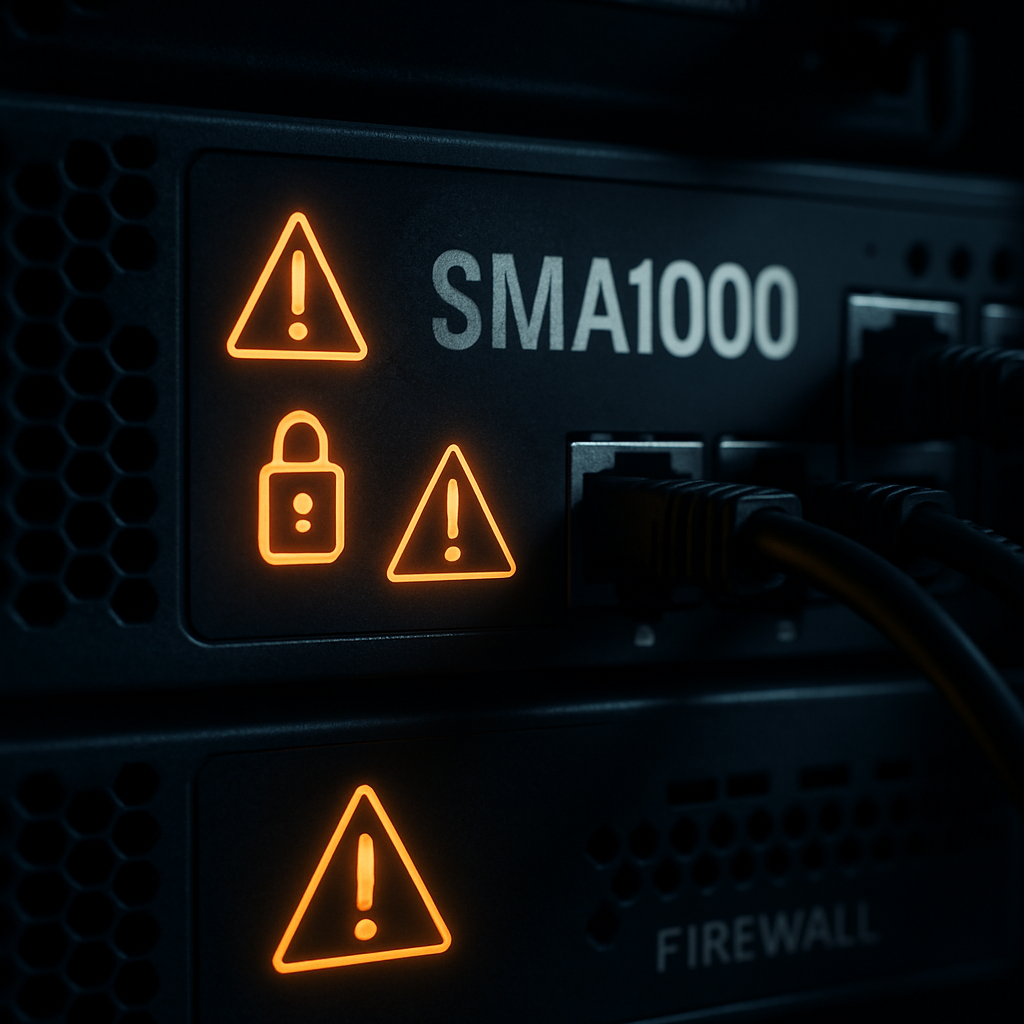
The U.S. Cybersecurity and Infrastructure Security Agency (CISA) has added two critical vulnerabilities in SonicWall’s SMA1000 appliance to its Known Exploited Vulnerabilities catalog, affirming that attackers are already leveraging these flaws in active breaches. These vulnerabilities—recognized on September 2, 2026—must be addressed by all federal civilian agencies by September 5, 2026.
The Vulnerabilities at a Glance
The first issue, CVE-2026-83549, is an OS command injection flaw (CWE-78). It allows someone who’s authenticated as an administrator to execute arbitrary operating system commands on the SMA1000 appliance. Such access could lead to remote code execution, system setting changes, persistence of malicious access, or lateral movement within a network.
The second, CVE-2026-83548, exposes a server-side request forgery (SSRF) weakness tied to CWE-918 and CWE-441. Unlike the command injection vulnerability, this one can be exploited by unauthenticated attackers. It enables them to make the device perform actions it shouldn’t, including accessing sensitive or restricted functionality.
Why This Matters Now
The SMA1000 units are often deployed at the network perimeter, where they manage remote access and administrative connections. If compromised, they give attackers a possible path into sensitive internal systems with little resistance. CISA has issued a Binding Operational Directive (26-04) for both vulnerabilities, categorizing them as serious enough to require forensic triage rather than routine patching.
Security teams are urged to assess whether their SonicWall SMA1000s are exposed to the internet, track administrative actions and authentication events, and hunt for suspicious behavior—unusual outbound connections, unknown accounts, unexpected configuration changes, or odd processes.
Although it’s not yet known if ransomware has been linked directly to these flaws, their confirmed active exploitation amplifies the risk—especially since attackers frequently target VPN appliances and remote access gateways as high-value entry points.
Recommended Actions for Organizations
- Immediately implement any mitigation or patches provided by SonicWall.
- Follow CISA’s risk-based guidance for patching and conducting forensic triage.
- If no patch is yet available, consider decommissioning or removing affected SMA1000 appliances, especially if they’re exposed to public networks.
This situation underscores a broader trend: vulnerabilities in remote access tools are among the fastest exploited once known. The urgency is real—not just for federal agencies, but for all organizations relying on SonicWall’s SMA1000. With attack windows narrowing, ignoring such vulnerabilities can lead to serious exposure.
What to watch next: monitor updates from SonicWall for patches or mitigations, watch vulnerability disclosure forums for similar flaws elsewhere, and review internal incident logs for any signs of these particular exploit chains hitting your environment.