AI is no longer optional for businesses—it’s already at the heart of many workflows. But for all its benefits, integrating AI across functions introduces serious security challenges. Research shows that while about a third of senior IT and security leaders report extensive AI use in areas like threat detection and incident response, many organizations aren’t prepared for tomorrow’s high-stakes AI threats—especially if a major cyberattack strikes without warning. It’s a risky gap that needs closing now.
Understanding the AI Security Gap
AI isn’t always formally adopted—sometimes it shows up through shadow projects, third-party tools, or quick integrations, often bypassing security review. As organizations increasingly depend on generative and agentic AI, those risks grow: the more autonomy and system access AI has, the greater the potential attack surface.
Despite 63% of enterprises expecting full AI integration by 2027, only about 38% have comprehensive AI policies in place. That mismatch leaves enterprises vulnerable to ungoverned AI use, ad hoc integrations, and privilege creep—risks that malicious actors can exploit using automated tactics and large-scale model attacks.
Hidden Threats & Lifecycle Vulnerabilities
Many assume limited AI use means limited risk. But breaches linked to unapproved AI tools are already being reported by 67% of executives. Key risks aren’t where most orgs expect: they lie in internal shortcuts, excessive permissions, and integrations that bypass oversight. When AI models or agents get access to critical systems without checks, the impact multiplies.
To manage these risks, organizations need to embed AI security practices into every phase of the lifecycle—from strategy to incident recovery. Common missteps include shipping AI tools without defined security requirements or failing to act when usage expands beyond initial expectations.
Operationalizing AI Security: Key Elements
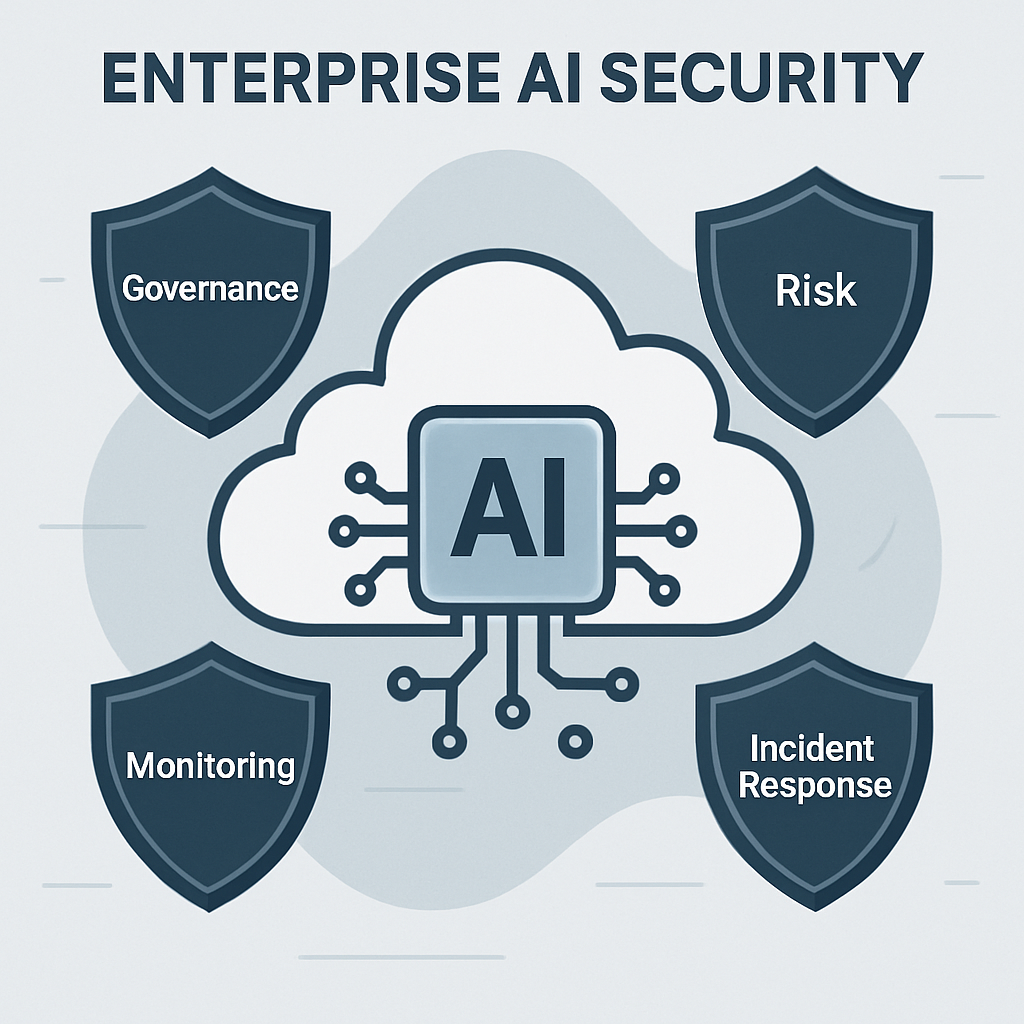
Executive alignment is essential. Security leaders cite lack of board or executive involvement as a top obstacle to readiness. Clear ownership, cross-domain oversight, and formal accountability tie AI efforts to business risk and legal responsibility.
Governance must define acceptable use, ownership, and risk frameworks. Guardrails go beyond policy: identity management, data protection, auditing, and vendor scrutiny are critical.
Employees bear a role too. Generic training won’t cut it. Everyone—from developers to business users—needs role-specific training so they understand how to handle data, assess risks, and follow governance.
Before rolling out any AI solution, formal assessment, testing, and validation are mandatory. And once live, systems need continuous monitoring—new integrations, model changes, or scope creep can radically shift risk profiles.
Incident response plans also need updating to reflect AI-specific threats. Scenarios like prompt abuse, model failures, or agent compromise require unique forensics, escalation paths, and stakeholder coordination.
What Proactive AI Security Looks Like
Waiting for an incident to expose gaps means reacting, not preventing. A proactive posture involves three ongoing priorities: mapping the organization’s AI cyber posture, building or refining governance and usage frameworks, and stress-testing both in-house and vendor tools against realistic adversarial behavior.
Adopting AI safely at scale demands that companies treat security and governance as inherent, not optional. Align executive accountability, define life-cycle controls, train the workforce, validate tools, and prepare incident plans tailored for AI. With threats evolving, so must the frameworks and readiness levels across every level of the organization—especially when sensitive data, external vendors, or mission-critical workflows are involved. Those who get ahead of this will gain visibility, control, and confidence; those who lag risk being exposed without warning.
Analysis:The trouble with enterprise AI adoption is not just the technology—it’s the speed. Enterprises are moving fast, often outpacing the maturity of governance, security, and incident response programs. What matters now is building a foundation: defining ownership, validating security early, and treating AI risk as business risk. Leadership must shift from awareness to accountability. And organizations need to view AI security as an evolving lifecycle, not a one-time checklist. What’s to watch: how regulation, threat models, and vendor capabilities adapt to pressures—from adversaries, the boardroom, and regulatory bodies—and whether organizations keep pace or fall behind.