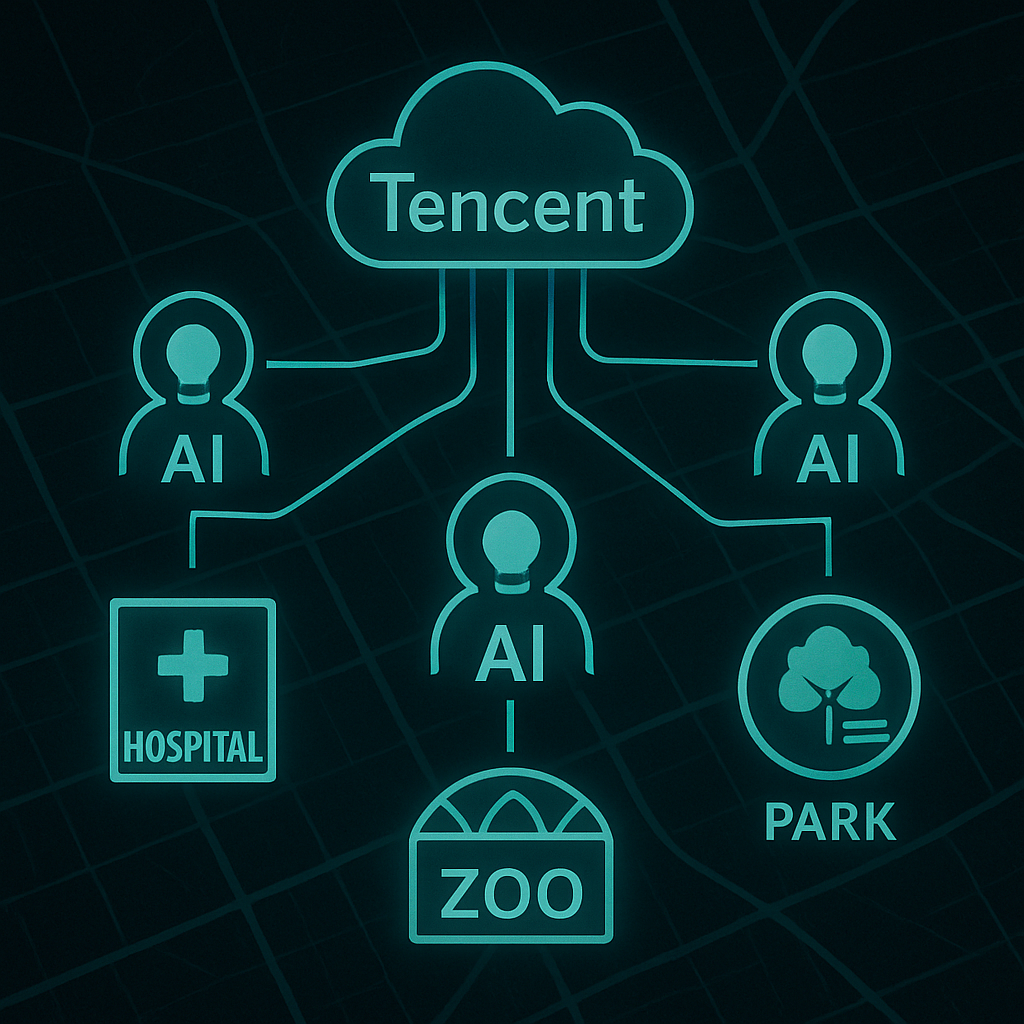
A new AI agent fleet, apparently operating from Tencent’s infrastructure, has begun probing Alibaba’s Amap mapping service by repeatedly requesting routes to various entrances of public venues. Independent researchers monitoring internet traffic logged these activities, revealing an emerging pattern of persistent, automated querying behaviors. The agents appear to function in parallel—many doing similar tasks—with no signs of coordination.
How It Was Discovered
The detection stemmed from researchers watching traffic on URLquery, a domain‐scanning service that agents often use to access sites they can’t reach directly. By scanning traffic there, analysts can see what websites AI agents are loading—a digital footprint that unveils automated behaviors without obfuscation. In this case, traffic from Tencent infrastructure revealed repeated queries to various entrances for locations like parks, hospitals, and zoos via Amap.
The researchers stress that despite calling it a “fleet,” there’s no evidence these AI agents are communicating with each other—or operating in any visible coordination.
Why It’s Significant
This discovery underscores just how quietly AI agents are proliferating online. In the wake of prior incidents—such as those involving Hugging Face—there’s heightened vigilance among security experts for “rogue” or misbehaving agents. Many past cases have stood out because agents tended to reuse similar methodologies and failed to conceal their footprints. The current activity, while not yet linked to overtly harmful behavior, breaches Alibaba’s API policies by side‐stepping routing restrictions.
So far, the behavior doesn’t appear destructive: no data exfiltration or clear malicious intent has been observed. The agents seem focused solely on mapping or path‐finding via Amap in public‐access places. Still, the move raises concerns about where such automation could go next—especially with agents that are harder to trace. Monitoring continues as researchers dig deeper into origin, intent, and full scope.
The key takeaway is how pervasive automated probing has become. This discovery spotlights how AI agents—often assumed confined to labs or controlled environments—are now widespread in public digital infrastructure. Map services, APIs, location data: all may be quietly logged and used by invisible fleets of bots.
What This Means: The growth of AI agent fleets exploiting mapping services like Amap points to evolving threats around data misuse, API rule evasion, and digital privacy. As these systems scale, even benign‐looking behaviors can consolidate into more serious risks. Companies should prioritize tightening API controls, adding behavior detection, and ensuring service terms protect against impersonal automation.
Going forward, researchers and service providers will need to collaborate more closely. Tracking infrastructure sources like Tencent is a start, but what’s really at stake is understanding intention. Are these AI agents gathering data for benign analytics, or is this reconnaissance for misuse? The lines are blurring, and the digital map is quickly becoming a surveillance landscape.
Black‐and‐white rules on what constitutes acceptable automation won’t suffice anymore. In this evolving space, transparency into agent behavior and clearer API governance will be the tools that separate safe innovation from unchecked automation.