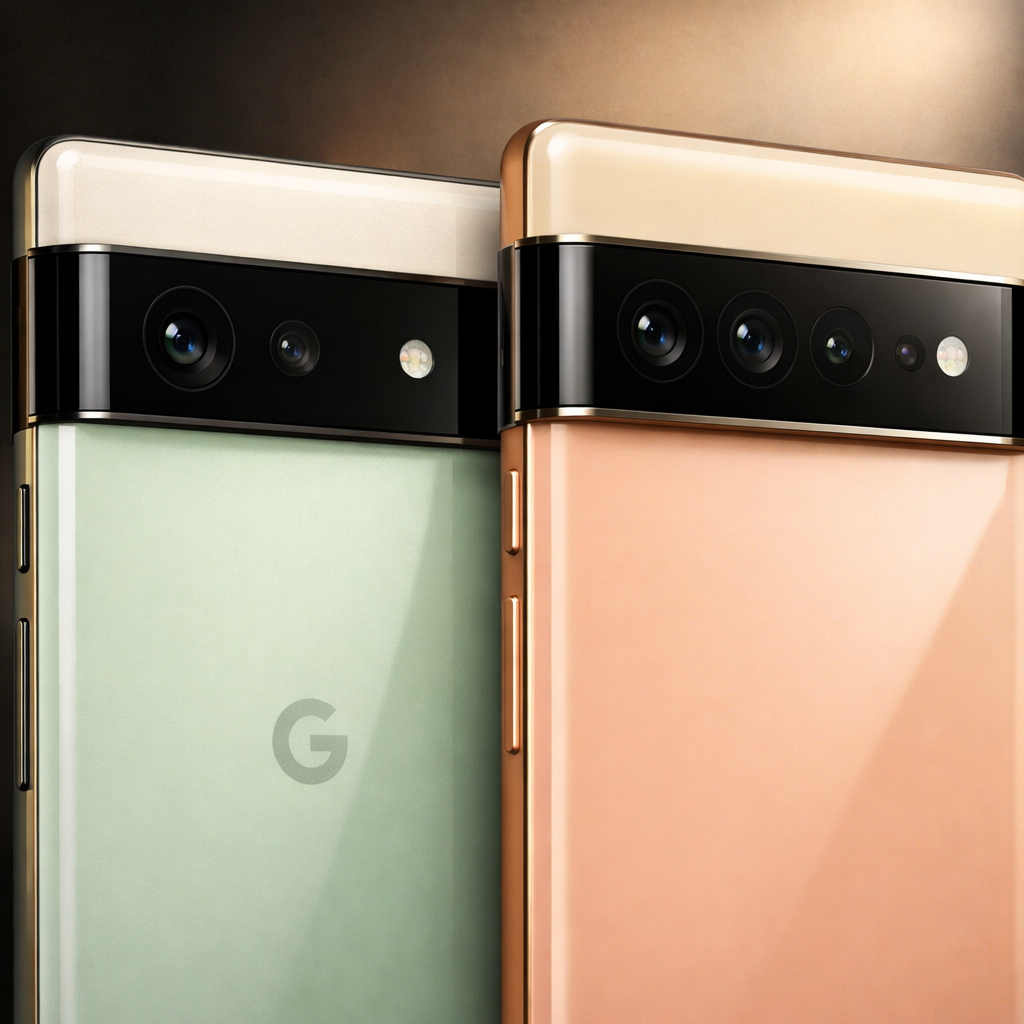
The Pixel 6 and Pixel 6 Pro launched in late 2021 as Google’s bold attempt to redefine its flagship game. With a totally new aesthetic, its own chipset, upgraded cameras, and an aggressive starting price around $599, this reboot was meant to shake things up and challenge expectations. Today, it’s clear the Pixel 6 line was a turning point — flawed in places, but foundational for what followed.
The bold new design & hardware shift
To start, Google overhauled its design language. The Pixel 6 series dropped understated for daring, introducing a striking visor-style camera bar that stretched across the rear and created an instantly distinctive silhouette. Both devices embraced pastel dual-tone glass backs — the base model went playful with fun colors and matte finishes, while the Pro took a more elegant route with polished aluminum frames and curved glass displays. But with the gains came trade-offs: both phones were large, heavy, slippery, and lacked compact alternatives for those used to smaller form-factor phones.
Central to the reboot was Google’s first in-house chip, the Tensor G1. Designed in partnership with Samsung, it wasn’t built to win benchmark races against Apple or Snapdragon high-ends. Instead, its strengths were in machine learning and AI-powered features — think improved voice typing, real-time translation, photo editing tools, and offline speech transcription. Tabs like Android 12’s Material You theming added polish. Yet the chip struggled under sustained loads, showing inefficiencies in battery life and thermal performance when pushed hard.
Pains in performance & software
Hardware bugs put real stress on early adoption. The under-display optical fingerprint reader replaced the reliable capacitive sensor of previous Pixels, but that came with slower response times and inconsistency. Meanwhile, the cellular modem introduced by Google — a Samsung Exynos model — suffered from signal drops, weak reception, and generally subpar performance. These weren’t just nuisances you could fix with updates; many required significant hardware-level work.
The software rollout added to the difficulty. Android 12 introduced sweeping changes, but patches struggled to keep up. A December 2021 security update, for example, caused such severe call-dropping problems that Google paused distribution and worked nearly a month on a fix. Camera enhancements also took time; initially, the main sensor saw oversharp edges and weak macro support, especially with ultra-wide and close-up shots. Video, while better than past Pixels, still lagged behind rivals in low-light stabilization.
What Pixel 6 got right — and what it taught Google
Where Pixel 6 truly delivered was camera hardware. Throwing out Google’s aging 12.2MP IMX363 sensor, both models adopted a 50MP GN1 main sensor that captured around 150% more light than the previous generation. That meant natural depth of field, stronger dynamic range, better low-light capabilities, and more accurate skin tones. The Pro added a 48MP periscope lens, enabling sharp zoom and long-range photography. Though initial images showed optical fringing and oversharp edges, later updates smoothed these issues out.
Beyond specs, Pixel 6 redefined what ‘premium’ could cost. Its aggressive pricing disrupted industry norms, proving that a phone with custom silicon and flagship cameras didn’t have to demand four-figure price tags. It also set design cues that carried into later Pixels — refined visors, better fingerprint sensors and connectivity, stronger base camera quality. These are now baseline expectations for Google’s hardware strategy.
In sum, the Pixel 6 generation was as messy as it was ambitious. It brought in the most aggressive design overhaul Google had attempted, introduced its own silicon in earnest, and pushed imaging hardware forward in meaningful ways. But mixed in were missteps: performance inconsistencies, connectivity woes, unreliable biometrics, and a software launch with too many growing pains.
This matters because without Pixel 6, today’s more polished hardware — the smoother design refinements, improved connectivity, better sensor clarity — might not exist. The risk and failure here weren’t accidental; they were essential training for Google’s rise. Going forward, all eyes will be on whether future Pixel releases can balance bold innovation with reliability from day one — reducing the ‘flaws’ while preserving the fire.