Traditional email security measures, designed to detect malicious content like harmful links and attachments, are becoming increasingly ineffective against sophisticated phishing attacks. These modern threats exploit the intent behind messages rather than their content, making them harder to identify and block.
Evolution of Phishing Tactics
Phishing attacks have evolved through several stages:
- Phishing 1.0: Focused on malicious content such as harmful links and infected attachments. Secure email gateways were effective in scanning and blocking these threats.
- Phishing 2.0: Centered on deceptive intent, including business email compromise and executive impersonation. These attacks lacked malicious payloads, relying instead on social engineering tactics that traditional gateways often missed.
- Phishing 3.0: Utilizes AI-powered, multi-channel strategies. Generative AI crafts convincing lures, while deepfake technology extends these attacks into voice and video formats, spanning email, collaboration tools, and live calls.
AI Agents in Cyber Attacks
The integration of AI agents has transformed the economics of cyber attacks. Previously, attackers invested significant time in reconnaissance—researching company websites, job postings, and social media to craft believable pretexts. Now, AI agents can rapidly analyze an organization’s public information, including GitHub repositories and cloud documentation, to generate tailored phishing content in seconds. This automation allows for the scaling of personalized attacks across numerous organizations, increasing both the quality and quantity of phishing attempts.
For instance, Microsoft has identified phishing platforms capable of generating tens of millions of messages monthly. A 2026 Dark Reading poll revealed that 48% of security professionals consider agentic AI the top attack vector for the year, surpassing concerns about deepfakes and other threats.
Real-World Implications
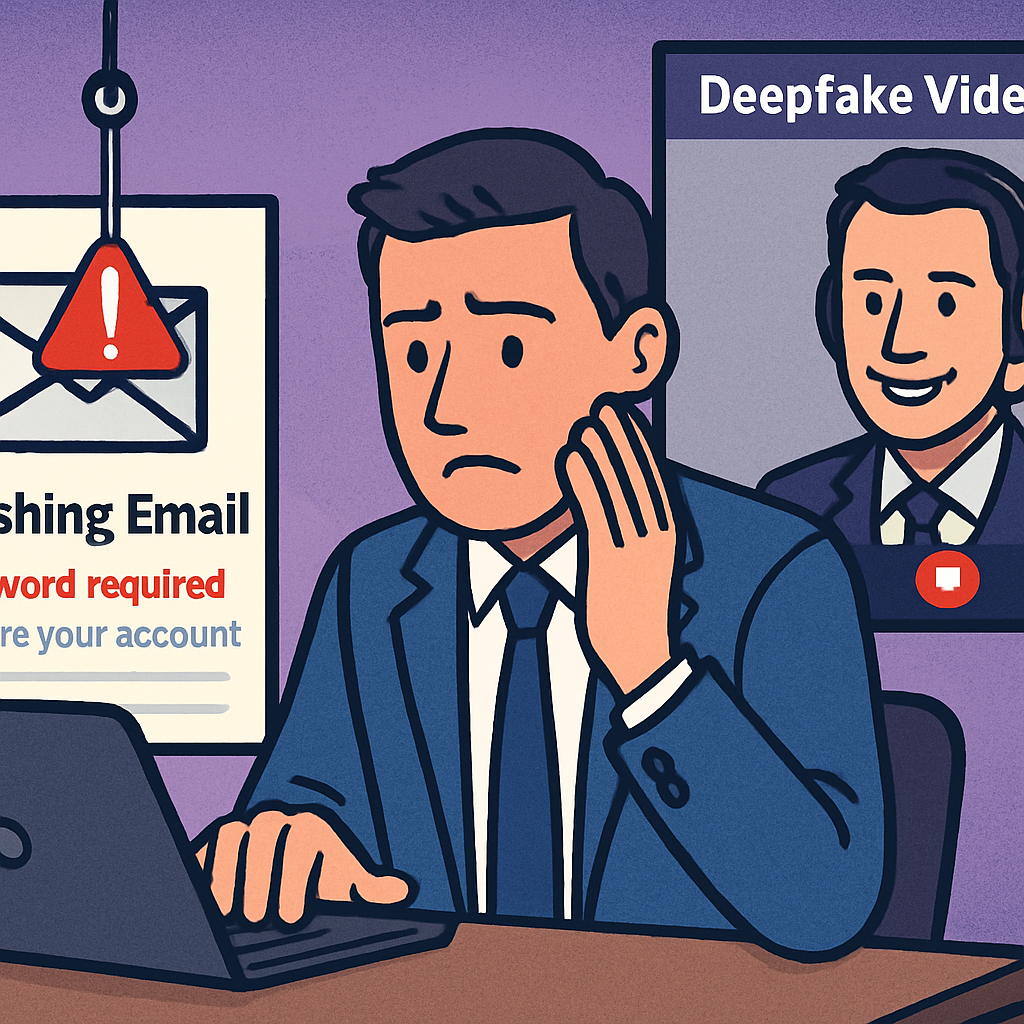
The impact of these advanced phishing techniques is evident in real-world incidents. At engineering firm Arup, an attack began with a phishing email impersonating the company’s UK-based CFO. When the targeted employee hesitated, the attackers escalated to a deepfake video call featuring synthetic representations of familiar colleagues. This convincing ruse led the employee to authorize 15 transfers totaling approximately $25 million. Such attacks exploit trust in visual and auditory cues, bypassing traditional email security measures.
Industry Response and Challenges
A January 2026 study by Osterman Research, commissioned by IRONSCALES, surveyed 128 security and IT leaders from U.S. organizations with 1,000 to 5,000 employees. The findings highlight the growing concern:
- 88% experienced at least one incident that undermined trust in their digital communications over the prior year.
- 82% reported that their existing email security solutions failed to detect or prevent these incidents.
These statistics underscore the urgent need for organizations to adapt their security strategies to address the evolving landscape of AI-driven phishing attacks.
As phishing tactics become more sophisticated, leveraging AI and multi-channel approaches, organizations must enhance their security frameworks. This includes implementing advanced behavioral analysis tools, conducting regular employee training on recognizing AI-generated threats, and fostering a culture of vigilance. Staying ahead of these developments is crucial to maintaining trust and security in digital communications.