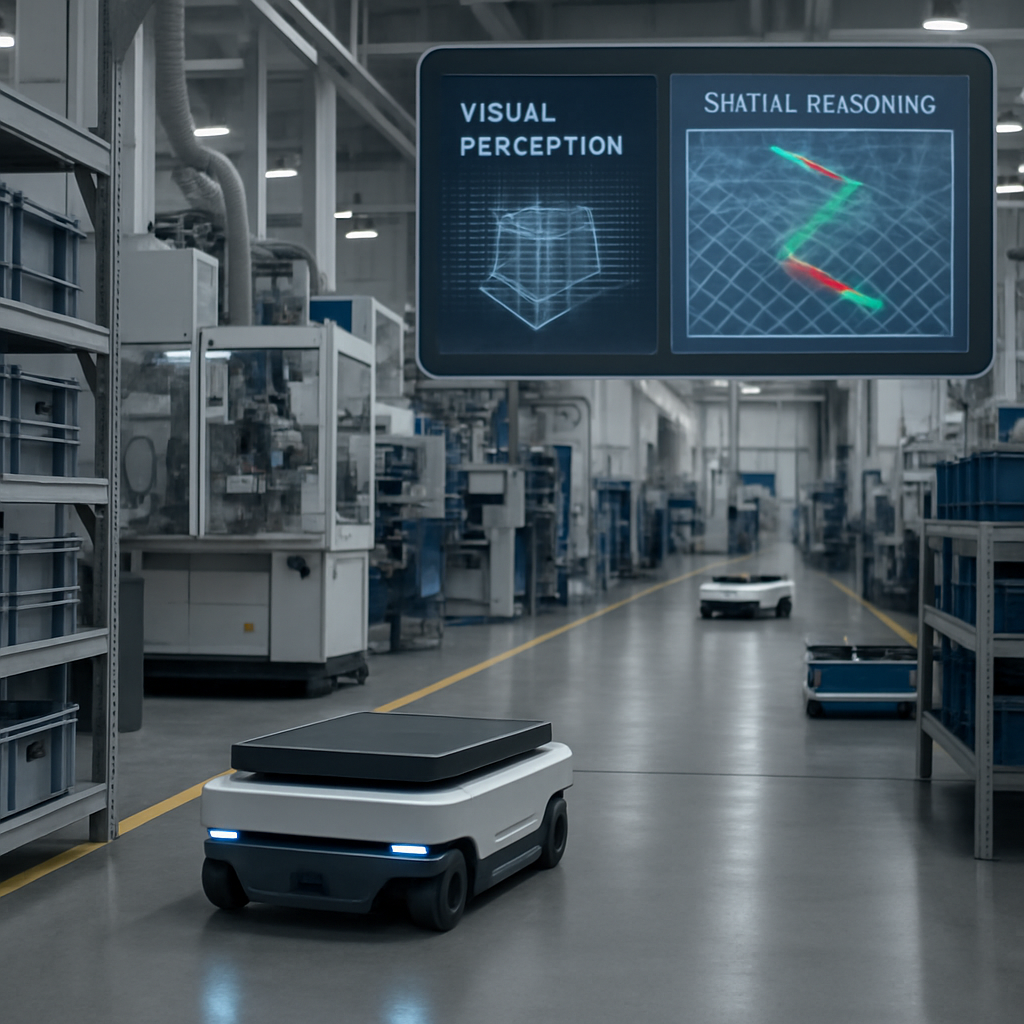
Perceptron, founded by two former Meta FAIR researchers, is pushing visual AI beyond screens and into the mechanics of factories and warehouses. The startup has rolled out Isaac 0.5, a generalist vision model tailored to help robots perceive, reason, and operate in complex physical environments. It’s built to address industrial automation tasks that today often rely on narrow or overly specialized software. Isaac 0.5 aims to handle both perceptual tasks (e.g. identifying objects, reading labels) and action-based reasoning (e.g. path planning, picking order) without locking robots into repetitive, single-use roles. August 26, 2026.
Training the Model: Learning from “General Video” and Ego-Motion
Isaac 0.5 learned its skills via massive-scale video training. The system was fed over one million hours of “general video” to build visual familiarity with diverse settings, features, and scenarios. To better capture how robots should move and act, Perceptron also incorporated ego video—first-person footage often used to model physical tasks—and UMI video, which captures repetitive human actions to teach motion and interaction patterns. Behind the scenes, the company says it has constructed its own petabyte-scale datasets across modalities like video, images, text, and robotic trajectories. The released model is open-weight, allowing anyone to inspect its training parameters and materials.
Designing for Flexibility Across Industries
Founded in November 2024 by Armen Aghajanyan and Akshat Shrivastava, Perceptron has secured a $21 million funding round led by Bessemer Venture Partners. The goal is to provide industrial operators with a software layer that can adapt to varying contexts rather than force compromises between specialization or generalism. Current automation tools often excel at a single task—like detecting defects, scanning barcodes, or moving along fixed paths—but struggle to integrate perception, reasoning, and action in one unified model. Isaac 0.5 is intended to fill that gap.
Potential applications span manufacturing, logistics, warehousing, security, mobility, and even media and entertainment. Use cases include robots navigating factory floors, sorting packages by label, planning optimal pickup sequences, and executing actions based on spatial reasoning. By combining perceptual intelligence and control methods in a more holistic architecture, Perceptron believes Isaac 0.5 can serve as an “intelligence layer” for robots in industrial settings.
Most industrial vision systems to date tend to be narrowly focused—dedicated sensors, fixed-purpose models, and rigid pipelines. Perceptron argues that a generalist model capable of simultaneous perception and control opens up more scalable deployments and faster adaptation to the unforeseen challenges of real-world settings.
What’s happening here could mark a shift: bringing AI out of servers and into the motion, mess, and variability of actual physical environments. If Isaac 0.5 delivers—performing across tasks, environments, and actions—it may recalibrate expectations for what is possible with robotics, automation, and visual intelligence.