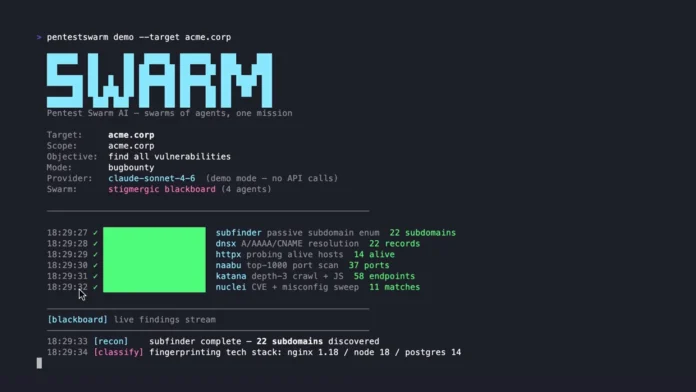
Pentest Swarm AI: Revolutionizing Autonomous Penetration Testing with Swarm Intelligence
In the rapidly evolving field of cybersecurity, the emergence of Pentest Swarm AI marks a significant advancement in autonomous penetration testing. Developed by Armur AI, this open-source platform introduces a novel approach by leveraging swarm intelligence to conduct comprehensive security assessments. Unlike traditional multi-agent systems that operate in linear sequences, Pentest Swarm AI employs decentralized coordination, enabling dynamic and efficient vulnerability detection and exploitation.
Understanding Swarm Intelligence in Penetration Testing
Swarm intelligence refers to the collective behavior of decentralized, self-organized systems, typically composed of simple agents interacting locally with one another and their environment. Pentest Swarm AI harnesses this concept through three core principles:
1. Stigmergy: Agents communicate indirectly by modifying a shared environment, known as the blackboard, which is backed by PostgreSQL with pgvector support. Each finding is assigned a pheromone weight that influences other agents’ actions, guiding them toward high-value targets. These pheromone weights decay over time, allowing the system to naturally phase out less relevant attack paths.
2. Emergence: Complex attack strategies emerge organically without explicit directives. For instance, a reconnaissance agent’s discovery can trigger classification agents, which, upon identifying critical vulnerabilities, activate exploitation agents. This spontaneous formation of attack chains enhances the system’s adaptability and responsiveness.
3. Decentralization: Each agent operates based on its own set of triggers and conditions, eliminating the need for a central orchestrator. This modular design facilitates the addition or removal of agents without necessitating extensive system reconfiguration.
Comprehensive Tool Integration
Pentest Swarm AI integrates a suite of robust tools to perform thorough security assessments:
– ProjectDiscovery Tools: The platform includes eight stable tools from ProjectDiscovery, such as `subfinder` for subdomain discovery, `httpx` for HTTP probing, `nuclei` for vulnerability scanning, `naabu` for port scanning, `katana` for web crawling, `dnsx` for DNS resolution, and `gau` for gathering URLs.
– Nmap Adapter: A fully parsed Nmap XML adapter with scope validation is incorporated, allowing for detailed network scanning and analysis.
– Future Integrations: The development roadmap includes adapters for tools like SQLMap, Burp Suite’s MCP bridge, Metasploit, and ZAP, aiming to enhance the platform’s capabilities progressively.
Getting Started with Pentest Swarm AI
Deploying Pentest Swarm AI is streamlined to ensure ease of use:
1. API Key Configuration: Set the orchestrator API key with the following command:
“`bash
export PENTESTSWARM_ORCHESTRATOR_API_KEY=sk-ant-your-key-here
“`
2. Initiating a Scan: Launch a scan using the command:
“`bash
pentestswarm scan example.com –scope example.com –swarm –follow
“`
The platform supports various AI models, including Claude (default with prompt caching for reconnaissance and classification agents), Ollama for air-gapped local deployments, and any OpenAI-compatible model. This flexibility allows teams to balance cost, privacy, and performance considerations. Notably, no GPU or local model download is required when utilizing cloud-based models.
Automated Reporting and Integration
Pentest Swarm AI generates comprehensive reports in multiple formats—Markdown, HTML, JSON, and SARIF—by querying the blackboard through a dedicated reporting agent. Key features include:
– Deduplication and Scoring: Findings are automatically deduplicated and scored according to the CVSS v3.1 standard, adhering to the FIRST specification.
– Scope Enforcement: The `–scope` flag is enforced at both the tool and executor layers, ensuring safe operation within CI/CD pipelines and bug bounty programs.
Comparison with Other Penetration Testing Tools
Pentest Swarm AI distinguishes itself from other tools through its true swarm intelligence architecture:
| Tool | Architecture | Execution | Memory Usage | True Swarm Intelligence |
|———————-|——————————-|———–|————–|————————-|
| Pentest Swarm AI | Stigmergic blackboard | Yes | pgvector + pheromones | ✅ |
| PentestGPT | Single-agent ReAct | Suggests | None | ❌ |
| PentAGI | 4 agents + planner | Yes | pgvector | Pipeline only |
| HexStrike | MCP tool wrapper | Delegates | Stateless | ❌ |
GitHub Actions and MCP Integration
To facilitate seamless integration into development workflows, Pentest Swarm AI offers:
– GitHub Action: A pre-configured GitHub Action with SARIF output enables automated penetration testing within CI/CD pipelines.
– MCP Server: The `pentestswarm mcp serve` command exposes the swarm as an MCP server, allowing native integration with tools like Claude Desktop and Cursor for IDE-level security testing.
Licensed under AGPL-3.0, Pentest Swarm AI is freely available for red team operations, providing a powerful and flexible solution for modern cybersecurity challenges.