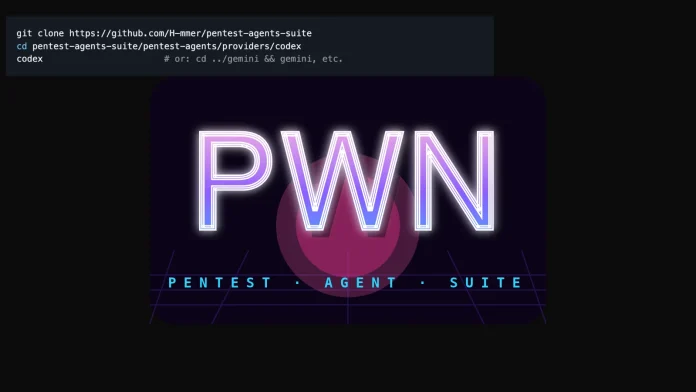
Revolutionizing Cybersecurity: The Pentest Agent Suite’s Autonomous Bug Bounty Framework
In the rapidly evolving landscape of cybersecurity, the introduction of the Pentest Agent Suite marks a significant advancement. This open-source, fully autonomous bug bounty framework is designed to enhance the efficiency and effectiveness of security assessments across multiple AI coding platforms.
Comprehensive Integration Across AI Platforms
The Pentest Agent Suite seamlessly integrates with seven major AI coding platforms: Claude Code, OpenAI Codex, Google Gemini, Cursor, Windsurf, VS Code Copilot, and OpenClaw. This broad compatibility ensures that developers and security professionals can utilize the suite within their preferred environments, facilitating a more streamlined workflow.
Robust Framework Structure
At its core, the Pentest Agent Suite is organized into three primary layers:
1. Specialized Security Agents: The suite includes 50 specialized agents, each tailored to identify and exploit specific vulnerabilities. These agents cover a wide range of security concerns, from common issues like Cross-Site Scripting (XSS) and SQL Injection (SQLi) to more complex threats such as Server-Side Request Forgery (SSRF) and Prototype Pollution.
2. Dual-Server Model Context Protocol (MCP) Infrastructure: This infrastructure supports the suite’s operations by managing communication between agents and external platforms. It includes integration with 16 bug bounty programs, such as HackerOne, Bugcrowd, Intigriti, Immunefi, and YesWeHack. The MCP servers expose tools like `list_platforms`, `get_program_scope`, `sync_program`, `draft_report`, and `submit_report`, enabling efficient interaction with these platforms.
3. Comprehensive Rules Library: The suite features an extensive rules library that agents reference in real-time. This library includes a FAISS-backed semantic writeup search engine, allowing agents to surface prior art before testing a vulnerability class. The library spans various attack patterns, including XSS, SSRF, SQLi, IDOR, OAuth, SSTI, JWT, LFI, Prototype Pollution, NoSQLi, and DeFi attack patterns.
Innovative Validation and Reporting Mechanisms
A standout feature of the Pentest Agent Suite is the 7-Question Gate, a validation pipeline executed by the `validator` agent on every finding. This rigorous process ensures that only validated and high-quality findings proceed to reporting and submission stages. The suite enforces a `/quality` score of 7 or higher, maintaining a high standard for reported vulnerabilities.
Additionally, the `/autopilot` command implements an anti-shallow depth engine, mandating multi-layer stacked-encoding in every payload attempt. This approach ensures thorough testing and prevents premature conclusions about an attack surface’s security.
Persistent Memory and Intelligent Backoff Strategies
The suite’s persistent `brain.py` component tracks every endpoint per target, enforcing circuit-breaker logic. For instance, if five consecutive 403 or 429 responses are received, the system triggers a 60-second auto-backoff. This intelligent strategy prevents unnecessary strain on target systems and optimizes the testing process.
Cross-IDE Installer for Seamless Deployment
To facilitate easy deployment, the suite includes a cross-IDE installer (`python3 -m tools.installer`). This tool generates native configuration formats for each supported IDE, writing them to the appropriate directories. For IDEs without native subagent support, such as Cursor, Windsurf, and OpenClaw, the installer translates content into skill files and rules, ensuring broad accessibility.
Diverse Agent Roster
The Pentest Agent Suite’s agent roster spans five tracks, including:
– HackerOne Weakness Specialists: Agents like `xss-hunter`, `sqli-hunter`, `ssrf-hunter`, `rce-hunter`, `oauth-hunter`, and `llm-ai-hunter` focus on specific vulnerability types.
– Static Application Security Testing (SAST) Pipeline: An 8-agent pipeline dedicated to static code analysis.
– Infrastructure and Reconnaissance Agents: Agents such as `cloud-recon`, `js-analyzer`, and `graphql-analyzer` assist in mapping and analyzing target infrastructures.
– Dynamic Application Security Testing (DAST) Agents: Tools like `api-fuzzer` and `web-fuzzer` perform dynamic testing to uncover runtime vulnerabilities.
– Reporting and Submission Agents: Agents like `report-generator` and `submission-handler` streamline the documentation and reporting process.
Enhancing Security Assessments
By automating and integrating various aspects of penetration testing and bug bounty processes, the Pentest Agent Suite significantly enhances the efficiency and effectiveness of security assessments. Its comprehensive approach ensures that vulnerabilities are identified, validated, and reported with precision, contributing to a more secure digital environment.