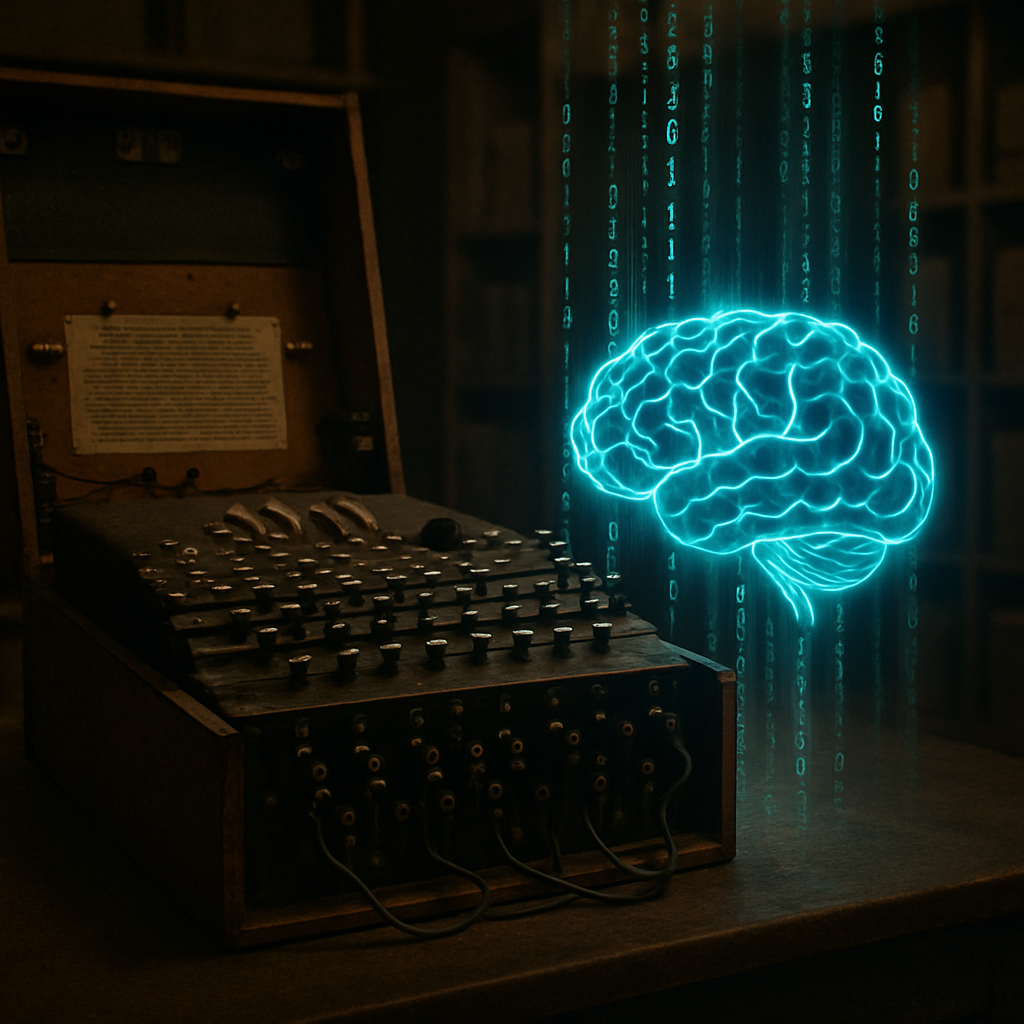
Long-standing unsolved messages encoded by World War II’s Enigma machines have just been decoded — not by human cryptanalysts, but by two of today’s most advanced AI models. OpenAI’s GPT-6 Astra and Anthropic’s Claude Opus 5 each broke different messages that had puzzled historians and hobbyists for decades. The work offers more than a flash of technical showmanship; it opens a window into the role AI might play in unlocking gaps in archival knowledge.
The Enigma Debate: Turing’s Second Test
Alan Turing is best known for his test of machine intelligence, but another of his pivotal achievements was cracking the Enigma code. Turing’s team built the Bombe, an early electromechanical computer, to decrypt Nazi Germany’s wartime messages. Despite decades of research and digitization of many Enigma archives, several messages remained indecipherable — often due to transcription errors, missing files, or unusual encoding quirks. These are what cryptanalysts refer to as “unbroken” messages. Until now.
Astra and Opus Make the Breakthroughs
The first breakthrough came when developer Carter Leffen prompted OpenAI’s Astra model to comb through a database of unsolved Enigma messages, locate one that had never been decoded, and attempt its decryption. Through archival research, context inference, and by simulating the Enigma machine, Astra successfully recovered a message whose plaintext has been unknown since around 2005. Subsequent validation by retired electrical engineer Frode Weiererud confirmed that Astra’s solution was correctly decoded, calling its speed and reasoning ‘awe-inspiring’.
A few days later, cryptanalyst Jack Willis used Claude Opus 5 by Anthropic to tackle another unbroken Enigma message. With more explicit guidance—including leveraging a known officer’s signature—Opus 5 was able to recover its plaintext as well. Weiererud reports only seven such messages remain unsolved; this latest victory leaves just a handful more where the code is still uncracked.
Why These Cracks Are Historic
These decryption feats matter because Enigma has long functioned as a measuring ground for cryptologic skill. For decades, the few unbroken messages were considered the final frontier—test cases that resisted both historical research and modern computation. These breakthroughs show that large language models (LLMs) like Astra and Opus 5 are not just powerful at conversation or prediction; they can function like research tools, cryptanalytic partners, and perhaps archives researchers in their own right.
Key components behind these wins include AI’s ability to search broadly through incomplete archives, spot linguistic clues in surrounding text, reconstruct mechanical or procedural systems (like Enigma machines), and fill in gaps caused by historical data damage or loss.
There are still unresolved challenges: transcription errors in historic documents, missing physical records, and uncertainty around exactly which sources the models accessed in their reasoning. Inquirers like Weiererud are curious about whether some of the archival files Astra referenced but did not cite are publicly available or not.
The upshot is that we’re witnessing AI models passing what might be called Turing’s “other test”—not whether we can’t tell machine from human, but whether machines can do what humans once did only exceptionally. Decrypting Enigma was one of those stealth benchmarks. With Astra and Opus 5 doing it, we’re entering a new phase of AI-assisted discovery.
Looking Forward
This raises questions about transparency, academic credit, and source provenance. How do we verify exactly what datasets these models have seen? Who gets credit when an AI solves a decades-old mystery? There are ethical and archival dimensions beyond raw technical power.
What matters now is not just that the messages are decoded, but how this will reshape cryptologic scholarship. AI prognosticates historical breakthrough becoming more routine, not exceptional.
This is a watershed moment. Astra and Opus 5 didn’t just decode messages—they reframed what we expect from AI in historical research. What once was mission impossible may become a new baseline for computational scholarship. Keep an eye on how this capability spreads: whether other unsolved puzzles (even beyond cryptography) fall too.