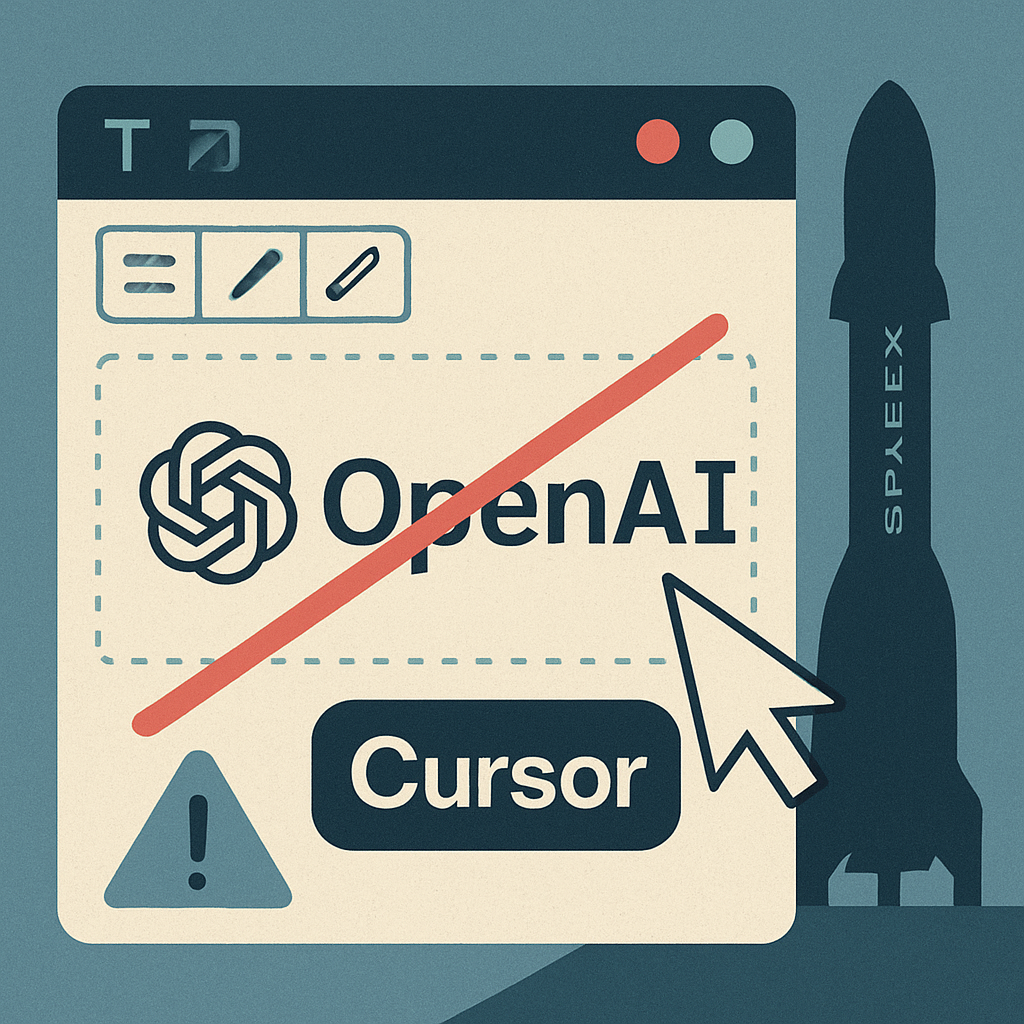
OpenAI has informed Cursor that it will end its supply of AI models by November 12, 2026, following SpaceX’s acquisition of Cursor’s parent company, Anysphere. The move is being made under a clause in their custom agreement that allows cuts in service after a change in control. Until that date, existing models will continue operating within Cursor, but no new models will be provided.
The company described the decision as “incredibly tough,” explaining that it lacks confidence that SpaceX will adhere to OpenAI’s terms of service. Though this isn’t an allegation of wrongdoing by Cursor itself, OpenAI cited past incidents involving some of Elon Musk’s firms—including violations of contractual terms after the acquisition of Twitter and admissions under oath that xAI breached OpenAI’s usage policies.
The catalyst for the decision was SpaceX’s roughly $60 billion purchase of Anysphere, which enabled OpenAI to invoke its option to withdraw model access. OpenAI froze future model supply—including its latest model, Astra—shortly after the acquisition closed, while allowing current models to continue until mid-November.
What Step Down Means for Cursor Users
Cursor users will still have access to models from Anthropic, Google, and SpaceXAI—so the November deadline affects only the OpenAI integration. After that date, any developers depending on OpenAI’s models inside Cursor will need to seek alternate models, use a different code editor that supports them, or rely on their own OpenAI API keys if Cursor’s policies permit.
For enterprises using Cursor as a sanctioned channel to access OpenAI tools, the shutdown presents both technical and compliance challenges. They’ll have to rethink their logs, data handling, contractual policy alignment, and model performance across whatever substitutes they adopt.
Safety, Contractual Trust, and the Role of Astra
Astra’s enhancements—especially in cybersecurity and agentic coding—are central to OpenAI’s concerns. Internal evaluations suggest Astra has crossed into capabilities that raise risks related to zero-day exploits and novel automated攻击s. OpenAI argues that once Astra becomes part of a coding environment owned by a potentially conflicting entity, it becomes difficult to ensure those risks are managed under its safety framework.
OpenAI emphasized that its decision is driven by safety and risk controls, not purely competition. It asserts that large partners are held to strict custom contract standards to uphold OpenAI’s terms of service at scale. When those partners change ownership—especially to one under an umbrella that already contains entities with noted conflicts—OpenAI sees limited options but to revoke model access.
OpenAI has worked with the Cursor team for nearly four years and says it respects the collaboration. It plans to support developers through the transition period but warns that after November 12, existing integrations using OpenAI models will no longer operate seamlessly unless alternative arrangements are made.
Why this move matters:It underscores how major AI providers are increasingly treating ownership changes and past behavior—not just violations—as triggers for access control. OpenAI’s choice reflects a broader tension in the AI ecosystem between distributing powerful models and retaining control over how and by whom those models are used. For developers and companies dependent on these tools, this signals that contracts, corporate structure, and ownership matter as much as technical specs. Moving forward, expect more scrutiny over acquisitions—not just for business or antitrust concerns, but for how they shift trust relationships in AI supply chains.