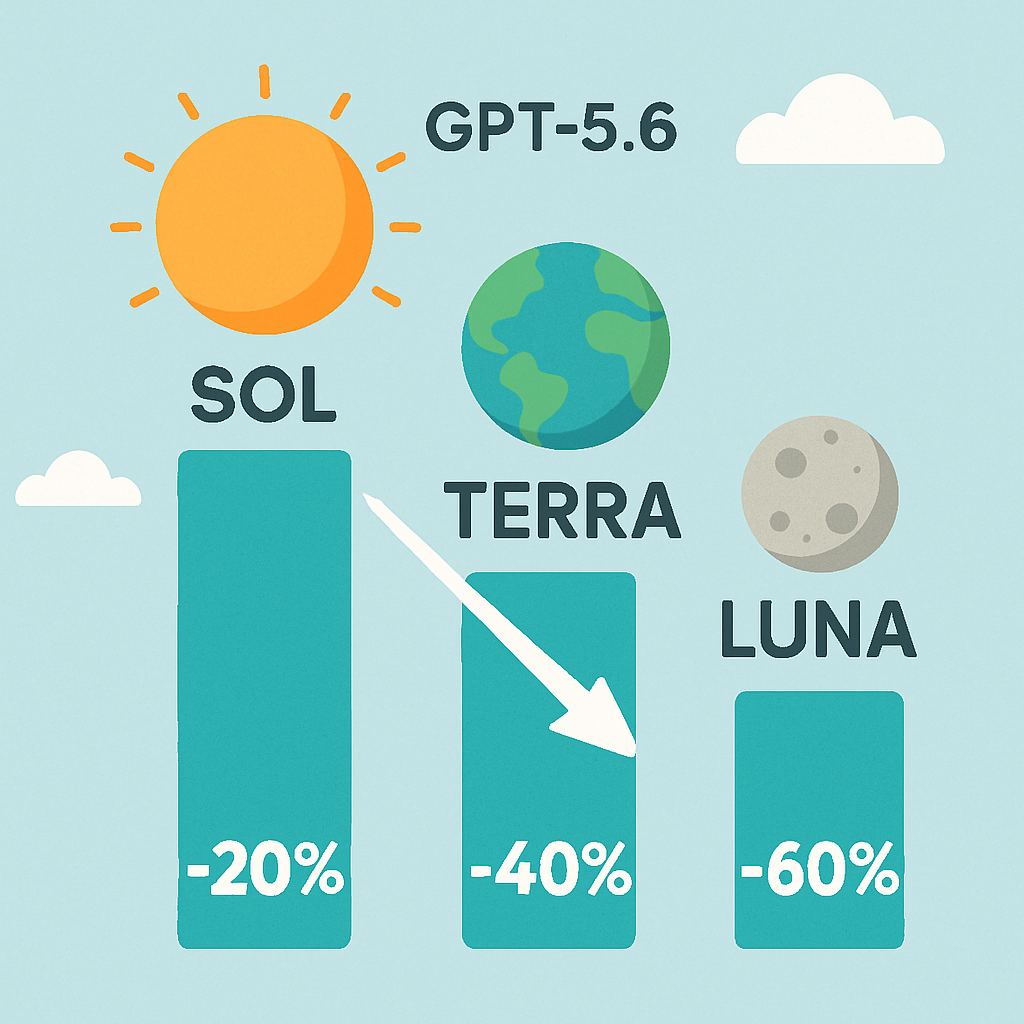
OpenAI has announced significant price reductions for two of its GPT-5.6 models, Terra and Luna, aiming to make advanced AI capabilities more accessible to a broader audience. This move comes shortly after the models’ initial release, reflecting OpenAI’s commitment to optimizing efficiency and affordability.
The GPT-5.6 lineup comprises three tiers: Sol, Terra, and Luna. Sol serves as the flagship model, offering the highest performance at a premium price point. Terra is designed as a balanced model suitable for everyday tasks, while Luna provides a cost-effective solution for users requiring faster, more affordable AI interactions.
Effective immediately, the pricing adjustments are as follows:
- Terra: Reduced by 20%, now priced at $2 per million input tokens and $12 per million output tokens.
- Luna: Reduced by 80%, now priced at $0.20 per million input tokens and $1.20 per million output tokens.
These reductions are not limited to API customers. Users of ChatGPT Work and Codex will also benefit, as OpenAI has adjusted token usage calculations for Terra and Luna models. This means subscribers can perform more tasks before reaching usage limits, enhancing the value of their subscriptions.
OpenAI’s decision to lower prices so soon after the models’ release underscores the company’s focus on delivering more computational intelligence per dollar. By improving system efficiency, OpenAI positions itself competitively in the AI market, especially against rivals like Anthropic. This strategy reflects a growing industry trend where customers prioritize affordability alongside performance in AI services.
For users and developers, these price cuts open new possibilities for integrating advanced AI into various applications without prohibitive costs. As AI becomes increasingly integral to diverse sectors, such pricing strategies are crucial for widespread adoption and innovation.