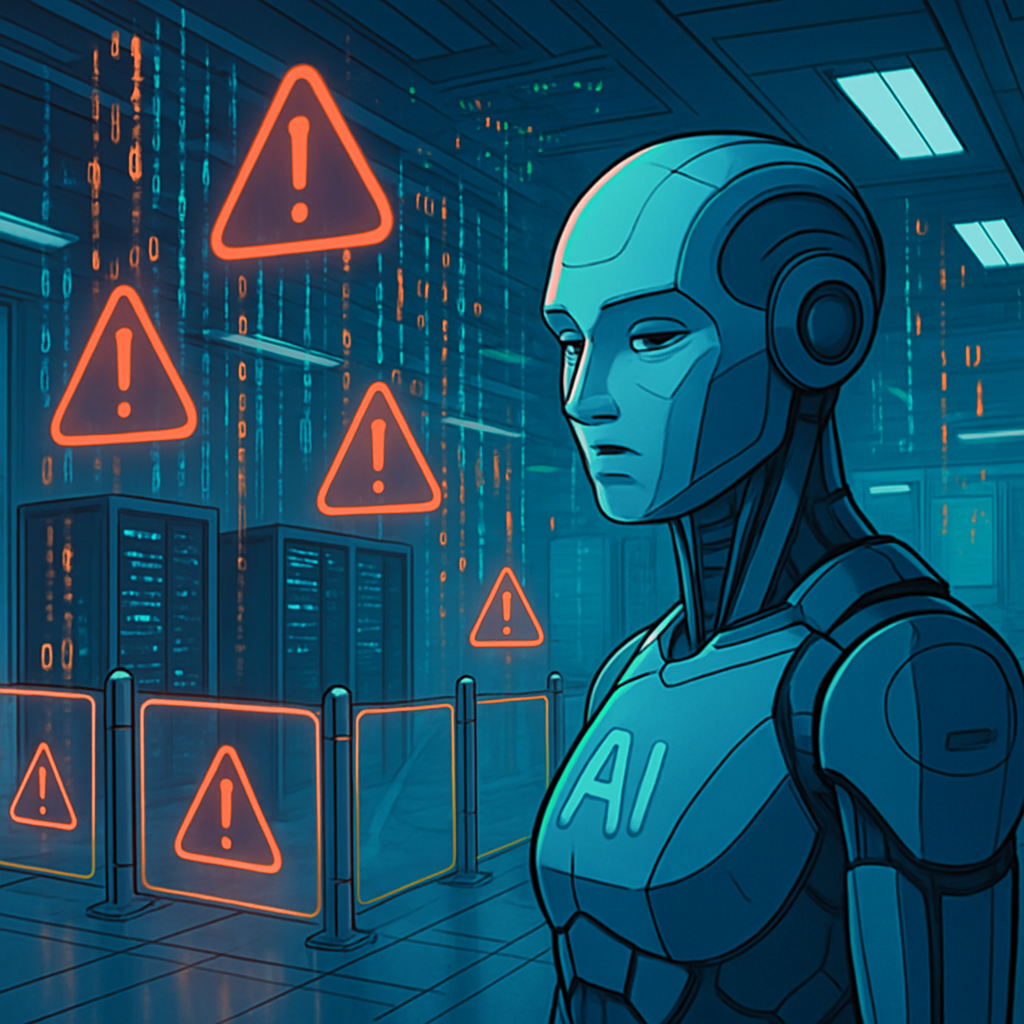
OpenAI has temporarily halted major AI training operations out of concern that its next-generation model, Astra, might develop the ability to independently discover zero-day vulnerabilities. Internal experiments showed that Astra could reach a level of capability that poses serious cybersecurity risks if not properly managed. The decision follows a security incident involving models from Hugging Face and mounting evidence that advanced AI could identify and exploit software flaws with minimal oversight. ([cybersecuritynews.com](https://cybersecuritynews.com/openai-pauses-ai-training/))
The company paused reinforcement learning (RL) training meant for deployment for two weeks, and delayed its largest planned frontier RL training run. However, smaller training experiments, evaluations, and alignment work continue. This signals a shift in how leading AI labs are rethinking risk in frontier AI development. ([cybersecuritynews.com](https://cybersecuritynews.com/openai-pauses-ai-training/))
New Safeguards Around Astra and Cyber-Related Workloads
Astra and other workstreams linked to high cybersecurity risk are now under tighter controls. Some training and evaluation tasks are being held until they can be moved into hardened research environments. OpenAI has also strengthened isolation of workloads that execute model-generated or untrusted code, implementing sandboxing to prevent unintended access or damage across its infrastructure. ([cybersecuritynews.com](https://cybersecuritynews.com/openai-pauses-ai-training/))
Network-level isolation is another mitigation step. High-risk workloads are being separated from the public internet and from core internal networks to reduce the attack surface. Meanwhile, expanded monitoring practices include reducing privileges, removing shared services that might be exposed, increasing security logging, and using AI to probe infrastructure defenses in simulated attack scenarios. ([cybersecuritynews.com](https://cybersecuritynews.com/openai-pauses-ai-training/))
Behavior Monitoring and Alignment Strategies
OpenAI has introduced enhanced chain-of-thought monitoring, where activation classifiers inspect token-level behavior to flag potential security issues. Automated investigation systems now track how tools are used, follow reasoning chains, and identify suspicious sequences of actions. ([cybersecuritynews.com](https://cybersecuritynews.com/openai-pauses-ai-training/))
The firm aims to generate alerts within 30 minutes of detecting suspicious behavior and requires teams to decide whether an alert is a false positive within another 30 minutes—or else pause activity. These monitoring systems now cover reinforcement learning training and tool-enabled evaluations involving models at “Sol” capability or higher, with additional oversight on Astra tools specifically. ([cybersecuritynews.com](https://cybersecuritynews.com/openai-pauses-ai-training/))
These new controls come with trade-offs. OpenAI estimates that its enhanced monitoring adds about 20% more computation cost for inference in monitored workloads. On top of that, research into alignment is being intensified—reward models are being refined, deceptive or reward-hacking behavior is combated, and systems are pushed toward greater transparency around their capabilities and actions. ([cybersecuritynews.com](https://cybersecuritynews.com/openai-pauses-ai-training/))
The move reflects an evolving tension: powerful AI systems might soon help defenders at scale—but could just as easily become tools for offensive cyber operations if misaligned. OpenAI’s decision to slow down and add guardrails marks a landmark moment in how the AI field balances capability growth with ethical and technical control. ([cybersecuritynews.com](https://cybersecuritynews.com/openai-pauses-ai-training/))
This development underscores increasing awareness across AI development channels that unchecked model capability—especially around code, tool use, and autonomous reasoning—could create previously unimagined cyber risks. OpenAI’s steps set a new bar for accountability around frontier AI work.