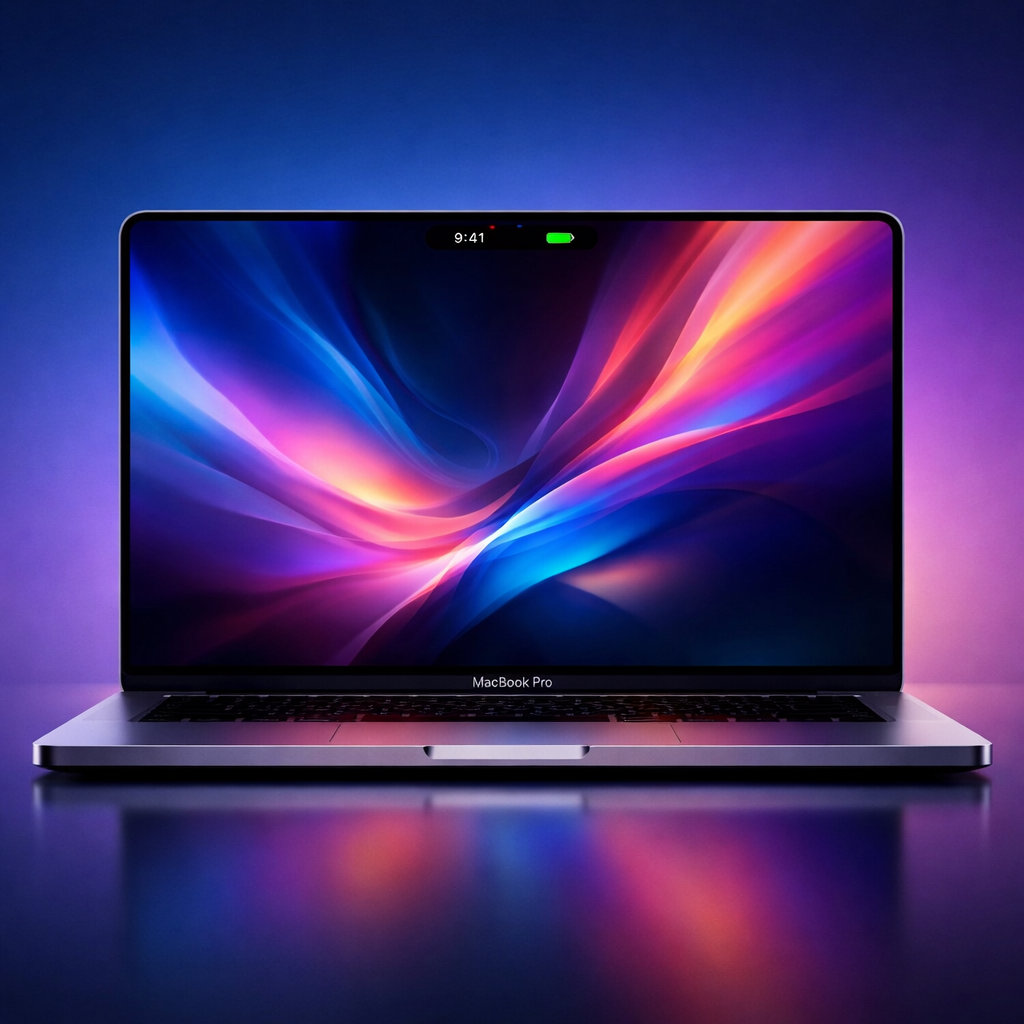
Apple looks poised to unveil a new MacBook Pro featuring a touchscreen OLED panel, possibly with M5 Pro or M5 Max chips, a redesign sans notch in favor of a Dynamic Island-style cutout, and a lighter chassis. Many of these features have been rumored for months, but just ahead of launch there’s still one big unanswered question: who is this machine actually aimed at?
Touchscreens, Tradition, and Troublesome Usability
Traditionally, Apple has rejected touchscreen laptops. Executives once dismissed the idea, saying the arm-raising interaction is fatiguing and that laptops are meant to be used with fingers resting near a trackpad, not poking at a screen. macOS is still optimized around a cursor, with window controls and menus that assume that precise input—hard to replicate with fingers.
Still, the rumor mill suggests this OLED MacBook Pro will be Apple’s first touch-enabled laptop. It may also be the first Mac to ditch the notch and embrace an iPhone-style Dynamic Island in its display. All exciting advances, yet there remains significant uncertainty about whether these changes will actually improve user experience—or simply introduce finger smudges and interface frustration.
OLED: Substantial Upgrade or Subtle Shift?
The switch to OLED is likely the headline feature. OLED brings deeper blacks, more vivid colors, faster response times—an upgrade that could significantly improve visual quality for media, design work, and video playback.
Yet Apple’s existing mini-LED MacBook Pros already deliver high brightness, excellent contrast, and strong color fidelity. For many users, especially those who don’t push content creation or color-critical work, the difference might feel incremental rather than transformative.
Performance, Price, and Positioning
Rumors don’t indicate upgrades to the processor beyond what’s already available in the current line-up; the M5 Pro and M5 Max chips are expected to carry over. That suggests this new model’s appeal hinges largely on its display, touch capability, and perhaps its aesthetic changes rather than raw performance gains.
With that in mind, there’s concern this machine could cost significantly more without offering dramatically more—unless Apple delivers some additional surprise features. The lack of major performance improvements and only modest hardware tweaks might make the price hard to justify for many potential buyers.
Interestingly, on the very day this OLED MacBook Pro is expected to be introduced, Apple released a new 14-inch MacBook Pro that still uses a non-OLED display. That move intensifies the question of how Apple will differentiate among its Pro line-up if OLED is only for the highest tier.
Who Might Care—and Why It Matters
For creatives—video editors, photographers, designers—OLED and touch could be compelling. Deeper contrast, richer color, more accurate visuals, plus a more interactive display might enhance workflows. But for everyday users, especially those who already have a recent mini-LED Pro or even a non-Pro MacBook, the benefits may not outweigh the drawbacks.
If Apple is going to launch this OLED MacBook Pro as a niche model, it needs a strong “why”—not just “because OLED exists now.” Otherwise, this machine risks being a premium curiosity instead of a practical upgrade.
It’s possible Apple already has something surprising up its sleeve—features that haven’t yet leaked and that would change this discussion. But absent that, this upcoming MacBook Pro looks like a gamble: bold in display tech, conservative in other hardware, and ambiguous in user benefit. What it really needs is justification. Are creatives feeling underserved or is this pushing a product into limbo? That’s what we’ll find out—and what everyone’s asking, quietly: “y tho?”