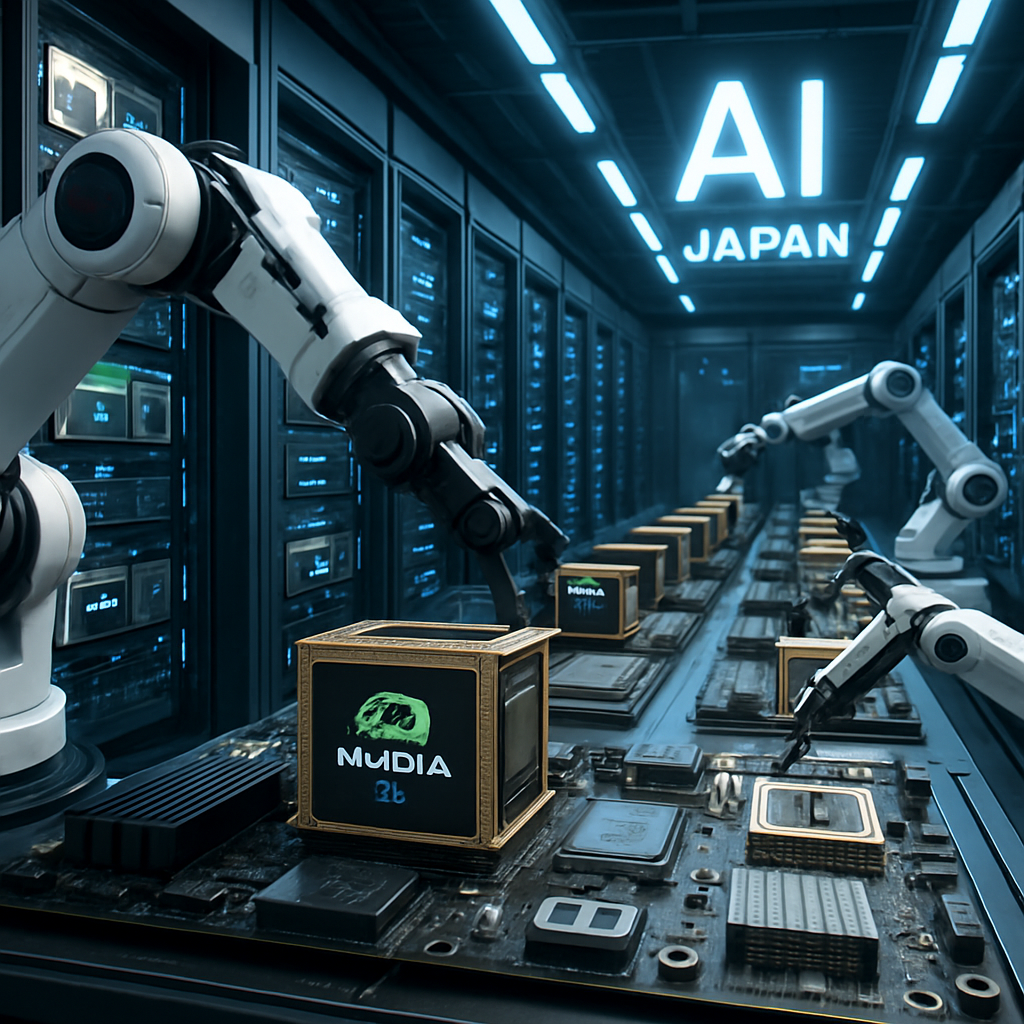
Nvidia CEO Jensen Huang recently concluded a two-day visit to Tokyo, where he engaged with Japan’s industrial and semiconductor leaders to forge significant partnerships aimed at advancing artificial intelligence (AI) integration across various sectors.
One of the key outcomes of Huang’s visit is the collaboration between Nvidia and Japan’s Noetra Corp. to establish a 140-megawatt AI facility named the FRONTia project. This state-funded initiative will be powered by 27,500 Nvidia Rubin GPUs and 13,750 Vera CPUs, forming the backbone of Japan’s national AI infrastructure. The facility is designed to support the country’s ambitions in AI-driven manufacturing, robotics, and automation. The system will consist of 382 Vera Rubin NVL72 racks, utilizing Nvidia’s DSX platform and Spectrum-X Ethernet. The estimated hardware costs for this project range from $1.9 to $2.7 billion. Noetra, a consortium backed by companies such as SoftBank, Sony, NEC, and Honda, will oversee the project alongside Japan’s National Institute of Advanced Industrial Science and Technology (AIST). The consortium has secured a first-year budget of ¥387.3 billion ($2.4 billion), with potential five-year funding reaching up to ¥1 trillion ($6.1 billion). The development roadmap includes launching a reasoning AI model in 2026, an omni-modal AI by 2028, and a spatially aware “real-world native AI” by 2030. This initiative marks Japan’s first state-funded national AI infrastructure and aligns with the country’s 2040 goal of capturing over 30% of the global AI robotics market, valued at $133 billion.
In addition to the FRONTia project, Nvidia is collaborating with Fujitsu and leading Japanese robotics manufacturers—Fanuc, Yaskawa Electric, and Kawasaki Heavy Industries—to develop “physical AI.” This technology focuses on creating autonomous, intelligent robots capable of working safely alongside humans in environments such as factories, hospitals, and homes. The initiative aims to address Japan’s severe labor shortage amid its aging population. The collaboration builds upon a previously established deal between Fujitsu and Nvidia. While concrete timelines or plans for a joint venture have yet to be announced, the first phase of the collaboration is expected to begin later this year. Japan is pursuing a national strategy to invest over 370 trillion yen ($2.3 trillion) in technologies such as AI, semiconductors, and data centers by 2040, under the leadership of Prime Minister Sanae Takaichi. Nvidia is already engaged in various partnerships across Japanese industries, strengthening its presence in the country.
Huang’s visit also included a notable gathering in Tokyo’s Kanda district, where he met with executives from key Japanese semiconductor materials and components companies, including Kioxia Holdings Corp., Shin-Etsu Chemical Co., Tokyo Electron Ltd., and Ajinomoto Co. This informal meeting, held at a local izakaya, underscored Nvidia’s commitment to deepening ties with Japan’s chip industry leaders and highlighted the importance of collaboration in the AI supply chain.
These developments signify a strategic alignment between Nvidia and Japan’s industrial giants to drive the next phase of AI integration into the physical world. By combining Nvidia’s technological expertise with Japan’s manufacturing prowess, these partnerships aim to position Japan at the forefront of the AI-driven industrial revolution. As these initiatives progress, they have the potential to reshape industries and address critical societal challenges, such as labor shortages and an aging population, through advanced AI and robotics solutions.