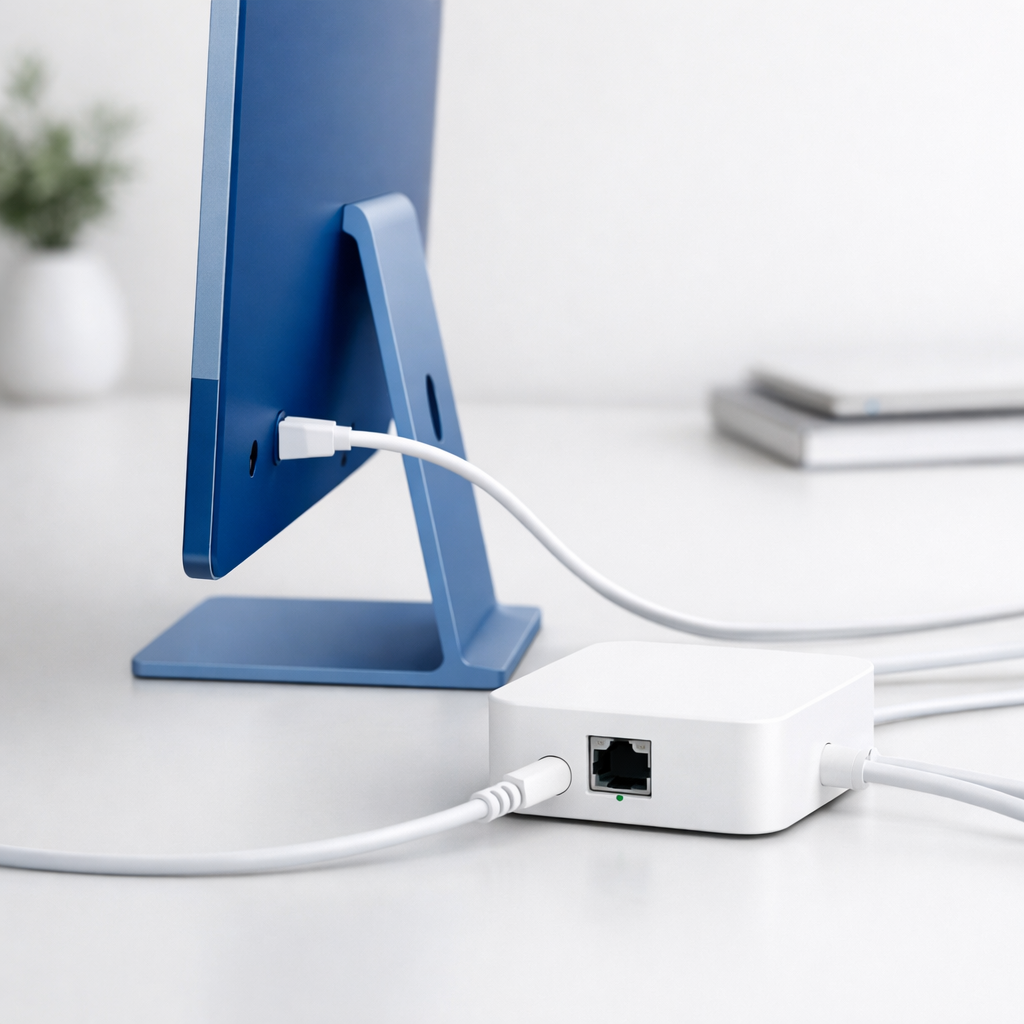
Apple has quietly upgraded its 24-inch iMac with a new 2.5 Gigabit Ethernet option, tucked not in the rear ports, but built directly into the power adapter. This change enhances wired networking performance significantly compared to the previous generation’s 1 Gigabit Ethernet. It’s available as a $30 upgrade on the entry-level model and is included by default with the higher-end configuration.
What’s New
The latest iMac runs on Apple’s M6 chip, with improvements across Wi-Fi, Bluetooth, and SSD performance. Among the connectivity upgrades is this faster Ethernet option — a multi-gig alternative to the traditional 1 Gbps wired port.
However, the 2.5Gb upgrade is not universal across all models. It’s standard only with the version that includes a 12-core CPU and GPU. The lower-end version, which uses a 10-core CPU and GPU, does not include this by default and only gets access to the faster Ethernet if selected at purchase.
Design & Configuration Differences
Apple follows its previous practice of integrating the Ethernet port into the power brick — a power adapter that doubles as part of the network connection. This avoids cluttered rear cable ports and keeps the iMac’s slim profile cleaner. For models configured with the four-port layout, the power adapter always has Ethernet built-in. For two-port models, Ethernet in the power adapter is optional and must be chosen at time of purchase; it cannot be added later. A USB-C to Ethernet adapter remains the only upgrade path for networking after purchase on models without integrated Ethernet in the power supply.
Pricing for the new iMac lineup begins at US$1,499 for the 10-core configuration, while the 12-core model, which includes the 2.5Gb Ethernet, starts at US$1,699. Pre-orders open October 28, with shipments and in-store availability starting November 6. Seven color options remain: blue, green, pink, yellow, purple, orange, and silver.
Other tech improvements include support for Wi-Fi 7 and Bluetooth 6, more than double the SSD read and write speeds of its predecessor, and the option for up to four Thunderbolt 4 ports. These specs combine to make the iMac better suited for heavier workflows — from creative tasks to on-device AI and multitasking.
One legacy feature carried over: the Retina 4.5K display, matching what Apple previously offered, along with its striking finishes and design.
Why this matters: upgrading to 2.5Gb Ethernet makes a tangible difference for users with fast local networks—photographers, video editors, developers—especially those moving large files. It signals Apple’s shift toward multi-gig wired networking, even as wireless improves.