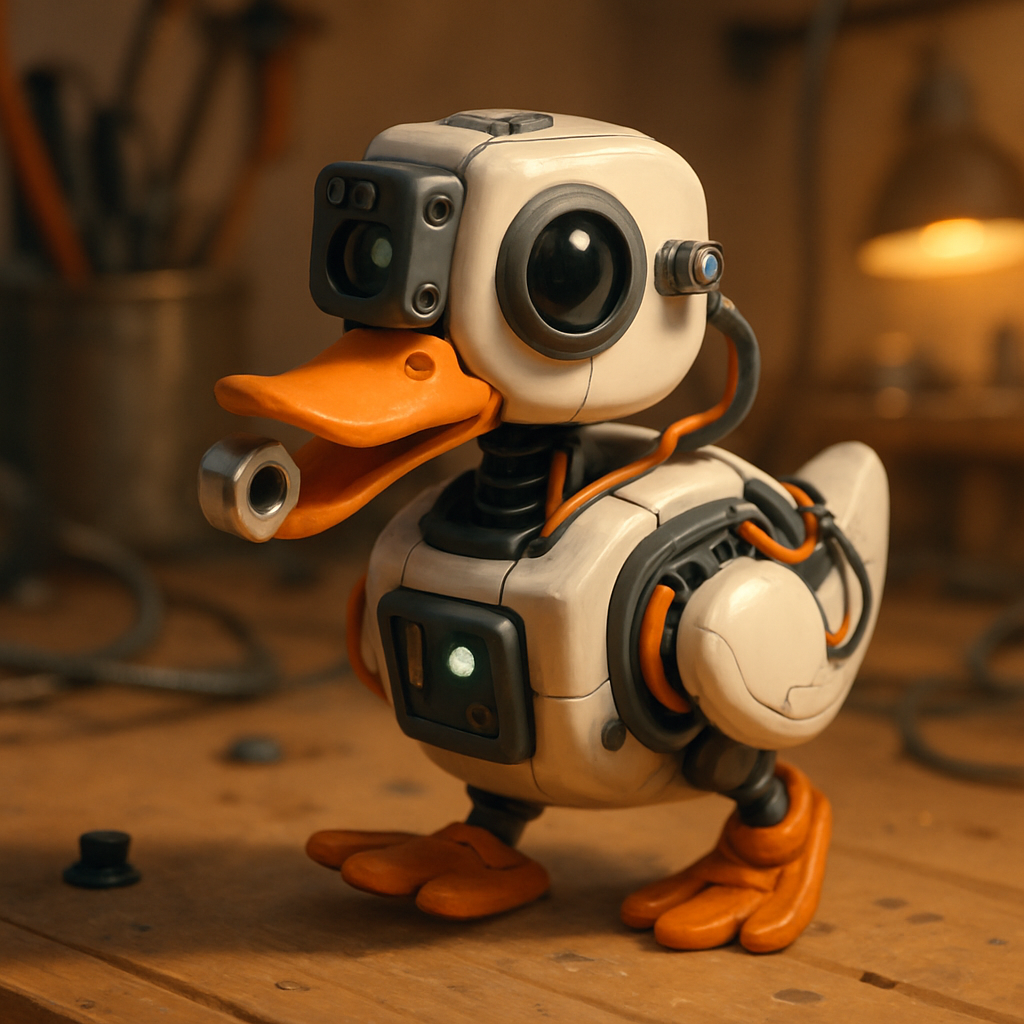
Hugging Face is rolling out Microduck, a duck-inspired robot you can program, for $399. The 25-centimeter tall bot waddles, picks up objects with its beak (up to 800 grams), gets back up when it falls, crouches, even roller-skates — all while being fully open source. It launches ahead of the holiday season.
Hardware and Capabilities
Microduck comes equipped with a camera, lidar sensors, and two inertial measurement units (IMUs) to understand its orientation and movement. Its design supports reinforcement learning: developers can train behaviors in simulation and deploy models directly onto the robot. Then they’re free to tweak or retrain and repeat. Its software dev kit, sim tools, and the full reinforcement learning training stack are published on GitHub.
This is Hugging Face’s latest in hardware since acquiring French robotics outfit Pollen Robotics in April 2025. That acquisition led to robots like Reachy Mini, a desktop robotic platform, and the slightly less expensive Reachy Mini Lite. Microduck takes a different form factor while maintaining the same ethos of affordability and openness.
Privacy, Openness, and the Bigger Picture
Because it’s built around open-source models, Microduck offers more visibility than closed systems when it comes to how its cameras, sensors, and software behave. That said, once third-party apps are added, they could still access its camera or mic and transmit data. Openness helps auditing, but data privacy still depends on how the software around it is built.
The launch of Microduck also takes place amid rumors that Hugging Face is being acquired by Nvidia for around $13 billion. The two companies have a long history together: Nvidia has supported Hugging Face’s infrastructure since at least 2023, and both have aligned on promoting open-source AI.
With its duck-like design and open-ended possibilities, Microduck shows how the robotics space is evolving from static objects to dynamic platforms for experimentation. Behind the quacks and waddles, there’s serious intent.
This isn’t just a novelty robot; it’s part of a shift toward robots that hobbyists, researchers, and makers can shape themselves — from the sensors to the code. As robotics becomes more accessible, Microduck could become a teaching tool, a research assistant, or simply a playful companion with smarts. What matters now is how the open ecosystem around it develops — who contributes, what behaviors people build, and how securely those contributions are shared.