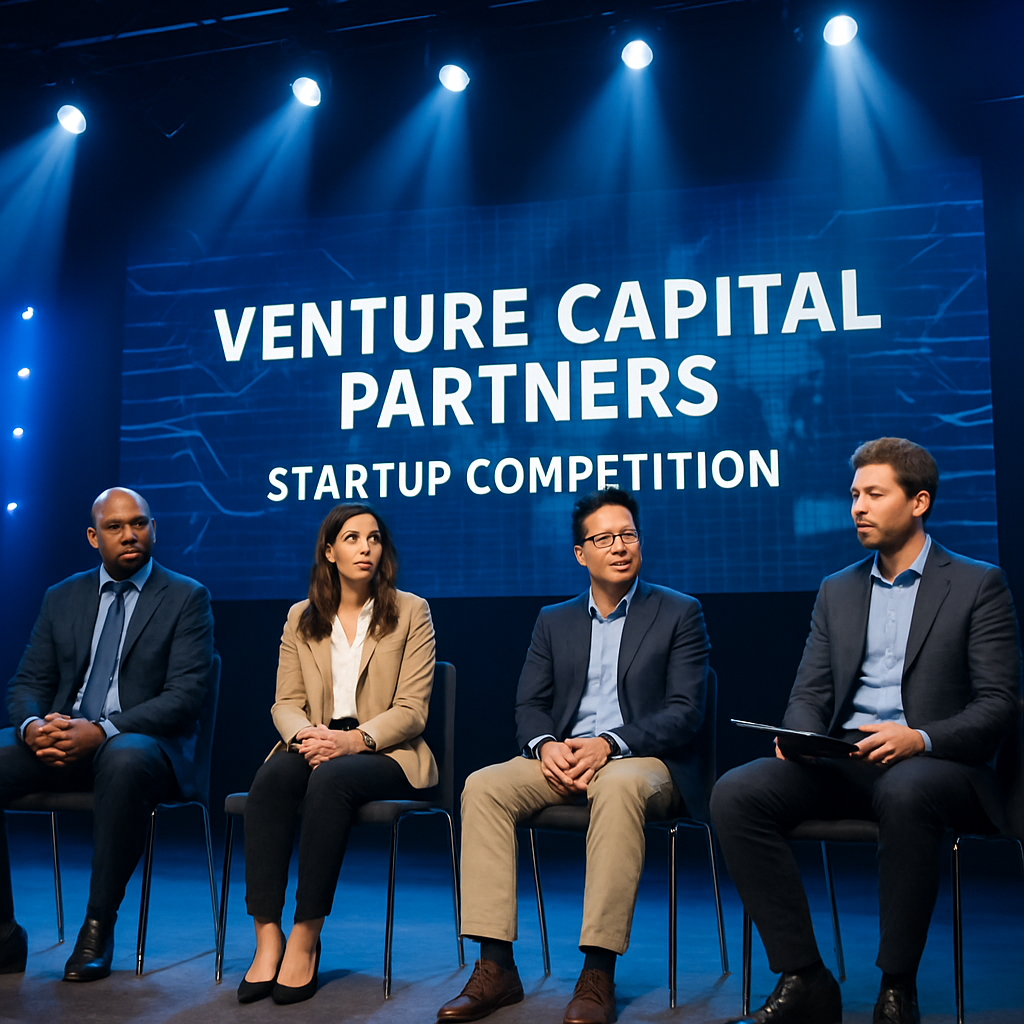
Disrupt 2026 is just around the corner. After sorting through thousands of applications and multiple review rounds, the Startup Battlefield 200 teams are set to take the stage in San Francisco, showcasing innovations and vying for a $100,000 equity-free prize and the prestigious Disrupt Cup. A key piece of that competition: the judging panel. Five seasoned investors have just joined the roster to help pick the finalists — and potentially the winner. Here’s a look at the newest judges and what they bring to the table.
Profiles of the New Judges
Caleb Appleton (Partner, Bison Ventures)
Appleton, a biomedical engineer by training, invests in companies at the intersection of physical AI, robotics, techbio, and real-world intelligence. His portfolio includes startups like Cobot, Vivodyne, Passkey, Sleuth, Inner Logic, Cosmon, and Grid Aero. Previously, he worked at Innovation Endeavors in frontier tech and spent several years as an operator with TuneIn, giving him both technical and operational expertise across early-stage science ventures.
Sara Deshpande (General Partner, Maven Ventures)
Deshpande joined Maven in 2014 as employee number one and has since focused on seed-stage startups that tap into emerging consumer behaviors. She specializes in consumer software, with a special interest in digital health and consumer AI applications. Alongside her work in venture capital, she teaches a course on startups and entrepreneurship at Stanford.
Aatish Nayak (Partner, Kleiner Perkins)
Since joining Kleiner Perkins as a partner in May 2026, Nayak has concentrated on AI-native founders who combine deep domain expertise with technical depth. Before this, he played key roles at Harvey (covering product, design, analytics, marketing, and support), Scale AI (building data infrastructure for e-commerce and NLP), and Shield AI (working on robotics and defense systems).
Jason Risch (Partner, Greylock)
Risch’s investment interests span enterprise security, AI/ML infrastructure, data platforms, and developer tools. His portfolio includes Onehouse (a lakehouse platform) and Baseten (ML model serving for data teams). Before Greylock, he gained experience in operations at Opendoor, consulting work at McKinsey in the Bay Area, and startup building at AI Fund. He holds a degree in Mathematical and Computational Science.
Mark Xu (Partner, Index Ventures)
Xu invests across stages in cybersecurity, infrastructure, and AI, particularly in companies led by technically strong founders with domain knowledge. He’s backed firms including Fireworks, Parallel, 7AI, Simile, and Flapping Airplanes. Before Index Ventures, Xu was involved in growth investments at Lightspeed, supporting companies like Wiz, Glean, and Grafana.
What to Expect at Disrupt
The Startup Battlefield 200 event runs October 13-15 at Moscone West in San Francisco. Over those days, founders will present their ideas to this expanded panel. After rounds of judging, a handful will advance to pitch live in front of thousands — including investors, media, and tech leaders.
This year’s judges bring diverse specialties: AI, robotics, biotech, data platforms, cybersecurity, and consumer software. Their varied backgrounds suggest the Battlefield finals will favor startups that combine deep tech with real-world applications — those that are not just disruptive in concept, but also grounded in domain expertise.
Why This Matters: With the judging panel nearly complete, including these five additions, it’s clearer what kind of startups will stand out at Disrupt 2026. If you’re on the stage, emphasize technical merit, vertical knowledge, and product traction. And for observers, this year promises a sharp display of what peer-voted innovation looks like in action — we’re likely to see more founders leveraging AI and domain specialization than broad plays.