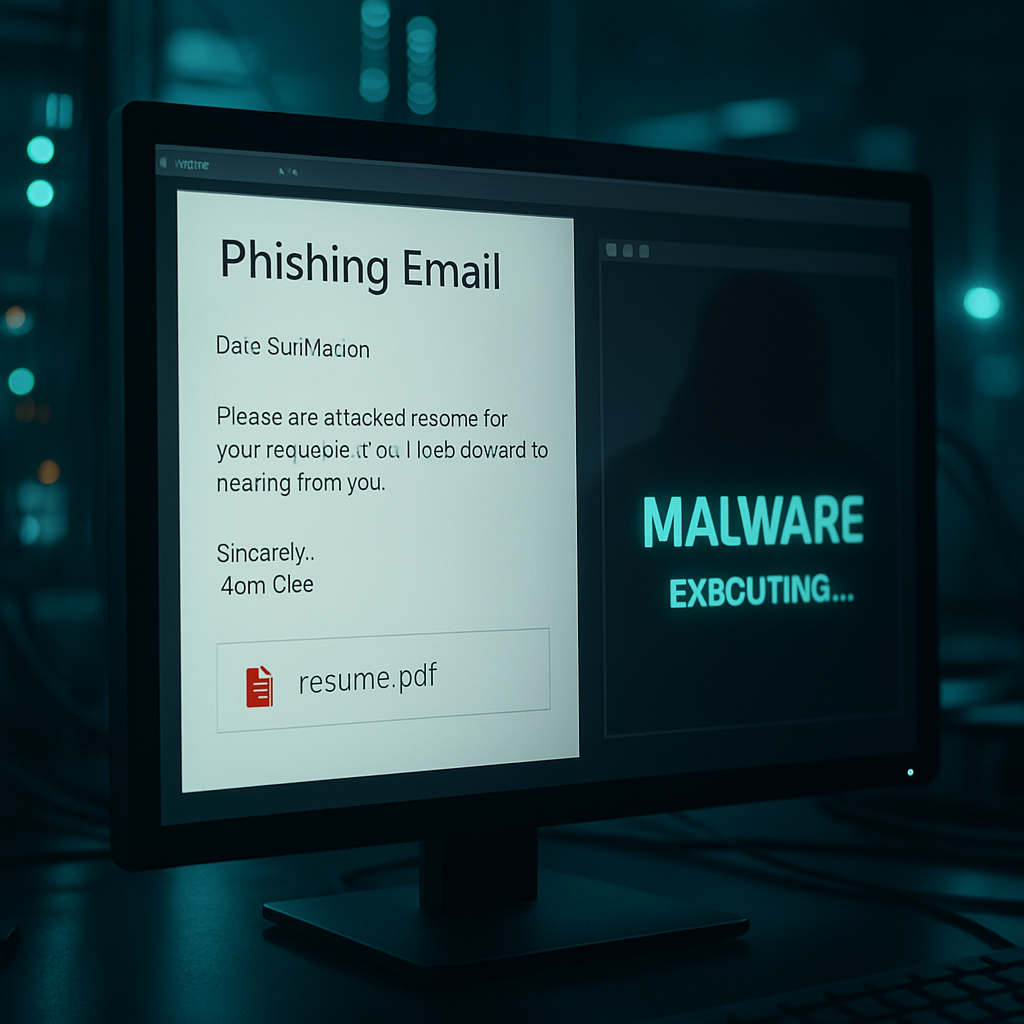
Cybersecurity researchers have uncovered a sophisticated phishing campaign targeting academics using a fake resume to secretly infiltrate Windows machines. An attacker sends an email posing as a recent graduate from the Beijing Institute of Technology, claiming expertise in electrical engineering, energy systems, and applied AI. Attached is a ZIP file containing what appears to be a student’s resume and supporting documents. In reality, the archive holds a remote access tool (RAT) hidden behind a decoy Word resume. The malicious executable runs in the background while the reader views the genuine-looking document. SNOWLIGHT and VShell are the two key payloads in use. SNOWLIGHT initiates the infection and delivers the encrypted shellcode in memory. Once decoded, it hands control over to VShell, which completes the remote-access connection. Capabilities include command shell access, file transfers, screen capture, network reconnaissance, and tunneling. While the exact attacker identity remains unknown, the campaign appears to be tailored toward researchers in mainland China.
How the Attack Works
The ZIP file is designed to look like it came from a graduate named “Zhang Yuguang,” with majors in network engineering—an effort to seem legitimate to academic recipients. The executable in the archive is disguised using naming tricks and leverages the fact that Windows by default hides file extensions.
When the target opens the archive, a loader executes and does two things: it launches a real DOCX resume so the victim sees something familiar, and it also checks for indicators of a sandbox or low-powered system (e.g., fewer than four CPU cores) to avoid detection or analysis. If the system passes these checks and a timing test, the loader proceeds with the infection chain.
Capabilities and Reach
The infection begins with SNOWLIGHT contacting a command-and-control (C2) server. After a short system check-in, the attacker sends down a ~4.65 MB payload containing VShell. That payload gets decrypted and loaded into memory, avoiding writing files to disk—a technique that evades many security tools. Once up and running, VShell maintains a hidden connection to the C2 server via encrypted traffic.
Thus far, analysts haven’t observed active remote sessions or data exfiltration—only that VShell is fully installed and ready. The tools have been tied to wider campaigns and clusters using similar frameworks, but no specific group or nation-state has been confirmed to be behind this precise operation.
Defending Against These Academic Phishing Lures
Academics and institution IT teams are being advised to treat incoming applications with caution—even ones that appear scholarly. Best practices include verifying credentials through separate channels, enabling visible file extensions, blocking executables in unexpected archives, and monitoring for unusual outbound connections or unexpected processes that begin command shells. Specific indicators of compromise (IoCs) have already been published, including malicious archive names and SHA-256 hashes for key components of the attack all the way down to the decoy DOCX file. Also flagged are certain IP addresses used in the command-and-control chain and encrypted shellcode staging.
In many ways, this attack is an evolution of traditional resume-themed malware campaigns, which have long exploited recruitment or academic submission workflows. But this one ups the ante with fileless techniques and academic-themed content, making it harder to spot for those predisposed to opening resumes and applications.
What this incident teaches us is that researchers are increasingly leaning into remote collaboration and open dialogue—which is good—but that also gives attackers more surface area to imitate.
IT environments at universities may lag behind corporate counterparts in their use of stronger controls. What to watch next: whether this method spreads to other research fields or geographic regions, and whether attribution emerges with solid evidence of ties to state or criminal actors. Institutions should invest in threat intelligence and behavioral detection, not just signature-based security.