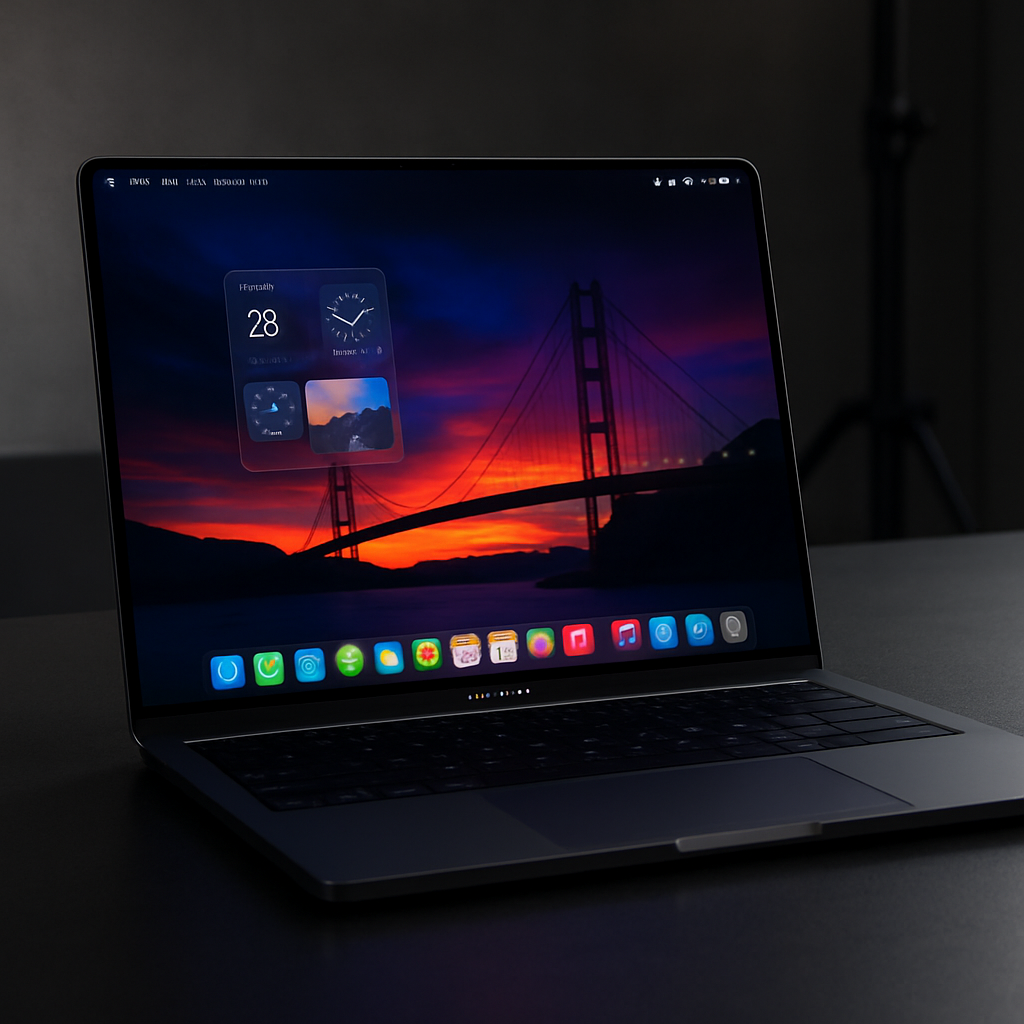
Developers exploring the macOS Golden Gate beta have noticed that “Liquid Glass” interface elements—the translucent, layered-glass visual effects—look dramatically more vivid and enhanced on HDR-capable OLED displays compared to traditional panels. These visual tweaks suggest Apple is optimizing Golden Gate for a new generation of OLED MacBooks, expected to arrive in early 2027.
This revelation comes via developer Steven Troughton-Smith, who observed the changes while testing on high-end OLED hardware. Interface components such as menus, windows, and overlays exhibit more vibrant translucency and deeper contrast when HDR is enabled, boosting clarity and richness. These enhancements, however, aren’t as noticeable on non-HDR or standard display types.
What This Signals About Upcoming MacBook Pro Models
Apple has long teased MacBook Pro refreshes, possibly under the name “MacBook Ultra,” featuring OLED displays. Analysts and supply-chain leaks point toward a launch around early 2027. The current Golden Gate beta appears to be laying groundwork for these devices by ensuring UI fidelity and polish that matches OLED strengths, like high contrast ratios and deeper blacks.
Developers implementing the Liquid Glass style in Golden Gate are likely testing for features that harness HDR’s potential—richness, color depth, and visual layering—that OLED panels deliver especially well. The system’s design language is thus being refined in anticipation of hardware that can fully support it.
Golden Gate’s Liquid Glass: What’s New
Previously, Liquid Glass effects on Apple’s platforms supplemented depth and dimension using transparency and blur. In Golden Gate with HDR support, these effects are dialed up: ambient glow, more pronounced layering, and a renewed sense of depth are more perceptible. The changes span system-wide UI components rather than isolated apps, pointing toward a cohesive visual overhaul across macOS.
While HDR OLED panels are where the improvements shine most, users with standard displays can still use Golden Gate—but the enhanced visual effects are muted or missing where HDR isn’t supported.
Apple is expected to officially introduce its next MacBook models, likely MacBook Pro or MacBook Ultra, early in 2027. OLED screen tech, coupled with Golden Gate’s UI refinements, could be a defining feature set intended to refresh the MacBook lineup. OLED panels offer advantages like better contrast, faster response times, potentially thinner designs, and improved power efficiency in certain scenarios.
What this means: The Liquid Glass enhancements in Golden Gate confirm one of the macOS beta’s most vivid visual changes is being optimized for OLED HDR displays—strong evidence that Apple is preparing new hardware with these specs. These visual effects are likely to set a new baseline for future Macs.
Analysis: These observations around Golden Gate’s Liquid Glass effects are more than just cosmetic—they’re a strong clue to Apple’s hardware direction. By tuning the UI for HDR OLED displays, Apple is investing in experiences that demand higher contrast, true blacks, and dynamic range. For users, it means that upcoming MacBooks won’t just have brighter displays—they’ll feel distinctly more premium in their visuals and may edge out competitors. Keep an eye on rumors around display specs, HDR capability, and what Apple calls the next MacBook Pro or Ultra in the coming months to see how these visual cues translate to real products.