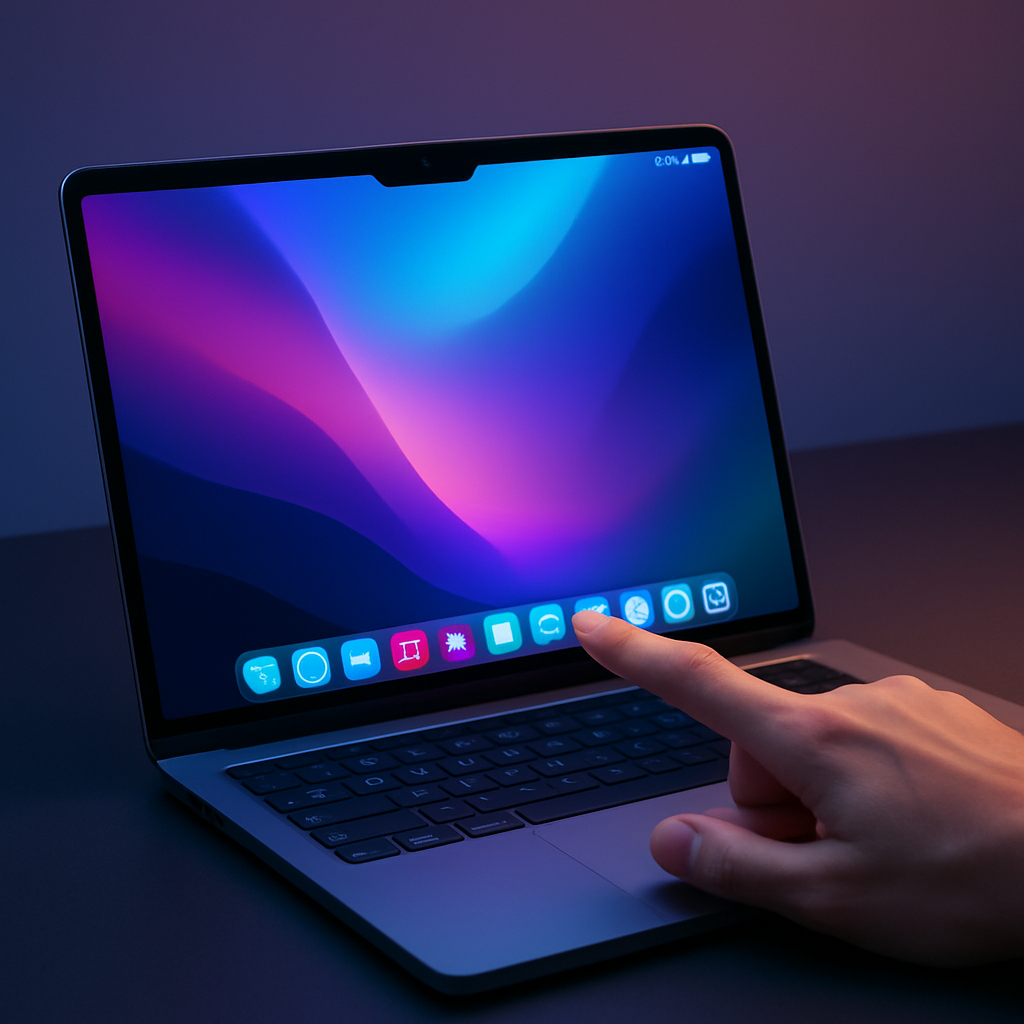
Apple’s latest macOS 27.2 developer beta, released this week, offers fresh clues that a touchscreen MacBook is close to reality. Visual hints that were once confined to iOS and iPadOS are now surfacing on macOS, suggesting gesture-based input could finally make its way into a MacBook lineup.
Touch-triggered animations make their way to macOS
In the third developer beta of macOS 27.2, long-pressing an app icon in the Dock causes it to slightly enlarge—mirroring the animation behavior seen when pressing icons on iPhones or iPads. This small interaction isn’t just decorative: it aligns with expectations for touch support on macOS. Other touch-style gestures have also shown up in this beta, reinforcing the idea that Apple is preparing macOS Golden Gate for capacitive input.
What the rumored touchscreen MacBook could look like
Sources anticipate that Apple will debut higher-end 14-inch and 16-inch MacBook Pro models—or possibly a new “MacBook Ultra”—featuring an OLED touchscreen later this fall. These models are rumored to include the upcoming M5 Pro and M5 Max chips, a thinner and lighter body, and a Dynamic Island cutout. There’s also speculation about built-in cellular connectivity, potentially enabled by Apple’s C1X or C2 modem hardware.
Why this matters
Touchscreens have long been among the most requested features missing from Apple’s MacBook line. For years, the company has kept input methods for Mac distinct from iPhones and iPads. If macOS 27.2 is any indication, Apple may finally be breaking that barrier—bringing touch input to the Mac without compromising the trackpad and keyboard approach.
This shift would also represent a major convergence in hardware and software. It could blur the traditional lines between macOS and iPadOS, bringing new opportunities for developers to build hybrid apps and streamline workflows. It would be the most significant MacBook redesign since Apple moved its laptops to its own silicon.
Keep an eye on Apple’s October-November product cycle: if recent software clues are any indication, the Cupertino company might launch these touchscreen Macs then. What to watch for: official headset visuals of gestures in macOS Golden Gate, parts supplier leaks pointing to OLED panels, and shipments of M5 Pro/Max chips ramping up.
Analysis: The inclusion of touch feedback in macOS gestures is more than cosmetic—it’s Apple’s way of testing how natural touch interaction feels on the Mac. Expect the company to refine gesture latency, responsiveness, and UI scaling leading up to launch. For end users, the big question will be whether touch input enhances or complicates Mac productivity. If done well, it could finally address a long-standing blind spot in Apple’s laptop portfolio; if done poorly, it could feel tacked on. Interface cohesion across devices is the ultimate goal—and macOS 27.2 appears to be laying the groundwork.