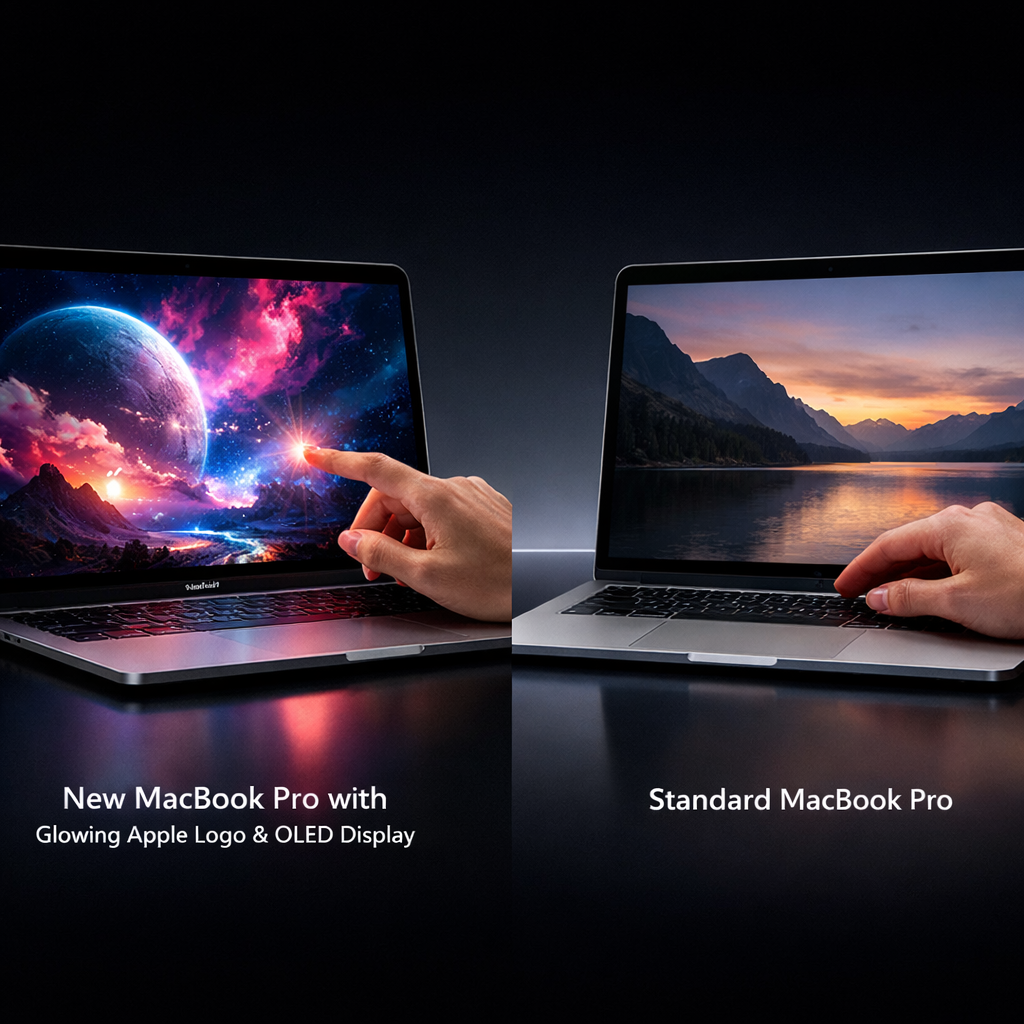
Apple’s new MacBook Pro with PROLED XDR Display brings a slew of upgrades over the existing MacBook Pro lineup, while retaining many of the core features that power users appreciate. Here’s a full breakdown of what’s new, what’s familiar, and whether the added price tag is worth it.
Design and Display Enhancements
The PROLED XDR model introduces a revamped industrial design—the first major redesign since 2021. It offers slight size tweaks: the 14-inch version retains the same display diagonal, while the 16-inch model grows to 16.3 inches, marginally larger than the standard 16.2-inch model. Notably, the PROLED XDR is thinner and lighter: the 14-inch version drops about half a pound in weight, and the 16-inch sheds nearly three-quarters of a pound. The lid features Apple’s return of the glowing logo, paired with an updated hinge for more stability.
One of the biggest changes is in display tech. Moving from mini-LED to tandem OLED, the PROLED XDR delivers deeper blacks, richer color, peak brightness up to 2,000 nits (up from 1,600), and introduces touch support—a first for a MacBook Pro, enabled by macOS 27 optimizations. The notch is gone; in its place is the Dynamic Island, used for Spotlight, Live Activities, Siri AI, and more.
Performance, Memory, Storage, and More
Under the hood, the PROLED XDR shares the same M5 Pro and M5 Max chips as the standard MacBook Pro models. Memory configurations are identical: M5 Pro starts at 24GB (going up to 64GB), while the M5 Max begins at 36GB with a ceiling of 128GB for high-end setups. Thus, general computing and graphics performance are expected to be comparable, though thermal behavior under sustained load may differ due to the slimmer chassis.
Storage options are mostly carried over, except for one new addition: a 16TB SSD when pairing with the M5 Max. Previously, 8TB was the highest capacity offered, so this doubles top-end storage for those who need it.
Audio, Camera, Ports, Battery
Audio sees a noticeable improvement: the six-speaker system retains its core architecture but now includes redesigned woofers for 50% deeper bass, tweeters tuned for better sound dispersion, and, for the first time, dedicated tuning for when the laptop is closed and connected to external displays—aiming to deliver richer sound even when using an external monitor.
The camera remains a 12MP Center Stage unit with Desk View, 1080p output, and a computational video pipeline. However, the PROLED XDR model adds Advanced Video Stabilization—particularly useful when touching the screen during video calls—to prevent camera feed jitter.
For ports, everything remains the same: SDXC slot, HDMI, MagSafe 3, three Thunderbolt 5/USB4 (up to 120 Gb/s), and a 3.5 mm headphone jack. One new perk: Thunderbolt 5 ports now support Genlock, a helpful tweak for video professionals.
Battery life is claimed to match the standard models—up to 22 hours (14-inch, M5 Pro), 20 hours (14-inch, M5 Max), 24 or 22 hours accordingly for the 16-inch versions. Charging is identical: fast-charge to 50% in 30 minutes remains intact.
Price vs Value
The price premium for the PROLED XDR models is $400 across both sizes: the 14-inch begins at $2,899, and the 16-inch at $3,399. Standard MacBook Pros with equal chip options start at $2,499 and $2,999 respectively. For those who prioritize display quality, touch input, brighter panels, or the new storage ceiling, the extra cost could justify itself.
The standard model still delivers the core performance, memory, battery life, and port selection that users expect. For tasks where display specs or physical design aren’t mission-critical, it may offer better value.
The most striking difference for creative professionals and power users is display and design: PROLED XDR marks Apple’s push into touchscreen Macs with tandem OLED, alongside a Dynamic Island and refined industrial design. If those matter to you, the PROLED XDR is the clear upgrade. Otherwise, the standard MacBook Pro remains a strong option.