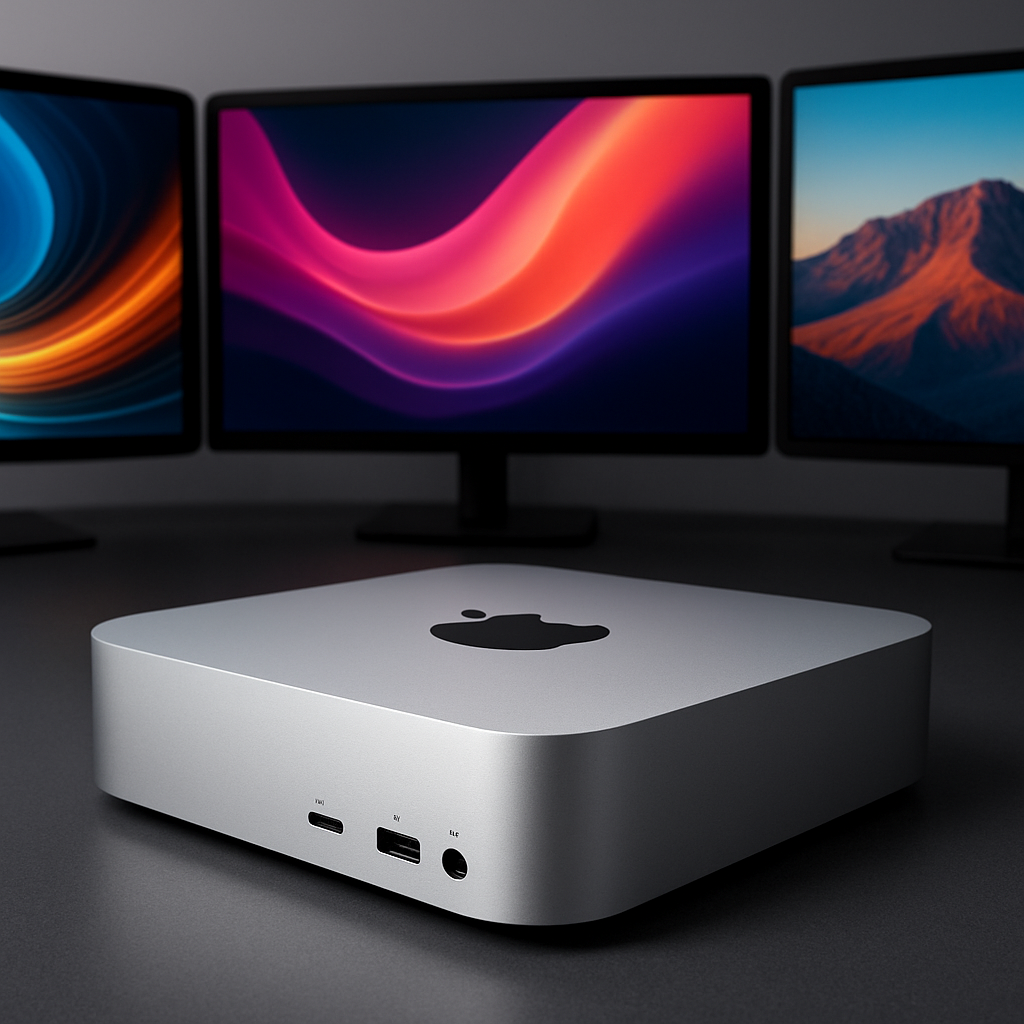
Apple’s updated Mac mini lineup—with its new M6 chip—delivers the most potent version of the compact desktop yet. Keeping the 5×5-inch design introduced in 2024, Apple hasn’t changed the shell. What’s new is what’s inside: more speed, better connectivity, and a few trade-offs in storage capacity that shift how “value” plays out.
What’s Different Under the Hood
The review unit runs with an M6 chip that pairs two super cores, four performance cores, and six efficiency cores—a first for Apple, using all three CPU core types in one chip. In comparison to the prior M4 model, it gains two CPU cores and ups its memory bandwidth from 120GB/s to about 170GB/s (dropping to 153GB/s on base memory configs). Graphically, the M6 chip includes a 12-core GPU—up from 10 cores—with ray-traced rendering roughly twice as fast, and CPU and GPU gains from 24% to 71% in benchmarks such as Geekbench 7 versus the M4. Storage speeds also see a big boost: write and read performances reach about 6,000-6,400 MB/s, compared to the 3,000-3,400 MB/s range on comparable M4 models.
Connectivity, Displays & Design Staying Strong
Externally, nothing except upgrades: M6 variants have three Thunderbolt 4 ports, the higher-end M5 Pro versions benefit from Thunderbolt 5. The standard Ethernet base across all new models is 2.5Gb, replacing the prior gigabit standard; 10Gb remains optional for those who need it. Wireless connectivity jumps up with Wi-Fi 7 and Bluetooth 6 replacing Wi-Fi 6E and Bluetooth 5.3. Display support remains robust: both versions can drive three external displays, though the exact combinations of resolution and refresh rate differ slightly depending on chip version.
Pricing & What You Actually Get
The M6 Mac mini starts at $899 with 16GB of memory and just 256GB of storage. Upgrading to 512GB costs another $200. The M5 Pro model begins at $1,699—$300 more than the M4 Pro’s launch price. Back in 2024, the base M4 version launched at $599, with 16GB RAM and 256GB SSD storage. Apple had removed the 256GB option from its base configuration earlier this year, making 512GB standard for M4s and pushing base pricing higher. Despite the more powerful internals, the starting model’s relatively modest storage makes the price jump more noticeable than the performance gains alone.
Final Take
For its size, the new Mac mini is a rare win: boosted processing, faster graphics and storage, stronger connectivity, all without changing the chassis that made the Mac mini a favorite. It’s versatile enough to serve as a little desktop workhorse, always-on server, or host for AI workflows. The choice between M6 and M5 Pro depends primarily on how much GPU and multi-core CPU performance you need—and how much you’re willing to pay. That said, the shift away from “entry-level value” toward “premium compact power” is unmistakable.
What this signals is where Apple sees the Mac mini slotting in its lineup: no longer just the entry point, but a serious midsize node of power for creatives, developers, and pros who need space-saving without compromise. As AI and desktop computing demands increase, these upgrades—especially in storage speed, GPU cores, and connectivity—could make the Mac mini a cornerstone for users building setups around high-performance tasks. If Apple’s next move includes bumping up base storage while keeping price increases modest, the Mac mini could reclaim both its prestige and its value crown.