Cybersecurity researchers have identified a significant evolution in the Kimwolf botnet, now referred to as Kimwolf v7. This latest iteration introduces advanced techniques to enhance its distributed denial-of-service (DDoS) capabilities and bolster its resilience against takedown efforts.
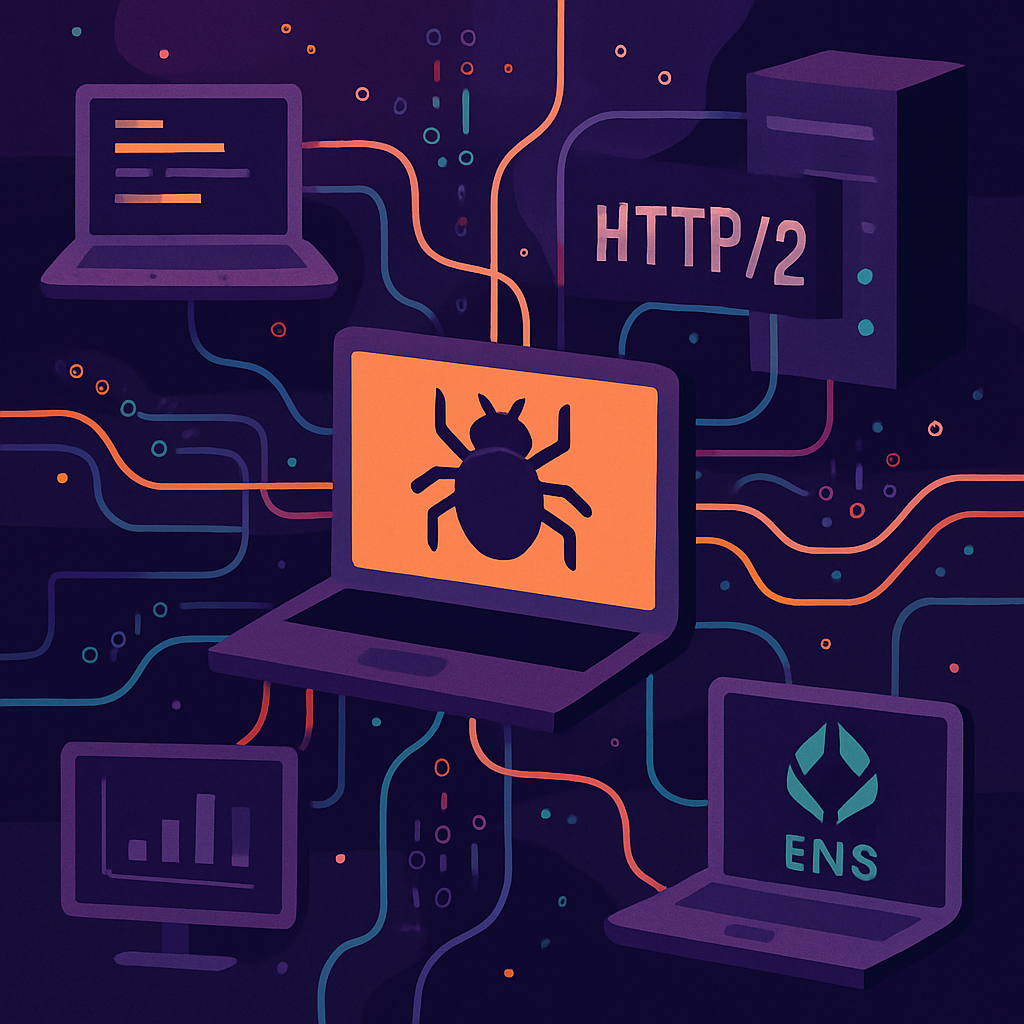
Kimwolf v7 incorporates HTTP/2-based DDoS attacks that meticulously craft browser fingerprints, making the malicious traffic closely resemble legitimate user activity. This approach complicates the detection and mitigation of such attacks by traditional security measures.
To fortify its command-and-control (C2) infrastructure, Kimwolf v7 employs a multi-tiered strategy. It utilizes the Ethereum Name Service (ENS) to dynamically resolve C2 addresses, integrates a hard-coded Tor .onion hidden service, and implements a local proxy to facilitate communication between the clearnet and the Tor network. Notably, this version omits previous scanning, exploitation, and brute-force functionalities, indicating a strategic shift where the initial infection phase is managed by separate loader mechanisms, while the core payload focuses on executing DDoS attacks and proxy operations.
Since its emergence in mid-2024, Kimwolf has primarily targeted Android TV boxes, exploiting devices with Android Debug Bridge (ADB) enabled on port 5555. By leveraging residential proxy services, the botnet infiltrates these devices, transforming them into nodes capable of launching DDoS attacks and relaying malicious traffic.
Upon infection, the malware disguises itself as legitimate Android system processes, such as “netd_service,” to evade detection. Key enhancements in Kimwolf v7 include:
- Implementation of HTTP/2 flood attacks using the nghttp2 library, accompanied by the generation of authentic browser fingerprints to mimic genuine browser behavior.
- Utilization of public Ethereum RPC services to query ENS domain records for dynamic C2 address resolution.
- Establishment of a backup C2 channel through a hard-coded Tor .onion hidden service.
- Deployment of a local proxy architecture that routes all C2 traffic through a designated local address, ensuring seamless communication across networks.
- Introduction of a high-performance UDP flood function optimized for ARM processors commonly found in Android TV boxes.
- Streamlining of DDoS attack commands to 15 numbered methods, reducing complexity from the 43 text-named methods observed in earlier versions.
Further analysis reveals that Kimwolf operators have distributed Android APK packages masquerading as system services named “SystemService.” These packages attempt to gain root access and execute embedded ELF kernel payloads. Between October and December 2025, eight such APK artifacts were identified, indicating ongoing efforts to refine the botnet’s propagation and execution mechanisms.
The evolution of Kimwolf v7 underscores the increasing sophistication of botnet operations, particularly in their ability to blend malicious activities with legitimate network traffic. This development poses significant challenges for cybersecurity defenses, necessitating continuous adaptation and vigilance to effectively counter such advanced threats.