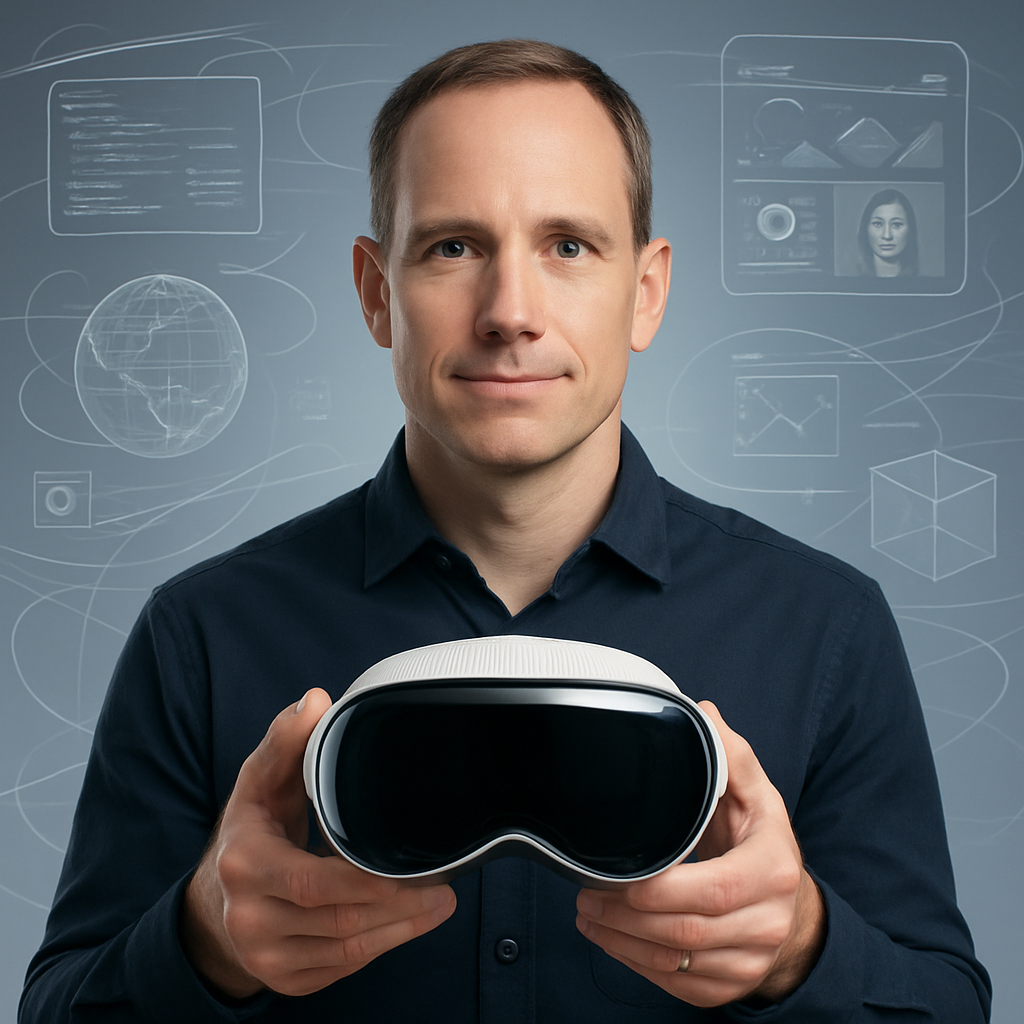
Apple’s Vision Pro continues to spark debate as consumers and critics question its value. The company’s new CEO, John Ternus, stepped into the spotlight this week with a more telling defense of the Vision Pro than we’ve heard so far—framing it as a foundational step in what could evolve into the next generation of computing.
Ternus Makes the Case
In a recent long-form interview with French outlet Clique TV, Ternus was asked whether the Vision Pro represented a failure, a mere test, or a true preview of future computing. He responded by placing the device in the same historical context as early personal computers—expensive, limited, but revolutionary in how they opened new possibilities.
He pointed out that while early PCs looked niche and impractical to many, they paved the way for industries like desktop publishing. Ternus argued that Vision Pro today is similarly finding its footing, with early adopters already using it, and practitioners in medicine and film production finding value that traditional monitors can’t match.
Real-World Use Cases Beyond Consumer Gadgets
Ternus emphasized that the Vision Pro isn’t just for enthusiasts or tech showrooms. He noted surgeons are employing it during operations, and production teams are using it in set design—instances where the immersive spatial experience offers advantages over flat displays. These apply to visualizing complex structures, planning physical spaces, or monitoring fine detail.
These examples suggest Apple sees the Vision Pro less as a flagship product and more as a platform, around which workflows can evolve and mature. The technology may be young, but its specialized applications are already emerging.
Why This Strategy Matters
Seeing the Vision Pro as analogous to the early personal computer era clarifies Apple’s posture. It shifts expectations: from mainstream, mass-market readiness toward long-term trajectory building. Tim Cook previously described the Vision Pro as an “early adopter product.” Ternus builds on that, emphasizing growth through expanding use case depth rather than breadth.
This narrative also reframes criticisms. Rather than judging current sales or consumer reach, Apple appears to be investing in institutional and professional value—fields willing to pay for premium, immersive hardware because it solves specific problems in medicine, visual design, engineering, or media production.
This moment is crucial: the Vision Pro needs to move beyond novelty. Compelling use cases in demanding environments could validate its price, its design, and its spatial computing vision. The company likely understands that convincing these specialized audiences first is essential before a broader push.
Analytically, Ternus’s defense matters because it signals a clear strategy: Apple is past the point of merely launching a product—it’s shaping a category. What to watch for next includes improvements in device weight, cost, developer support for spatial apps, and whether usage in professional scenarios leads to noticeable performance or functionality optimizations. How Apple moves from early adopter praise to indispensable tool will decide if Vision Pro becomes the PC moment reimagined for spatial computing.