With the iPhone 18 Pro lineup and Apple’s first foldable device expected to debut in less than two months, rumors are swirling about what’s true vs. what’s speculative. The full iPhone 18 lineup—including the standard model, the “iPhone 18e,” and iPhone Air 2—is tipped to arrive in spring 2027 under Apple’s split-launch strategy. Here’s a breakdown of the 20 most discussed features, grouped by how likely they are to make the final cut.
Strong Signals: Rundown of Features Likely to Land
One of the clearest expectations is the iPhone Air 2 gaining a second camera—the addition of an Ultra Wide lens alongside the main shooter. Design-wise, it should look much like its predecessor aside from the extra lens.
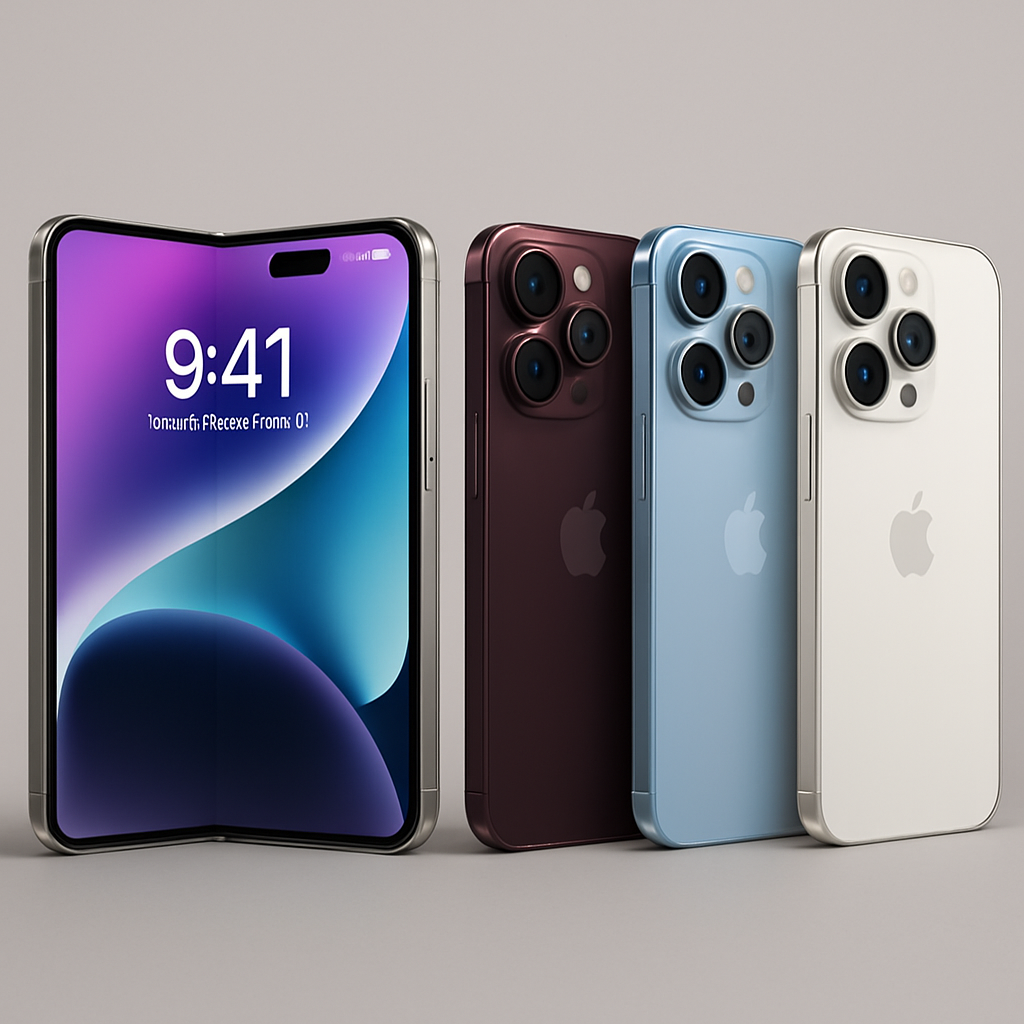
Color-wise, “Dark Cherry,” Light Blue, and Silver are said to be the signature tones for the iPhone 18 Pro range, based on leaked components and corroborating reports.
Camera upgrades are also in focus. The Pro models are rumored to get a variable aperture on the 48MP main camera—something that would allow better control over exposure and depth of field. Users should also see more RAM in standard iPhone 18 models—possibly 9GB or even 12GB—up from the current 8GB. That leeway appears targeted at powering advanced on-device AI features coming with iOS 27.
Battery life is expected to improve significantly for the Pro Max model—leaked figures suggest around 5,567mAh. Combined with a new 2-nm A20 Pro chip and an upgraded LTPO+ display, this points toward noticeable efficiency gains.
Apple’s foldable—going by names like iPhone Ultra or “Duo”—is repeatedly described as a book-style device with roughly a 5.5-inch outer screen and a 7.8-inch inner display in a 4:3 aspect ratio. In many reports, it resembles two thin titanium iPhone Airs side by side when unfolded.
The Pro series outside the U.S., and the new foldable, are also likely to adopt Apple’s second-generation C2 modem with faster connectivity and possibly satellite support. In the U.S., however, Apple may still use Qualcomm if the C2 lacks mmWave.
One more sure bet: prices are going up. With more memory, better cameras, and more premium builds, the Pro and Pro Max models are projected to start around $1,299 and $1,399—about $200 more than current equivalents—and the foldable model could top $2,000.
Could Go Either Way: Mid-Likelihood Add-Ons
Some earlier rumors pointed to a black or dark-gray finish for the Pro models, but that possibility seems to be fading with newer color leaks pushing more saturated options.
The Air 2 may also get a battery bump—to approximately 3,500mAh, around 11% larger than previous models. Alongside thinner displays, that could improve longevity despite more powerful internals.
As for the foldable, color options may be limited—white or silver appears most likely, with a darker alternative also discussed under different names like indigo or space gray.
Another visual tweak under discussion is a smaller Dynamic Island on the Pro models—roughly 35% narrower according to some leaks. But component constraints, especially around Face ID, could delay or prevent this change.
The camera bump (or plateau) is expected to be a little thicker—Pro Max may go from about 11.23mm to 11.54mm; the smaller Pro may see a less dramatic bump.
Apple may simplify the “Camera Control” hardware, removing the capacitive sensing layer in favor of pressure sensitivity only. The change could reduce accidental touches and streamline manufacturing.
The foldable’s inner display is said to have a crease reduced to less than 0.15mm—near-invisible under normal use. Total elimination of the crease is likely out of reach this year.
Naming for the foldable has also been in flux. Older leaks leaned toward “Ultra,” but more recent reports favor “iPhone Duo.”
Unlikely or Speculative
Some far-flung features appear less probable. A teleconverter (a lens-attachment-style accessory to extend focal length) is mentioned in one report, but technical and implementation details are murky and unverified.
The idea of replacing the Dynamic Island altogether with a hole-punch camera design has lost traction—recent leaks favor keeping the Island (possibly narrower) instead.
More extreme cost-cutting rumors—such as the standard iPhone 18 sharing many components with the Air 2 or seeing display/chip downgrades—are weakly supported and often contradicted by other leaks pointing to a powerful base-model chip.
The foldable might have been rumored to include a 24MP under-display selfie camera, but that tech doesn’t seem mature enough yet—visible hole-punch designs are more likely for both inner and outer screens.
While most of the foldable versions are expected to be eSIM-only, the SIM tray isn’t going away for all variants. Markets like China and Hong Kong will still likely get physical SIMs.
What This All Means
We’re looking at one of Apple’s most ambitious iPhone cycles: Pro models that go bigger in price and performance, the introduction of a foldable flagship, and a standard model that may shift launch timing. Features most likely to arrive—variable aperture, bigger batteries, beefier RAM, new colors, and a foldable form factor—suggest Apple is betting on camera innovation, AI computation, and form-factor variety. Speculative features serve as clues about internal debates, but many seem to be grappling with cost, manufacturing constraints, and the maturity of new technology (like under-display cameras).
For consumers, this means phones will cost more—both upfront and potentially in upgrades—but also offer meaningful upgrades if rumors pan out. Watch closely for Apple’s event in fall 2026: that’s when the Pro and foldable models are expected to launch. Also watch for what happens in spring 2027 with the iPhone 18, 18e, and Air 2. Changes in naming, pricing, and feature differentiation may shift strategy already in motion across Apple’s product lines.