Apple’s newly released iOS 27 brings a fresh opt-in privacy control during setup that lets users decide whether to share their Siri, Dictation, and Translate interactions to help train Apple’s foundation models. This update shifts from what users were previously asked at setup: permission only to improve Siri services.
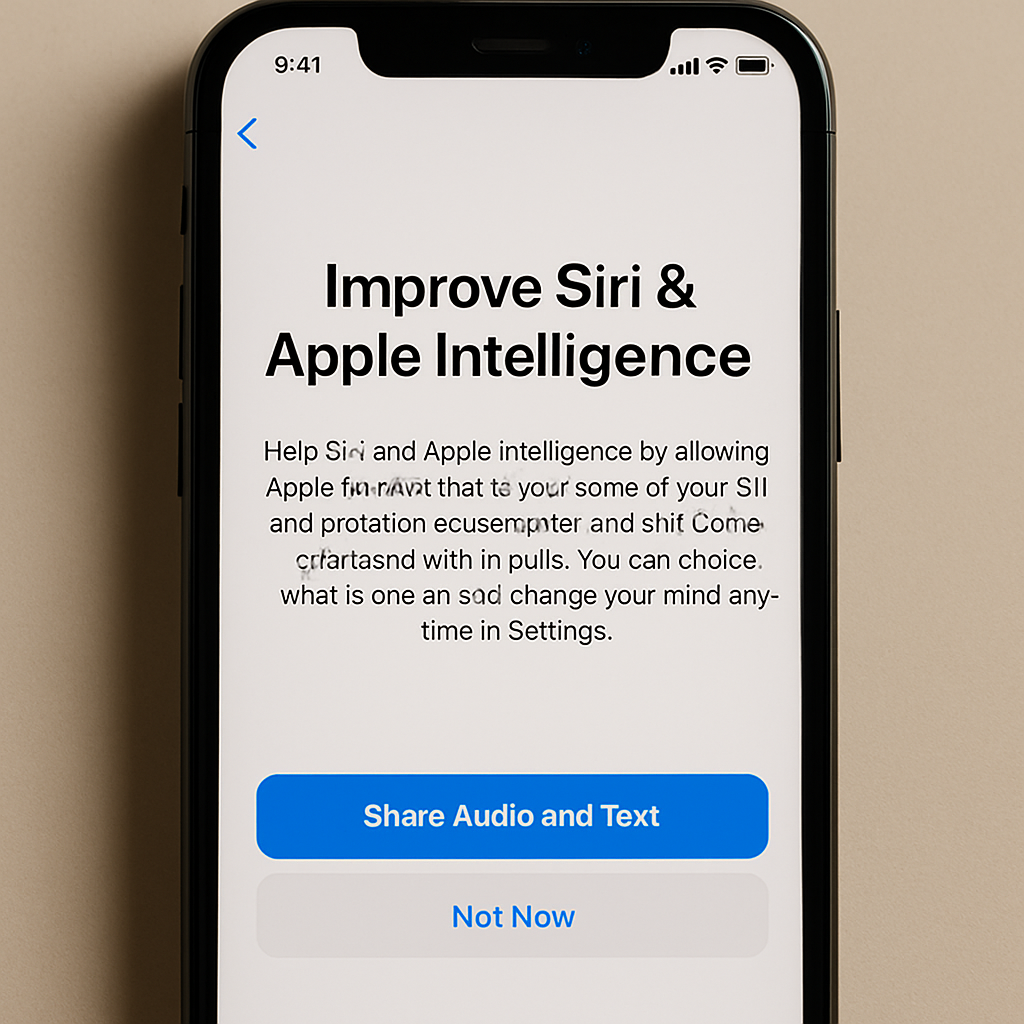
When enabling Siri AI for the first time under iOS 27, you’ll be prompted to “Improve Siri & Apple Intelligence.” Two choices appear: “Share Audio and Text” or “Not Now.” If you agree, Apple will collect both your audio and transcripts from Siri, Dictation, and Translate to refine not only those individual services but also its broader foundation-model training.
It’s worth noting that the change does not introduce a new type of data collection for those who opt in—Apple’s use of audio and transcript data remains largely what it has been. What’s new is the explicit inclusion of foundation models alongside Siri and Dictation in terms of what the data will be used for. Users who had opted in under the old system will be asked again during iOS 27 setup so they can reconsider given the expanded usage.
Apple emphasizes privacy protections tied to this new setting. Audio, transcripts, and related data are linked to a device-generated identifier that refreshes multiple times each hour. This identifier is unconnected to your Apple ID or email address. Apple says this data won’t be used for marketing profiles or shared with third parties.
For those who skipped or changed their mind, the opt-in status can be adjusted any time. The toggle is located under Settings › Privacy & Security › Analytics & Improvements › Improve Siri & Apple Intelligence. Apple also published a support document that lays out how this setting works across its platforms.
Why This Reset Matters
This new opt-in setting reflects how Apple is evolving its AI offerings—and its privacy language—to keep pace with rising concerns over how user data is used to train large AI systems. Foundation models are the backbone for tasks ranging from language generation to translation to smart assistants, so this shift shows Apple’s intent to incorporate user data into those models directly.
It’s especially significant given the rising scrutiny over how personal interaction data gets collected and processed. By asking all Siri AI users, even those who’ve already consented, to explicitly agree under the new terms, Apple is giving people a clearer chance to understand what data is doing and how it benefits broader AI training—not just immediate Siri performance.
But it won’t be without criticism. Users will be keeping a close eye on how well Apple’s rotating-identifier system anonymizes data, and whether opting out means losing access to improvements Apple says come from this kind of data sharing. Transparency around model updates and user benefit will be crucial.
In essence, with iOS 27, Apple is drawing a more direct line between what you say to Siri or Translate and how that contributes to building the generative AI features behind its products. It’s a meaningful privacy choice disguised in familiar territory—but it may well mark a turning point in how Apple balances service performance, user consent, and data use.