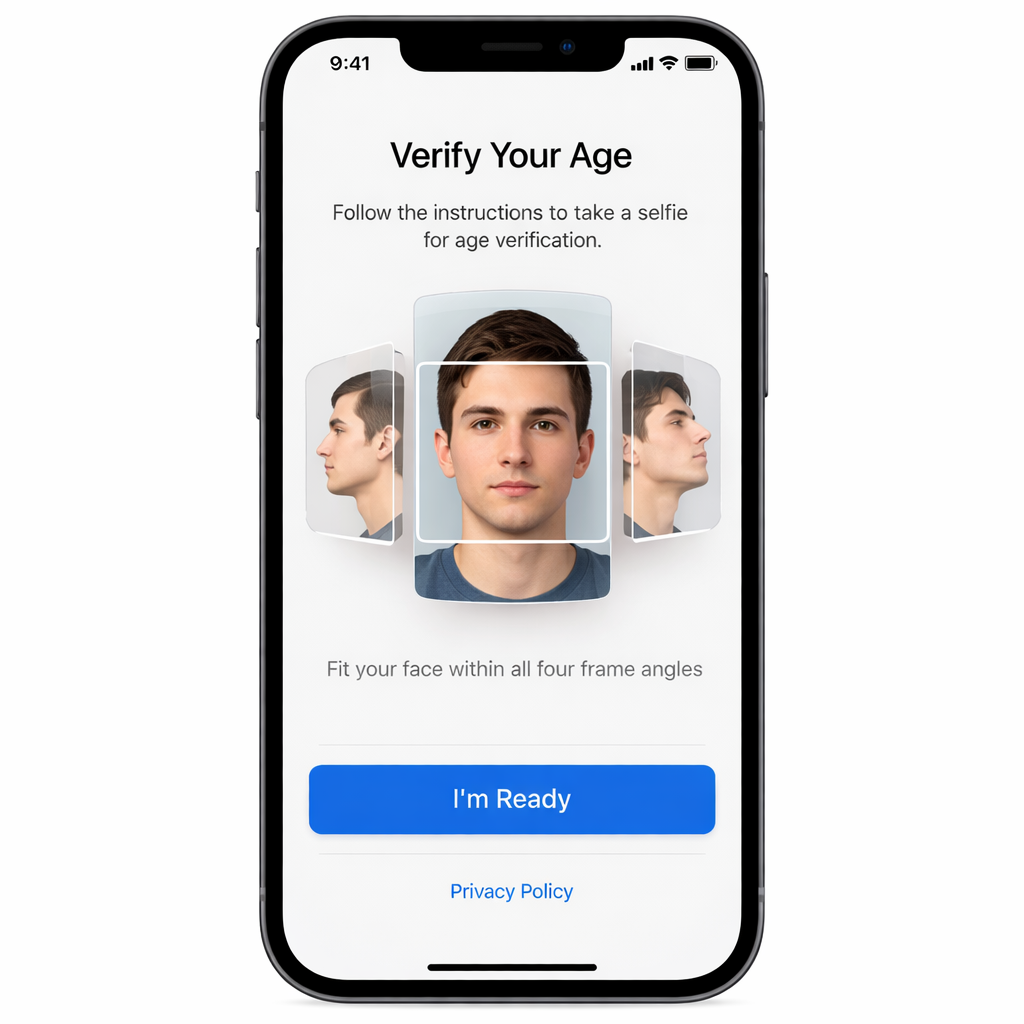
Apple’s latest software release, iOS 27.2, introduces a new way to confirm your age using a selfie. This joins existing options like credit card checks or ID scans and is aimed at meeting legal age-verification requirements in specific countries and regions. Currently, these rules apply in Australia, Brazil, Singapore, South Korea, the UK, and Texas, USA.
How the Selfie Age-Check Works
If you’re prompted to verify your age in iOS 27.2, you may see a “take a selfie” option. Selecting this begins a guided process where you hold your iPhone in front of your face and capture images from all four angles—right, left, up, and down. The key component is an age-estimation model that analyzes these images to confirm you’re over the required age.
Apple emphasizes privacy: the age-estimation model can run entirely on your device, as well as via its Private Cloud Compute system. The selfie is never accessible to anyone, including Apple. Once your age is verified, the image is deleted immediately, and it’s not stored or retained in any form.
Why It’s Being Rolled Out—and Where
Many governments are pushing for stricter identity verification, particularly for accessing certain Apple services, downloading apps, or changing specific account settings. To comply, Apple is giving users in affected regions more options to prove their age. The selfie option is not universal yet—it will appear only in territories where age verification is required by law.
With this update, Apple is trying to balance legal compliance, user privacy, and usability. The selfie method joins the existing alternatives of using credit cards and scanning IDs. While it’s certainly more convenient for some, it also raises questions about biometric data handling—questions that Apple has addressed through its commitment to local processing and immediate deletion of images.
This feature begins rolling out with iOS 27.2, so if you’re in one of the regions mentioned, expect to see the selfie prompt in relevant situations. For everyone else, Apple’s existing age verification methods remain in place.
What this addition means is Apple’s increasing use of AI models for sensitive tasks, and a push toward meeting regulatory demands without compromising privacy. What to watch: how accurate and reliable the age-estimation proves in real-world conditions, how widely the selfie option becomes available, and whether this approach will influence how other platforms deal with age and identity verification.