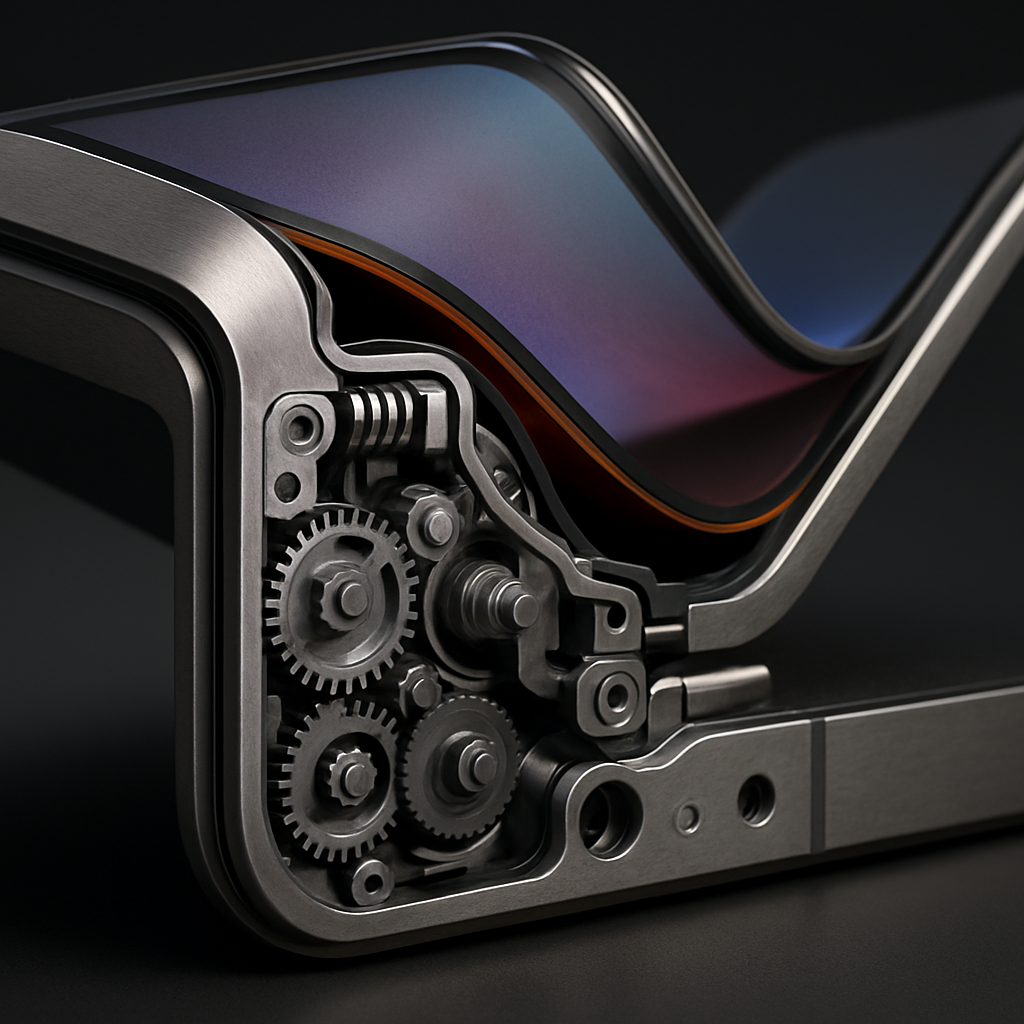
Apple’s first foldable iPhone, the Duo, reveals a hinge that’s far more complex and refined than typical folding phones. A recent CT scan and mechanical analysis by HTX Studio, shared via YouTube, has peeled back the engineering layers behind this hinge—showing how it bends, holds angles, resists wear, and smooths over the dreaded crease.
How the hinge holds & bends
The Duo can stay open between approximately 15° and 145°—below 15°, magnets snap it closed; above 145°, it forces a full open position. The hinge is divided into six main sections: two edge pivots connected by a central shaft, gear mechanisms that keep both sides synchronized, and paired spring-cam assemblies near the middle. These springs add resistance as the cams compress during folding, countering the device’s own weight to hold angled positions. Between the edge assemblies and central shaft, there’s a central opening reserved for flex cables so the screen’s connection isn’t interrupted. All hinge components are mirrored top to bottom.
Crease reduction, strength, and durability
The inner folding screen uses a ten-layer stack, with a nano-textured cover that helps hide the crease better than glossy foldables. Built-in optically clear adhesives allow the layers to glide over one another to relieve stress during folding. The folding radius—known as the bending space—measures about 3.85 mm at its widest point, fitting between typical foldables that offer 3.8 to 4.2 mm.
To reinforce the design, the entire hinge system is encased in titanium. Apple also achieved an IP68 dust-resistant rating—a rare feat for foldables. The Duo does away with raised metal buffers near the hinge that other devices use to protect against impact, achieving a completely smooth display surface. The titanium cover, in conjunction with the ten-layer screen, guards against scratches: in tests using pencils of hardness 6B through 8H under 100 g force, only faint marks appeared at 6H and more visible damage at 8H—still better than comparable foldables.
Why all this hinge complexity matters
Apple’s hinge is composed of nearly 100 components, combining gears, cams, springs, magnets, and a central shaft to balance flexibility and structural integrity. Unlike many foldables that essentially lock at two states (open or closed), the Duo supports swaths of angles in between—delivering more versatile uses. And in doing so, Apple has rejected common compromises by opting for a seamless, smooth screen and reinforced hinge protections instead of bumpers.
That said, the engineering wisdom here isn’t without trade-offs. Size added, fabrication complexity, and long-term wear are all open questions. Real-world testing will still be essential to judge how many folds the hinge retains its stiffness, how the crease evolves, and whether the milling and materials chosen truly balance premium feel with functional longevity.
What this means and what to watch: The iPhone Duo’s hinge is not just a mechanical gimmick—it’s central to the usability of Apple’s foldable vision. By supporting partial angles, reducing crease visibility, and reinforcing durability, Apple is trying to avoid several pitfalls that have dogged prior foldables. What will matter now: how the Duo performs after tens or hundreds of thousands of folds, how screen flex and crease evolve with daily wear, and whether rival devices can keep up or surpass this design in future iterations.