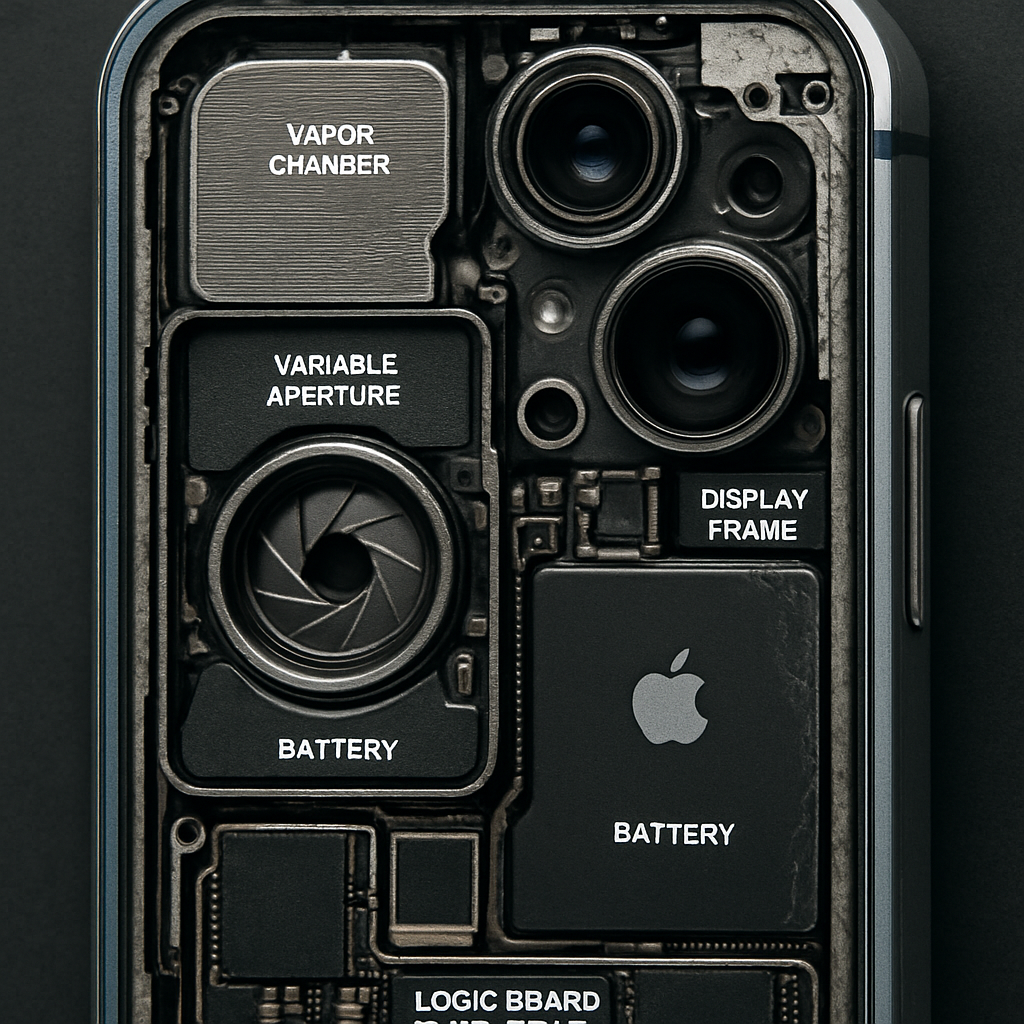
iFixit’s full teardown of Apple’s newly released iPhone 18 Pro and Pro Max uncovers a complex mix of innovation and concern. Detailed inspections reveal a variable aperture system in the main camera, a beefed-up cooling setup, and reconfigured internal components—but also issues that may affect repairs, especially around the display and storage.
Specs & New Hardware
The battery sizes in the eSIM-only models are now confirmed: the iPhone 18 Pro carries a 4,288 mAh cell (a modest increase over last year’s 4,252 mAh), while the 18 Pro Max steps up to 5,567 mAh, almost 10 percent more than its predecessor. Physical SIM versions have smaller batteries. Both phones use a new vapor chamber for heat dissipation that spans much more of the internal body, paired with a redesigned logic board architecture where the A20 Pro chip is placed directly in thermal contact with this cooling structure. Meanwhile, memory and NAND storage are now sandwiched between layers of the board—making access more difficult for service work.
One of the most headline-grabbing upgrades is the main camera’s variable aperture lens—six polymer-composite blades arranged in a mechanical iris mechanism. Actuated magnetically, this allows four preset aperture values (ƒ/1.48, ƒ/1.8, ƒ/2.8, ƒ/4.0). The widest opening, ƒ/1.48, is the largest on an iPhone so far, enabling more light in low-light conditions. However, optical effect enhancements are modest; compromises in repairability are more evident here. If one tiny blade fails or gets stuck, the whole camera module likely has to be replaced. The new camera assembly is modular, so replacement is possible—but the tolerances are extremely tight.
Repairability & Risks
Although several components are more user-serviceable than before—such as battery trays secured with screws and the modular camera assemblies—iFixit encountered a worrying issue during disassembly. The plastic frame around the display cracked or detached in three of the four iPhone 18 Pro units opened. Since major repairs like battery replacement require entry through the display, any damage to this frame can lead to poor fit, compromised water resistance, and difficulty resealing the device properly.
Accessing critical components is also more challenging now: the NAND storage chips reside inside the board sandwich, not on the outer layer. That complicates both routine service operations and data recovery. Likewise, replacing ports such as the USB-C jack requires removing many internal pieces due to their placement deep in the assembly.
On balance, the repair community gave both the iPhone 18 Pro and Pro Max a provisional repairability score of 7 out of 10. This is the same as last year’s Pro models. Scores take into account the new battery tray, improved camera module design, and thermal enhancements with disclaimers: repairs are riskier if display damage occurs, and some components are harder to reach.
What Changed vs. Last Year
- Vapor chamber area is about three times larger than in iPhone 17 Pro, offering better thermal spread and improved sustained performance.
- A20 Pro chip is relocated so it sits next to its memory rather than being layered above it as before, helping reduce thermal bottlenecks.
- Display frame design carried over since iPhone 15 Pro but now shows consistent damage during teardown—not seen in earlier units.
- Variable aperture mechanics are new, with added moving parts increasing potential failure points.
- Battery replacement is still front-entry (through screen), meaning screen removal—already a delicate process—is unavoidable.
The display panels themselves still function after removal, but frame damage has consequences that may outlast this generation.
Overall, the iPhone 18 Pro and Pro Max deliver meaningful hardware evolution, especially in camera flexibility and thermal engineering. However, innovation comes with trade-offs: fragile display frames, harder access to internal chips, and high tolerance components make certain repairs more difficult and costly. Whether these changes will be a nuisance for end users depends on how widespread frame damage becomes, how Apple supports repairs, and whether later production cuts improve durability.