Apple’s new PROLED XDR MacBook Pro has finally been stripped down by iFixit, revealing long-awaited design details, repairability trade-offs, and how Apple managed to shave significant weight from the latest models. The teardown offers a closer look at how the glowing logo works, what can actually be repaired, and how this MacBook stacks up against its predecessors.
The Illuminated Logo & Display Innovations
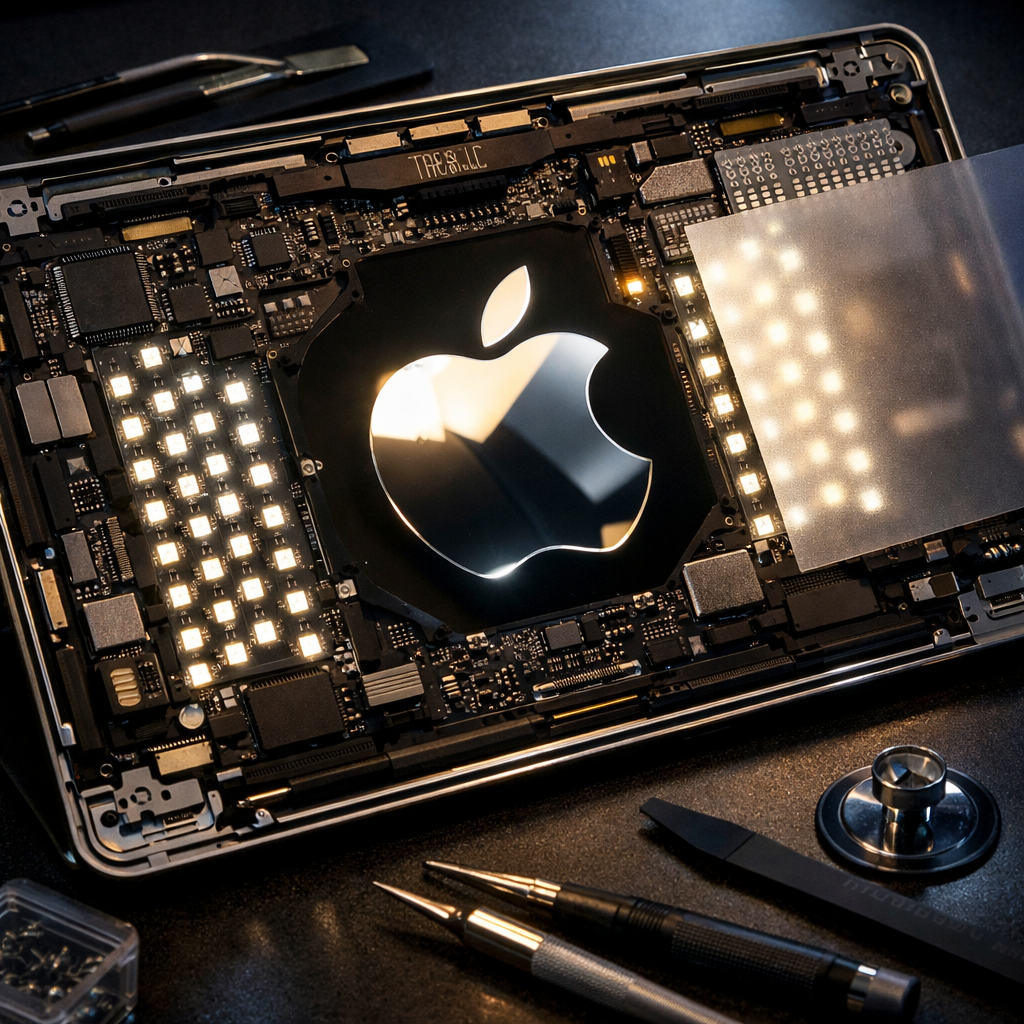
The glowing Apple logo on the back of the PROLED MacBook Pro is not just reflective polish—Apple added four discreet LEDs, a reflective layer, and a diffuser to make it glow uniformly. With the system off, the logo takes on a mirrored appearance due to its two-way mirror coating. Because the logo resides behind the display, any damage to it means the entire screen must be removed; in iFixit’s case, the panel actually cracked during disassembly, destroying the OLED beneath. Notably, since OLED panels have no backlights like those in older MacBooks, this LED solution was required.
Repairs, Parts & Chassis Changes
Although some internal parts retain replaceability—Thunderbolt/USB-C ports and fans are among them—many components are now soldered, including the logic board, HDMI port, SDXC card reader, memory, and SSD. The logic board must be removed even for replacing some ports. As for the hinge, Apple advertises one built for touch input: iFixit reports it’s stiffer than the hinge in the M6 MacBook Pro, better resisting movement when the display is tapped near the top.
Weight Reductions & Physical Differences
One of the big wins with the PROLED models is lighter build. Apple removed material from the lower aluminum case—bringing the lower case weight down to ~364 grams from ~456 grams in the M6 model. The display assembly dropped about 101 grams despite now integrating touch and the glowing logo, and the battery trimmed about two grams. Though the overall footprint remains similar, subtle changes like thinner bottom bezels, rounded lower display corners, and tighter screen edges contribute to a sleeker aesthetic.
Repairability & Trade-Offs
PROLED’s repairability rating: 5 out of 10. That’s one point higher than the M5 MacBook Pro, but still trailing devices like the MacBook Neo. While replacement parts are available and documented via Apple’s repair manuals—including options for Self Service Repair—the level of soldered components and the screen-integrated logo impose serious repair challenges when things go wrong.
swapping logic boards between two PROLED units resulted in full functionality—including Touch ID and the touchscreen—reports iFixit. The display’s touch functionality does not introduce extra pairing issues for replaced components.
What this means:the logo does more than just win design points—it exemplifies how Apple is blending glossy design with new display tech. But the reveal also doubles as a reminder that cosmetic innovation comes with costs in terms of repair risk and component replaceability. The weight savings are welcome, especially for professionals who carry their machines daily, but the PROLED isn’t as repair-friendly as Apple’s patent-heavy marketing might otherwise suggest. Going forward, keep an eye on how the glowing logo holds up under stress, whether Apple offers more modular repair access in future models, and whether these trade-offs affect long-term durability in real-world use.