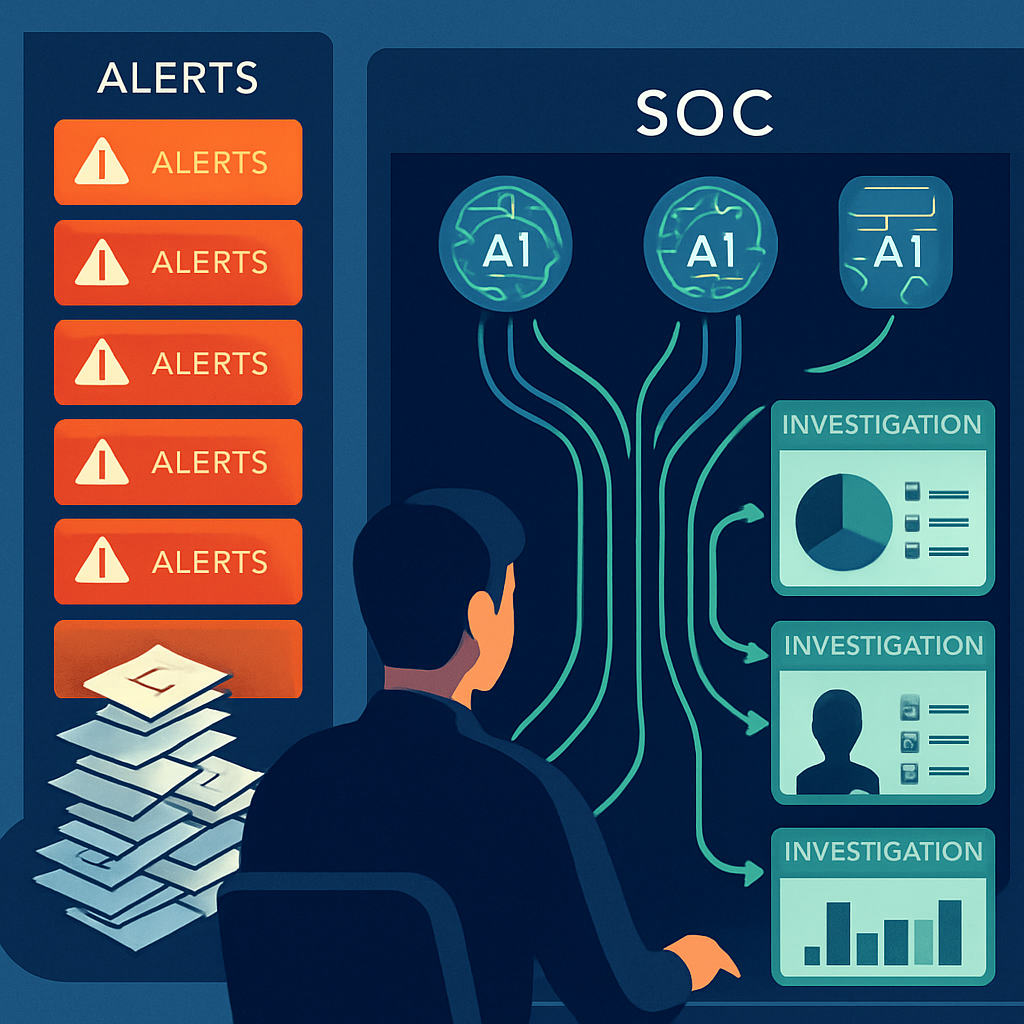
Security Operations Centers (SOCs) today are drowning under alert queues. Detection engines constantly flag signals, score them, then hang them in a lineup waiting for human review. With telemetry pouring in from endpoints, the network, identity systems, and the cloud, analysts simply cannot keep up. Analysts end up picking which alerts to investigate before they even know if those alerts are threats. What many don’t realize: there’s a way to flip this workflow upside down.
Agentic AI-driven SOCs turn traditional alert triage on its head. As soon as a signal is detected, an AI agent starts investigating—validating the detection, exploring underlying network activity, profiling the relevant host or user, examining past behavior, and connecting related events. Only after gathering evidence does the alert move to a human, armed with context and analysis. In effect, the SOC works continuously and asynchronously instead of waiting for analyst availability. Numerous alerts that were once dead in the queue get resolved automatically, while those that merit human attention arrive fully documented.
From Hypotheses to Action
Traditional threat hunting starts with detection: an alert is triggered, then someone asks what’s happening. Agentic threat hunting flips this. Teams form behavior hypotheses—like spotting unusual protocol use for command-and-control, lateral movement via remote admin tools, or hidden exfiltration staging. AI agents search for evidence in network telemetry: what communications look out-of-place, what timing or patterns are suspicious, what behaviors contradict normal baselines. Detection rules still matter—but hypothesis-driven AI lets SOCs test attacker behaviors on a broader scale, uncovering threats that traditional detection may miss.
A New Role for Human Analysts
With this model, human time becomes far more valuable. Rather than using hours for initial investigation, analysts focus on reviewing well-founded cases, making high-stakes decisions, responding, and refining policies. Speed and coverage go up; costs per investigation drop. Threat exposure gets reduced, because risks aren’t buried beneath noise. Telemetry becomes actionable evidence rather than just data waiting to be parsed. Humans engage when it matters—when an agent presents a case with supporting facts and impact.
Operationally, this means designing agentic workflows: define investigative playbooks, determine which telemetry sources feed the agent, set rules for escalation, and preserve audit trails so analysts can see which data was used and how conclusions were reached. Metrics shift away from queue size and wait time—to things like rate of true positives surfaced by AI, escalation accuracy, response speed, and how much human workload is concentrated on decision-making rather than triage.
This is a model already being delivered by platforms like Corelight’s Open NDR, which merge high-fidelity network telemetry, multi-layered detection, and AI-powered investigation to change signal handling. Ultimately, SOCs powered by agentic AI treat signals as opportunities for early, evidence-driven investigation, not just as alerts to be queued.
Why It Matters: In an era when threats evolve faster than analysts can handle alerts, the traditional SOC alert queue has become a liability. Agentic AI models could rewrite the rules: signal-driven investigation, smarter threat hunting, and human focus where judgment counts—on containment, remediation, and strategic defense. What to watch: the rise of auditability, hypothesis-driven workflows, and whether organizations can ensure the data feeding agents is complete, trusted, and context-rich.