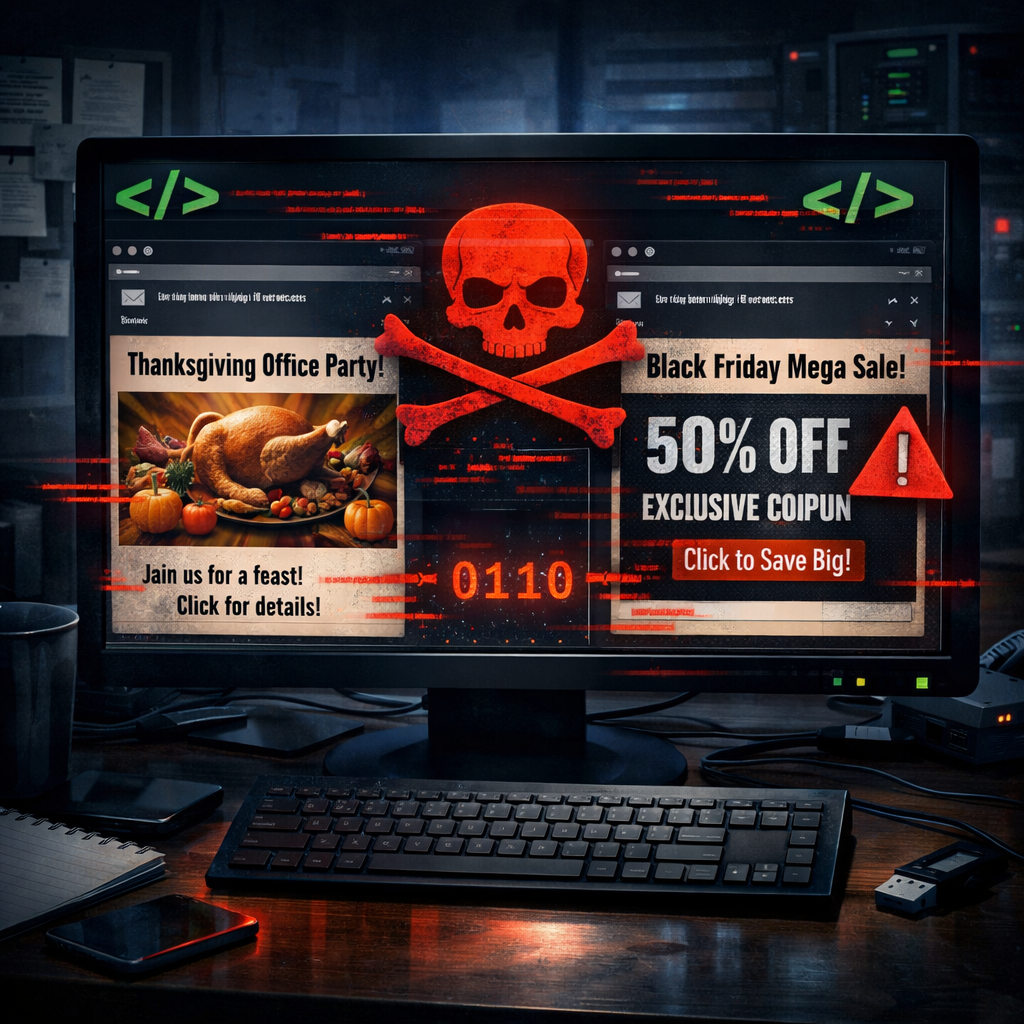
As Thanksgiving and Black Friday approach, seemingly benign invitations, discounts, and greetings are enabling cybercriminals to launch targeted attacks that go well beyond the typical holiday phishing scam. Researchers at ANY.RUN uncovered five holiday-inspired campaigns aimed at stealing credentials, installing remote access tools, and infiltrating business endpoints. These attacks pose serious risks for users and companies alike.
Thanksgiving Scams Masquerading as Festive Messages
The first three campaigns used Thanksgiving-themed lures to trick recipients into compromising personal data or exposing corporate systems.
One operation sent a Thanksgiving potluck invitation from what appeared to be a real estate franchise office. The “View & RSVP” button redirected employees through a fraudulent chain of pages ending in a counterfeit Google Workspace login screen designed to capture credentials. The investigation exposed dozens of related domains and more than 350 sandbox sessions tied to the broader phishing infrastructure.
Another scheme arrived as a Thanksgiving e-card, mimicking the format of Blue Mountain greetings. Embedded in a PDF attachment, the e-card claimed to let recipients view an invitation but instead led them through DocSend to a Cloudflare R2-hosted page, which automatically downloaded remote access software known as ScreenConnect. This setup not only jeopardizes endpoint security but also compromises environments where unauthorized access software can run unchecked. The malicious page also sent users’ public IP addresses to a Telegram bot.
The third attack impersonated MyChart, a health portal, offering a free medical monitoring kit. Using an image-based email, the campaign funneled victims through traffic-distribution systems and fake verification pages to collect personal details. A $10.55 “processing fee” was also requested, adding financial theft into the mix.
Black Friday: Blend of Genuine Content and Hidden Dangers
The final two attacks combined real promotional content with hidden malware or phishing infrastructure, making detection much trickier.
In one case, a Black Friday newsletter featuring genuine discount links doubled as a phishing launchpad. Among dozens of links—most leading to real sites—several pointed to phishing infrastructure. The attackers used browser fingerprinting and conditional redirects to mask malicious links, bypassing many automated security checks and hiding behind familiar brands like SpaceX and USA Today.
The other campaign involved a counterfeit coupon offering extra discounts at popular retailers such as Amazon, eBay, and AliExpress. The coupon was packaged in a Word document embedding an OLE object containing a malicious VBS script. If executed, that script launched through standard Office tools (WINWORD.EXE), used wscript.exe, scheduled tasks with schtasks.exe for persistence, and attempted to download further payloads. Though those payload downloads failed in the observed incidents, the potential for damage was clear.
Defensive Moves for Security Teams
These five cases illustrate how holiday season attacks are adopting more complex, stealthy tactics. For security operations centers (SOCs), it’s no longer enough to rely purely on signature detection or surface-level scanning.
- Use interactive sandboxing to simulate behavior and expose hidden redirects, auto-downloads, and other suspicious network activity.
- Leverage threat intelligence lookups to link individual indicators of compromise (IOCs) to broader infrastructures and recognize campaign patterns proactively.
- Incorporate real-time threat intelligence feeds. As shown by the research, up to 30% of unique malicious IOCs tracked were already available via TI feeds, allowing early detection before analysts manually spot them.
Every incident that slides past defenses during seasonal spikes can ripple into operational disruption, regulatory exposure, or costly incident responses. Tightening detection, triage, and response workflows now can mean the difference between containing an attack or enduring long-lasting damage.
**Why it matters:** These attacks underscore a growing sophistication in holiday-themed phishing efforts. When festive content is laced with phishing, ransomware, or remote access tools, defenders must look past the seasonal veneer. In coming weeks, what to watch for are campaigns that mix benign content with hidden threats, exploit calendar-driven trust, and leverage legitimate platforms for infection chains. The companies that stay alert—investigating even the seemingly innocuous, using behavioral tools, threat intelligence, and context—will be the ones that avoid being the next victim.