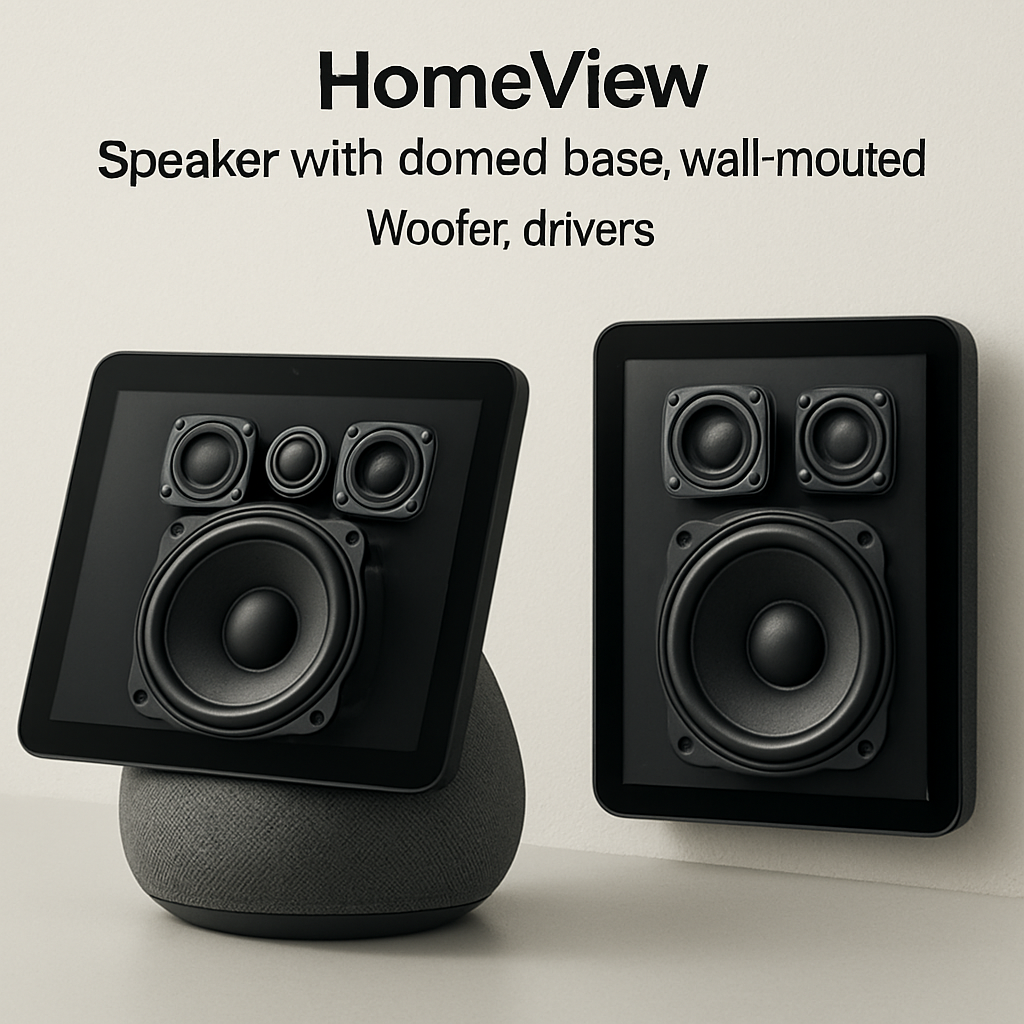
Apple has released its new HomeView smart home hub in two versions: the standard model with a domed speaker base, and a Wall-Mounted Edition without it. While the outward designs differ, there’s another, less visible divergence—one that affects sound quality significantly.
Speaker Systems Compared
The domed-base HomeView delivers a more advanced audio setup than the wall-mounted version. It includes a custom down-firing woofer and dual force-cancelling passive radiators that enhance bass and broader sound fidelity. These hardware additions boost the acoustic punch, allow for deeper lows, and improve fullness across the range. Both versions share two custom full-range drivers and support Spatial Audio.
The Wall-Mounted model, meanwhile, skips the woofer and passive radiators. It retains the dual full-range drivers and computational audio tuned for wall placement, but lacks the enhanced bass and volume performance of its domed counterpart. While still capable, it’s quieter and less powerful when compared.
What That Means in Use
If your priority is rich, immersive sound—say, for music, movies, or podcasts in a living room—the domed HomeView is clearly the stronger choice. Its added speaker components offer louder, more robust sound output, especially at lower frequencies.
On the other hand, the wall-mounted version may suit secondary areas—bedrooms, hallways, bathrooms—where sleek design and space-saving are more important than booming audio. Its quieter performance still supports Spatial Audio, and its shape could be better for aesthetics or placement against walls.
Both models run on the same foundational architecture, including custom drivers and computational audio via the same chip, so things like Atmos or Spatial Audio will function on both. Yet, the key hardware difference—woofer and radiators—creates a meaningful divide in sound performance.
Choosing between them comes down to trade-offs. Want powerful audio? Go domed. Prefer low-profile design and less bulk? Wall mounted delivers on that front.
What this difference signals is that Apple intends the HomeView lineup to span distinct use-cases rather than just form-factor variety—it’s not just décor versus function. Buyers who assume both models are equivalent in sound may be in for a surprise.