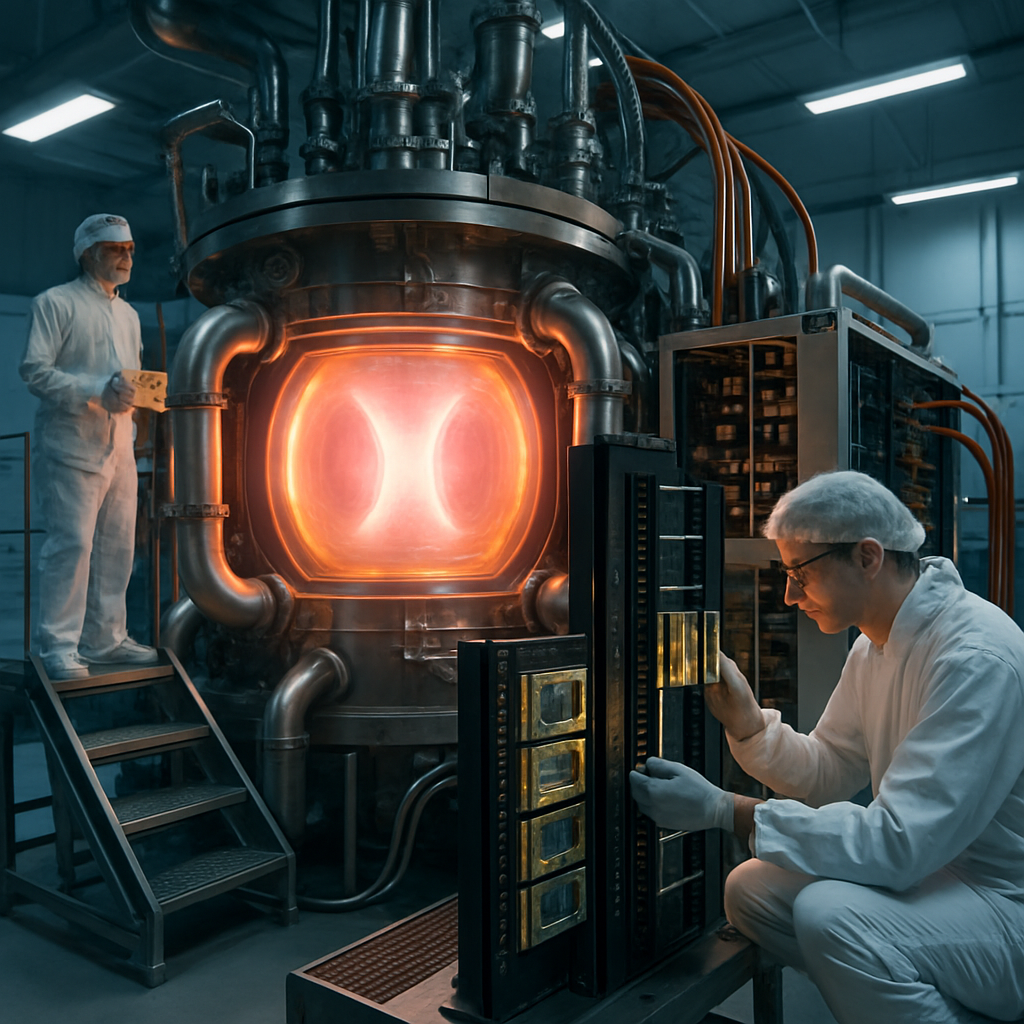
Helion Energy just secured $175 million in federal support to advance its work on specialized power semiconductors and electronics, aiming to dramatically boost the performance of its fusion reactor plants. The startup plans to cut inefficiencies in its electrical systems—currently losing 5% to 10% of power—nearly in half, which would nearly double net electricity output from its fusion systems.
Numerous fields already rely on these semiconductor modules—from wastewater treatment and defense to medical devices—but the U.S. has virtually no domestic manufacturers for the particular kind Helion needs. To change that, the company will establish a new production line in Washington state to fabricate, package, and test these high-voltage, pulsed semiconductors for its Orion plant, its first fusion power facility. That plant is scheduled to start supplying electricity by 2028.
Funding Breakdown & Partners
The funding comes from the U.S. Department of Commerce under the CHIPS Act—a bill designed to strengthen U.S. semiconductor design and manufacturing. Alongside the federal grant, Helion also raised an additional $50 million in undisclosed private investment, bringing its total funding to over $3.2 billion. That makes it the second-best-funded fusion startup in the industry.
Of the $175 million award, over $100 million will go to research and development of semiconductor modules and packaging in Washington. The rest—about $80 million—will be used for tooling, design, and process development in Vermont in partnership with GlobalFoundries. Meanwhile, GlobalFoundries has itself received more than $80 million from the federal government to support gallium-nitride semiconductor production, a material widely used in power electronics.
Efficiency, Reactor Design & Broader Impacts
Helion’s fusion system uses a design called field-reversed configuration, where fusion fuel is injected from both ends of a chamber, heated into plasma, accelerated magnetically, collided and compressed, all to create fusion under high temperatures. The reactor uses direct energy conversion: instead of heating steam to spin turbines, it captures energy electrically from plasma-magnet interactions. This approach demands very efficient semiconductors, since every percentage point of efficiency gain directly translates into more useful power.
While the R&D funded by this award won’t be ready in time for Orion’s 2028 launch, it’s expected to improve future plants’ performance. Helion believes that enhanced semiconductor efficiency will make its power more competitive in energy markets. Beyond fusion, these advances could benefit electric vehicles, grid infrastructure, consumer electronics, and even defense systems—particularly in applications such as energy-based weapons and critical load handling.
Helion’s focus remains grid-scale electricity delivery and energy reliability. Leadership emphasizes that while defense applications are relevant, energy independence and bolstering the domestic power supply are the top priorities.
Analytically, this move signals a crucial turning point for fusion energy. The other major technical challenge for fusion beyond achieving net positive energy is building and integrating semiconductor systems that can handle extreme electrical loads with minimal losses. For Helion, reducing losses from 5–10% toward about half that doesn’t just improve margin—it reshapes the economics of fusion plants. If the federal CHIPS funding succeeds, Helion may lead in making U.S. fusion power not just feasible, but competitive. What to watch next: how fast the semiconductor line scales, whether designs make upcoming plants significantly cheaper, and if competitors can keep up in materials and system efficiency.