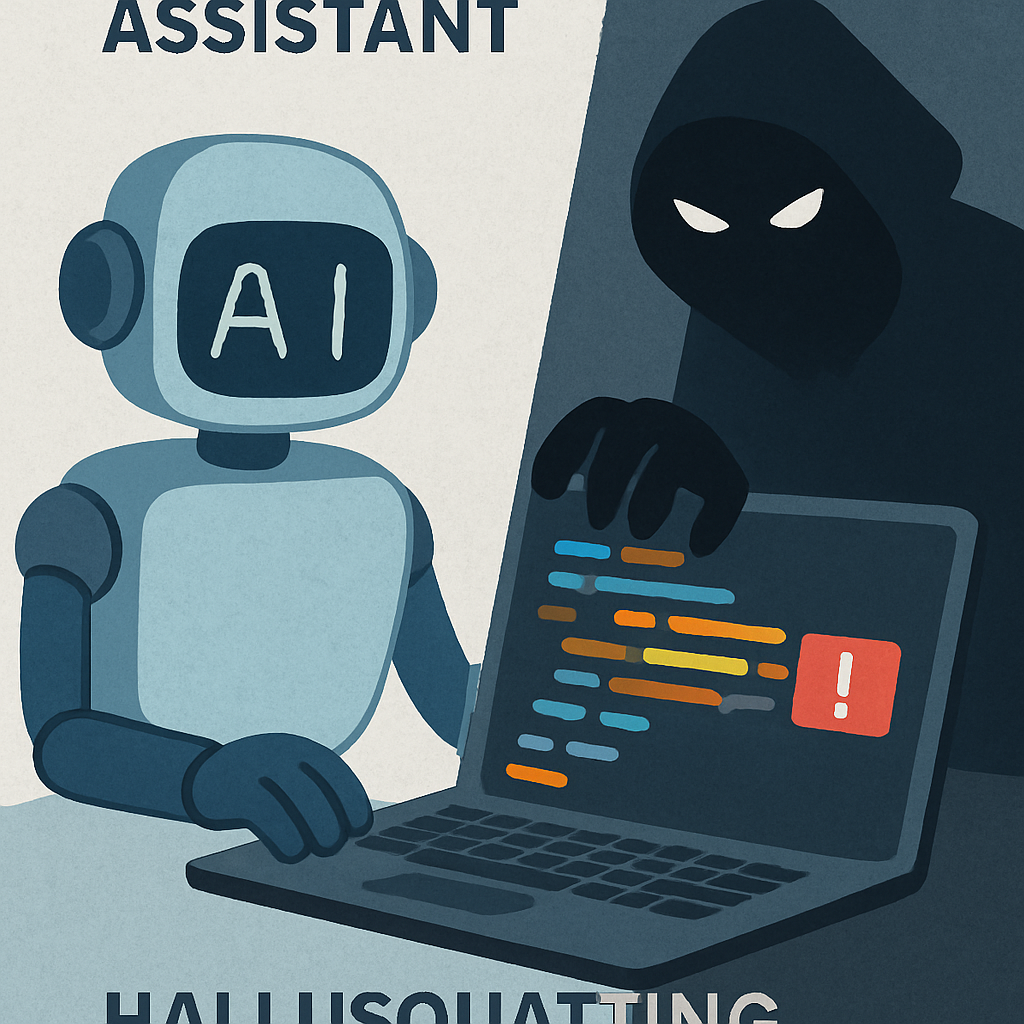
Researchers have unveiled a novel cyberattack technique termed “HalluSquatting,” which exploits the tendency of AI coding assistants to generate non-existent package or repository names—a phenomenon known as hallucination. This method allows attackers to introduce malicious code into developers’ environments by registering these fictitious names and embedding harmful payloads within them.
AI coding assistants, such as GitHub Copilot and Cursor, are designed to enhance developer productivity by suggesting code snippets and automating tasks. However, their reliance on large language models (LLMs) makes them susceptible to generating plausible yet incorrect resource identifiers. Attackers can predict these hallucinated names, register them on platforms like GitHub or npm, and seed them with malicious content. When developers, guided by their AI assistants, attempt to fetch these resources, they inadvertently introduce malware into their systems.
The HalluSquatting attack chain involves several steps:
- **Identification of Hallucinated Names**: Attackers analyze common prompts and the corresponding hallucinated outputs from AI assistants to determine likely non-existent package or repository names.
- **Registration of Malicious Resources**: Once potential names are identified, attackers register these names on relevant platforms and embed malicious code within them.
- **Exploitation**: When developers use AI assistants to fetch or install these resources, the assistants retrieve the attacker-controlled content, leading to the execution of malicious code on the developer’s machine.
In controlled experiments, researchers observed hallucination rates reaching up to 85% for repository requests and 100% for certain skill installations. This high predictability enables attackers to effectively position their malicious resources where AI systems are likely to access them. The attack has been demonstrated to deliver reverse shells and other malware without relying on traditional software exploits or stolen credentials.
Tools susceptible to this attack include Cursor, Cursor CLI, Gemini CLI, Windsurf, GitHub Copilot, Cline, OpenClaw, ZeroClaw, and NanoClaw. Many of these tools can fetch third-party resources and operate with elevated command-line privileges, amplifying the potential impact of such attacks.
To mitigate the risks associated with HalluSquatting, developers and organizations should consider the following measures:
- **Disable Auto-Execution**: Configure AI assistants to require explicit user approval before executing fetched code or installing packages.
- **Implement Verification Steps**: Cross-reference package names and repositories against trusted sources before installation.
- **Enhance AI Training**: Improve the training of AI models to reduce the occurrence of hallucinations and implement stricter validation mechanisms for generated outputs.
The emergence of HalluSquatting underscores the evolving landscape of cyber threats targeting AI-driven development tools. As AI continues to integrate into software development workflows, it is imperative to address these vulnerabilities proactively. Organizations must balance the productivity benefits of AI coding assistants with robust security practices to safeguard against such sophisticated attacks.