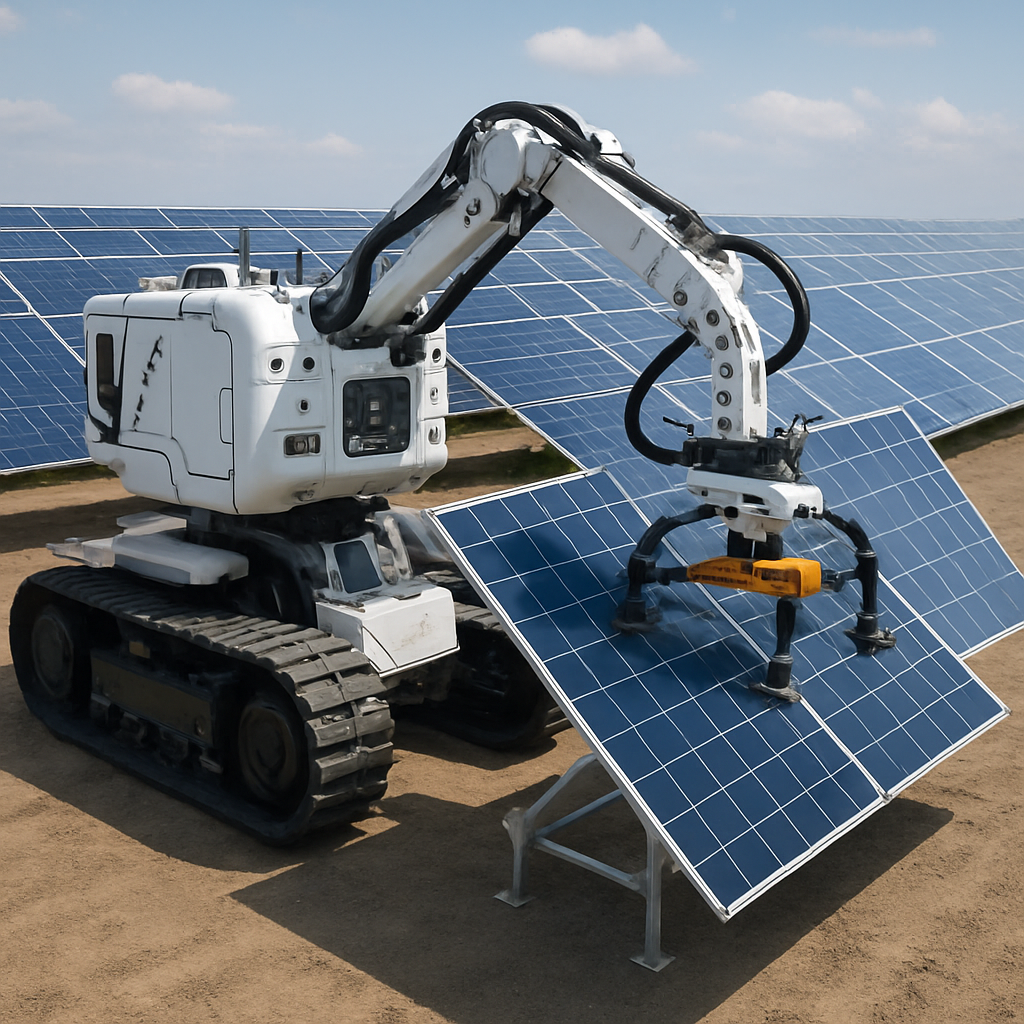
Gritt, a startup specializing in robotics and artificial intelligence for infrastructure construction, has emerged from stealth mode with a $34 million funding boost. This includes a recent $26 million Series A round led by Obvious Ventures, with contributions from Union Square Ventures and Active Impact Investment. The company’s mission is to accelerate infrastructure development by deploying intelligent robotic systems, starting with solar energy projects.
Founded by Carnegie Mellon alumni Puneet Puri and Vishal Dugar, Gritt focuses on integrating AI with existing construction machinery to enhance efficiency on job sites. Instead of creating proprietary robots, Gritt utilizes standard equipment like skidders and robotic arms from manufacturers such as Kawasaki. These machines are equipped with Gritt’s AI to perform tasks like transporting and precisely positioning solar panels, thereby streamlining the installation process.
Traditional solar panel installation is labor-intensive and time-consuming. A standard crew of eight can install approximately 800 panels daily. With Gritt’s robotic systems, the same crew can install between 3,000 to 4,000 panels per day, significantly boosting productivity. This efficiency is particularly beneficial in remote areas where labor shortages are common.
Currently, Gritt has two systems operational in the field, with plans to deploy 48 more within the next six months. The company has secured contracts to assist in installing 2.8 gigawatts of solar capacity over the next 18 months, collaborating with three of the top ten U.S. power construction firms.
Gritt’s approach addresses the growing demand for renewable energy infrastructure amid a limited labor pool. By leveraging AI and robotics, the company aims to make large-scale solar installations more feasible and cost-effective, potentially accelerating the transition to sustainable energy sources.
As the renewable energy sector continues to expand, innovations like Gritt’s robotic systems could play a pivotal role in overcoming labor challenges and enhancing construction efficiency. The success of such technologies may set a precedent for broader adoption of AI and robotics in various construction domains, signaling a transformative shift in how infrastructure projects are executed.