Governments and state-affiliated organizations’ Linux servers have become the target of a sophisticated espionage campaign that blends traditional malware tools with scripts likely produced by AI. The campaign—named CL-UNK-1211 by researchers from Unit 42—was active between October 2025 and April 2026. It focused on reconnaissance, credential theft, and persistent access across Linux infrastructure tied to government operations.
Tools, Tactics, and AI-Assisted Payloads
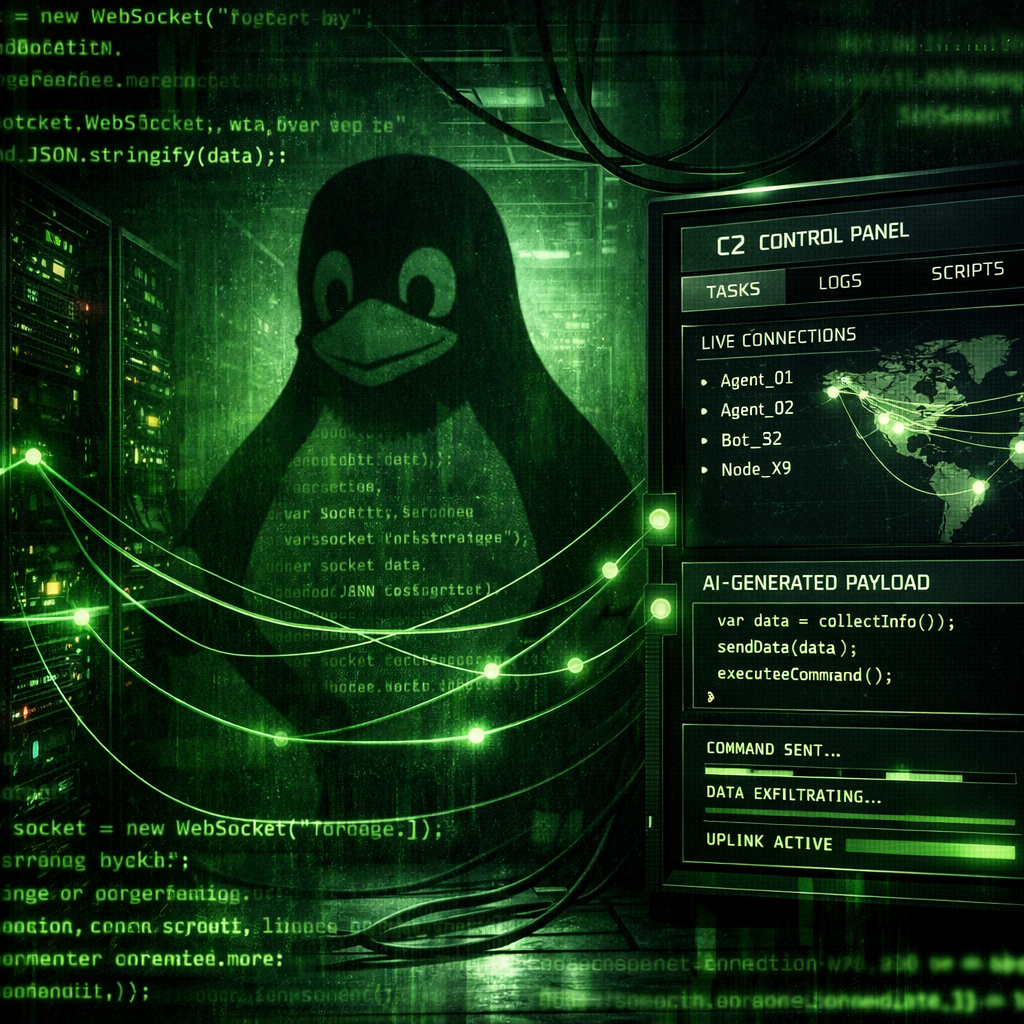
The attackers employed a flexible toolbox: open source utilities, custom backdoors, and web shells to establish and sustain footholds. Key goals included disabling security protections, erasing logs, and even inserting deceptive artifacts to mimic red-team activity. Malicious PHP and shell scripts—embedded with conversational, step-by-step reasoning notes—suggest the use of large language models or automated agents to write or generate the code.
An advanced remote access Trojan dubbed SysGoRAT is central to the operation. Developed in Go, this cross-platform RAT works on both Linux and Windows. It connects over WebSocket to a hard-coded IP and can execute commands, list directories, capture screenshots, download and upload files, launch interactive shells, set up persistence, and proxy traffic. Attackers also used in-memory reverse shells to reduce forensics artifacts.
Credential Harvesting and Data Exfiltration
The threat actor harvested credentials by a mix of techniques: replacing the.bashrc file with a version that steals passwords, injecting code into login pages, and scanning configuration and history files for clear-text credentials like SMTP, database, or email passwords. Social media‐related emails were a specific target, with PHP scripts parsing email headers for sender, recipient, subject, and file path.
The campaign also attempted to bundle emails into ZIP files for exfiltration, though some scripts failed due to syntax errors.
Unit 42’s findings align with a wider trend: attackers employing agentic offensive frameworks such as ARTEX, PentAGI, Hexstrike, and CAIRN to accelerate moves through the attack lifecycle. These tools deliver speed and automation, though at the cost of stealth, according to security experts.
This particular campaign—CL-UNK-1211—marked a growing convergence of old-school persistence techniques and AI-driven scripting. The adversary moved fast, adapted operations quickly, and offloaded much of the manual coding to automated systems.
What this means: cyberespionage is entering a new phase. Attackers are increasingly using AI not just as a tool to draft phishing emails or generate fake content, but as a primary engine to build and deploy operational scripts targeting critical infrastructure. For defenders, this calls for stronger logging, rapid detection of anomalous scripted activity, and more aggressive hardening of Linux systems—especially in government settings where stakes are high. Monitoring AI usage in-house, building visibility into all automation agents, and preparing for the speed-stealth trade-off will be defining factors in the security posture moving forward.